100% satisfaction guarantee Immediately available after payment Both online and in PDF No strings attached 4.2 TrustPilot
logo-home
Exam (elaborations)

BIOS 255- Week 7 - The Respiratory System- Physiology Practice Questions with Verified Solutions Rated A+ (Latest Update 2025)

Rating
-
Sold
-
Pages
13
Grade
A+
Uploaded on
08-01-2025
Written in
2024/2025

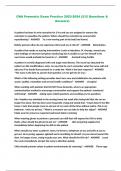
BIOS 255- Week 7 - The Respiratory System- Physiology Practice Questions with Verified Solutions Rated A+ (Latest Update 2025) The relationship between pressure and volume in a closed space is described by Bohr's Law Boyle's Law Charles's Law Dalton's Law Henry's Law. - Answers Boyle's Law Boyle's Law describes the relationship between pressure and volume in a closed space. Henry's Law is related to a gas diffusing into and out of water and its relationship to its partial pressure. Dalton's Law is related to the independence of partial pressures. Charles's Law is related to the expansion of gases when heated. Bohr's Law is related to electrons rotating around the nucleus of an atom. Which gas is the most common in the atmosphere? Hydrogen Carbon dioxide Nitrogen Helium Oxygen - Answers Nitrogen When you think of the air we breathe, your first thought is probably oxygen; however, we have more nitrogen in our atmosphere than any other gas. Air is around 78% nitrogen, 21% oxygen, and 0.4% carbon dioxide, with helium and hydrogen only being found in trace amounts. Which is not considered a conducting zone structure? Trachea Pharynx Bronchioles Larynx Alveoli - Answers Alveoli The conducting zone consists of the nose, nasal cavity, pharynx, larynx, trachea, bronchi, and bronchioles. The respiratory zone consists of the respiratory bronchioles, which contain the alveoli. In spirometry, what is the definition of tidal volume (TV)? The volume of air inhaled or exhaled during a normal, quiet breath. The maximum volume of air that can be inhaled after a normal inhalation. The volume of air remaining in the lungs after a maximal exhalation. The maximum volume of air that can be exhaled after a normal exhalation. - Answers The volume of air inhaled or exhaled during a normal, quiet breath. Tidal volume (TV) represents the basic amount of air moved with each normal, quiet breath. Residual volume (RV) is the volume of air that remains in the lungs after a maximal exhalation. Inspiratory reserve volume (IRV) is the maximum volume of air that can be inhaled after a normal inhalation. Expiratory reserve volume (ERV) is the maximum volume of air that can be exhaled after a normal exhalation. Which lung volume represents the air that remains in the lungs after a maximal exhalation and never leaves, maintaining lung elasticity? Expiratory reserve volume (ERV) Residual volume (RV) Inspiratory reserve volume (IRV) Tidal volume (TV) - Answers Residual volume (RV) Residual volume (RV) represents the air that remains in the lungs after a maximal exhalation to maintain lung elasticity and prevent lung collapse. Tidal volume (TV) is the volume of air that is inhaled or exhaled during a normal, quiet breath. It represents the basic amount of air moved with each breath. Inspiratory reserve volume (IRV) is the maximum volume of air that can be inhaled after a normal inhalation. It represents the extra air that can be inhaled beyond a regular breath. Expiratory reserve volume (ERV) is the maximum volume of air that can be exhaled after a normal exhalation. It represents the extra air that can be exhaled beyond a regular breath. What is a function of anatomical dead space in the respiratory system? Oxygen transport to tissues Humidification and filtration of inhaled air Carbon dioxide removal from the blood Gas exchange in the alveoli - Answers Humidification and filtration of inhaled air A function of anatomical dead space is to humidify and filter the inhaled air as it passes through the conducting airways. Which calculation describes the total amount of air inhaled per minute? Alveolar ventilation rate Minute ventilation rate Peak flow Maximum voluntary ventilation - Answers Minute ventilation rate Minute ventilation rate is the amount of air inhaled per minute, calculated by multiplying the tidal volume by the respiratory rate. Alveolar ventilation is the amount of air that is ventilated by the alveoli. Maximum voluntary ventilation is the amount of air inhaled per minute during heavy exercise. Peak flow represents the maximum speed of expiration. A client has a tidal volume of 650 mL/breath, an anatomical dead space of 150 mL, and a respiratory rate of 20 breaths/min. Calculate the client's alveolar ventilation rate (AVR). 500 mL/min 10 mL/min 100 L/min 10 L/min 5 L/min - Answers 10 L/min Alveolar ventilation rate (AVR) is determined by multiplying the amount of air that reaches the alveoli by the respiratory rate. You will need to subtract 150 mL from the total amount of inhaled air as this air is in the dead space and does not reach the alveoli. 650 mL - 150 mL = 500 mL reaching the alveoli AVR = 500 mL x 20 breaths/min = 10,000 mL/min or 10 L/min. (To convert to liters, divide by 1000.) What is the primary purpose of measuring functional residual capacity (FRC) in spirometry? To assess the amount of air left in the lungs after a normal exhalation To measure the volume of air inhaled during deep breaths To calculate the maximum exhalation capacity To determine the maximum lung capacity Showing student answer. Correct! - Answers To assess the amount of air left in the lungs after a normal exhalation Functional residual capacity (FRC) measures the volume of air left in the lungs after a normal exhalation. What is a characteristic of restrictive lung disorders? Air trapping in the lungs Decreased lung compliance Increased vital capacity Obstructed airway flow Increased lung compliance - Answers Decreased lung compliance Restrictive lung disorders are characterized by reduced lung compliance, meaning that the lungs become less able to expand. Obstructive lung disorders are characterized by airway obstruction, making it difficult for a person to exhale air effectively. Because gas exchange does not occur within the conducting zone of the respiratory system, it is also referred to as

Show more Read less
Institution
BIOS 255- We-ek 7 -The Respiratory System- Physiol
Course
BIOS 255- We-ek 7 -The Respiratory System- Physiol


Whoops! We can’t load your doc right now. Try again or contact support.

Written for

Institution
BIOS 255- We-ek 7 -The Respiratory System- Physiol
Course
BIOS 255- We-ek 7 -The Respiratory System- Physiol

Document information

Uploaded on
January 8, 2025
Number of pages
13
Written in
2024/2025
Type
Exam (elaborations)
Contains
Questions & answers

Subjects

Content preview

BIOS 255- Week 7 - The Respiratory System- Physiology Practice Questions with Verified Solutions
Rated A+ (Latest Update 2025)

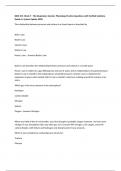
The relationship between pressure and volume in a closed space is described by


Bohr's Law

Boyle's Law

Charles's Law

Dalton's Law

Henry's Law. - Answers Boyle's Law


Boyle's Law describes the relationship between pressure and volume in a closed space.

Henry's Law is related to a gas diffusing into and out of water and its relationship to its partial pressure.
Dalton's Law is related to the independence of partial pressures. Charles's Law is related to the
expansion of gases when heated. Bohr's Law is related to electrons rotating around the nucleus of an
atom.

Which gas is the most common in the atmosphere?

Hydrogen

Carbon dioxide

Nitrogen

Helium

Oxygen - Answers Nitrogen


When you think of the air we breathe, your first thought is probably oxygen; however, we have more
nitrogen in our atmosphere than any other gas. Air is around 78% nitrogen, 21% oxygen, and 0.4%
carbon dioxide, with helium and hydrogen only being found in trace amounts.

Which is not considered a conducting zone structure?

Trachea

Pharynx

, Bronchioles

Larynx

Alveoli - Answers Alveoli


The conducting zone consists of the nose, nasal cavity, pharynx, larynx, trachea, bronchi, and
bronchioles.

The respiratory zone consists of the respiratory bronchioles, which contain the alveoli.

In spirometry, what is the definition of tidal volume (TV)?


The volume of air inhaled or exhaled during a normal, quiet breath.

The maximum volume of air that can be inhaled after a normal inhalation.

The volume of air remaining in the lungs after a maximal exhalation.

The maximum volume of air that can be exhaled after a normal exhalation. - Answers The volume of air
inhaled or exhaled during a normal, quiet breath.


Tidal volume (TV) represents the basic amount of air moved with each normal, quiet breath.

Residual volume (RV) is the volume of air that remains in the lungs after a maximal exhalation.
Inspiratory reserve volume (IRV) is the maximum volume of air that can be inhaled after a normal
inhalation. Expiratory reserve volume (ERV) is the maximum volume of air that can be exhaled after a
normal exhalation.

Which lung volume represents the air that remains in the lungs after a maximal exhalation and never
leaves, maintaining lung elasticity?

Expiratory reserve volume (ERV)

Residual volume (RV)

Inspiratory reserve volume (IRV)

Tidal volume (TV) - Answers Residual volume (RV)
Get to know the seller

Seller avatar
Reputation scores are based on the amount of documents a seller has sold for a fee and the reviews they have received for those documents. There are three levels: Bronze, Silver and Gold. The better the reputation, the more your can rely on the quality of the sellers work.
TutorJosh Chamberlain College Of Nursing
View profile
Follow You need to be logged in order to follow users or courses
Sold
343
Member since
1 year
Number of followers
16
Documents
28821
Last sold
7 hours ago
Tutor Joshua

Here You will find all Documents and Package Deals Offered By Tutor Joshua.

3.6

53 reviews

5
18
4
14
3
12
2
0
1
9

Recently viewed by you

Why students choose Stuvia

Created by fellow students, verified by reviews

Quality you can trust: written by students who passed their tests and reviewed by others who've used these notes.

Didn't get what you expected? Choose another document

No worries! You can instantly pick a different document that better fits what you're looking for.

Pay as you like, start learning right away

No subscription, no commitments. Pay the way you're used to via credit card and download your PDF document instantly.

Student with book image

“Bought, downloaded, and aced it. It really can be that simple.”

Alisha Student

Frequently asked questions