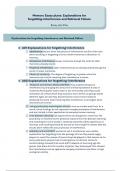
● A01 Explanations for forgetting-interference
Interference: occurs when two pieces of information conflict with each
other resulting in forgetting of one or both memories or distortion in
memory.
Retroactive Interference: newer memories disrupt the recall of older
memories already stored.
Proactive Interference: older memories that are already stored disrupt the
recall of newer memories.
Effects of similarity:-The degree of forgetting is greater when the
memories are similar meaning that interference is worse.
● A03 Explanations for forgetting-interference
McGeoch and William Mcdonald(1931): They studied retroactive
interference by changing the amount of similarity between 2 sets of
materials.Participants had to learn a list of 10 words until they could
remember all of them.Then they learned a new list.The six groups learnt
different types of lists.They found that the most similar material
produced the worst recall meaning that interference is strongest when
memories are similar
using particularly meaningless stimuli, such as simple word lists. As a
result, these findings do not represent everyday examples of interference
and are limited in their application to everyday human memory.
Time between learning- lab experiments are designed to maximise the
possibility of interference.For practical reasons the time between learning
and recalling the list of words is relatively short.The whole experience of
learning and recalling should be around an hour long.This means that the
results don’t reflect the actual process of interference.
Baddeley and Hitch(1977) wanted to see if interference was a better
explanation for forgetting than the passage of time.They asked rugby
players to recall the names of teams they had played in that season so far
every week.Some players had missed games so had less names to
recall.Findings showed that recall didn’t depend on how long ago the
games took place but the number of games they had played.This showed
that interference can be applied to everyday situations and there is high
ecological validity.
Interference: occurs when two pieces of information conflict with each
other resulting in forgetting of one or both memories or distortion in
memory.
Retroactive Interference: newer memories disrupt the recall of older
memories already stored.
Proactive Interference: older memories that are already stored disrupt the
recall of newer memories.
Effects of similarity:-The degree of forgetting is greater when the
memories are similar meaning that interference is worse.
● A03 Explanations for forgetting-interference
McGeoch and William Mcdonald(1931): They studied retroactive
interference by changing the amount of similarity between 2 sets of
materials.Participants had to learn a list of 10 words until they could
remember all of them.Then they learned a new list.The six groups learnt
different types of lists.They found that the most similar material
produced the worst recall meaning that interference is strongest when
memories are similar
using particularly meaningless stimuli, such as simple word lists. As a
result, these findings do not represent everyday examples of interference
and are limited in their application to everyday human memory.
Time between learning- lab experiments are designed to maximise the
possibility of interference.For practical reasons the time between learning
and recalling the list of words is relatively short.The whole experience of
learning and recalling should be around an hour long.This means that the
results don’t reflect the actual process of interference.
Baddeley and Hitch(1977) wanted to see if interference was a better
explanation for forgetting than the passage of time.They asked rugby
players to recall the names of teams they had played in that season so far
every week.Some players had missed games so had less names to
recall.Findings showed that recall didn’t depend on how long ago the
games took place but the number of games they had played.This showed
that interference can be applied to everyday situations and there is high
ecological validity.