UNIT 5 — MILESTONE 5
22/22
22/22 that's 100% RETAKE
22 questions were answered correctly.
1
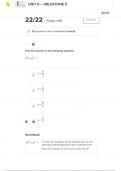
Find the solution to the following equation.
RATIONALE
To solve this equation, first re-write the term on the
right side so that both terms have a common base.
Since 9 is a power of 3, we can re-write 9 as .
, The two terms now have the same base, 3. Use the
UNIT 5 —properties
MILESTONE 5
of exponents to simplify by
multiplying the exponents 2 and 3 – x.
22/22
2 times 3 – x is equal to 6 – 2x. Because the bases
are the same, we can focus on the exponents and set
them equal to each other.
Since the exponents are equivalent, we can simply
solve for x. Add 2x to both sides to undo the -2x on
the right.
We now have the x term isolated on the left side.
Next, divide both sides by 4 to solve for x.
Once we divide 6 by 4, we have isolated x on the left
side. However, we can still simplify this fraction.
is equivalent to . The solution for x is .
CONCEPT
Solving an Exponential Equation
Report an issue with this question
2
Simplify the rational expression by canceling common factors:
, UNIT 5 — MILESTONE 5
22/22
RATIONALE
In order to cancel like terms, we
have to first factor both the
numerator and denominator, and
then look for common factors in the
top and bottom of the fraction. Let's
take a look at the numerator first.
To factor this quadratic, we need to
identify a pair of integers whose
product is the constant term (18) and
whose sum is the coefficient of the
x-term (-9).
Two integers that multiply to 18 and
add to -9 are -3 and -6. This means
that -3 and -6 make up the integer
pair for this quadratic.
The original numerator can be
written as (x – 3)(x – 6). Let's take a
look at the denominator.
Again, we need to identify a pair of
integers whose product is the
constant term (-30) and whose sum
is the coefficient of the x-term (-1).
Two integers that multiply to -30
and add to -1 are 5 and -6. This
means that 5 and -6 make up the
integer pair for this quadratic.
The original denominator can be
written as (x + 5)(x – 6). Now we can
rewrite the original fraction with the
, new factored numerator and
UNIT 5 — MILESTONE 5 denominator.
The original fraction is now rewritten
with both numerator and 22/22
denominator written in factored
form. To simplify, we cancel factors
that appear in both the top and the
bottom.
The factor (x – 6) can be canceled.
The rational expression
can be simplified to
.
CONCEPT
Simplifying Rational Expressions
Report an issue with this question
3
Suppose $15,000 is deposited into an account paying 6.5%
interest, which is compounded annually.
How much money is in the account after five years, if no
withdrawals or additional deposits are made?
$20,125.00
$20,597.80
$20,551.30
22/22
22/22 that's 100% RETAKE
22 questions were answered correctly.
1
Find the solution to the following equation.
RATIONALE
To solve this equation, first re-write the term on the
right side so that both terms have a common base.
Since 9 is a power of 3, we can re-write 9 as .
, The two terms now have the same base, 3. Use the
UNIT 5 —properties
MILESTONE 5
of exponents to simplify by
multiplying the exponents 2 and 3 – x.
22/22
2 times 3 – x is equal to 6 – 2x. Because the bases
are the same, we can focus on the exponents and set
them equal to each other.
Since the exponents are equivalent, we can simply
solve for x. Add 2x to both sides to undo the -2x on
the right.
We now have the x term isolated on the left side.
Next, divide both sides by 4 to solve for x.
Once we divide 6 by 4, we have isolated x on the left
side. However, we can still simplify this fraction.
is equivalent to . The solution for x is .
CONCEPT
Solving an Exponential Equation
Report an issue with this question
2
Simplify the rational expression by canceling common factors:
, UNIT 5 — MILESTONE 5
22/22
RATIONALE
In order to cancel like terms, we
have to first factor both the
numerator and denominator, and
then look for common factors in the
top and bottom of the fraction. Let's
take a look at the numerator first.
To factor this quadratic, we need to
identify a pair of integers whose
product is the constant term (18) and
whose sum is the coefficient of the
x-term (-9).
Two integers that multiply to 18 and
add to -9 are -3 and -6. This means
that -3 and -6 make up the integer
pair for this quadratic.
The original numerator can be
written as (x – 3)(x – 6). Let's take a
look at the denominator.
Again, we need to identify a pair of
integers whose product is the
constant term (-30) and whose sum
is the coefficient of the x-term (-1).
Two integers that multiply to -30
and add to -1 are 5 and -6. This
means that 5 and -6 make up the
integer pair for this quadratic.
The original denominator can be
written as (x + 5)(x – 6). Now we can
rewrite the original fraction with the
, new factored numerator and
UNIT 5 — MILESTONE 5 denominator.
The original fraction is now rewritten
with both numerator and 22/22
denominator written in factored
form. To simplify, we cancel factors
that appear in both the top and the
bottom.
The factor (x – 6) can be canceled.
The rational expression
can be simplified to
.
CONCEPT
Simplifying Rational Expressions
Report an issue with this question
3
Suppose $15,000 is deposited into an account paying 6.5%
interest, which is compounded annually.
How much money is in the account after five years, if no
withdrawals or additional deposits are made?
$20,125.00
$20,597.80
$20,551.30