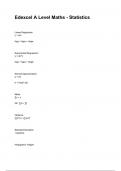
Edexcel A Level Maths - Statistics
Linear Regression
y = axⁿ
logy = loga + nlogx
Exponential Regression
y = ab^x
logy = loga + xlogb
Normal Approximation
µ = np
σ =√(np(1-p))
Mean
∑x ÷ n
GF: ∑xf ÷ ∑f
Variance
(∑x²/n) - (∑x/n)²
Standard Deviation
√variance
Histograms: Height
,Area = k x frequency
Frequency Density
frequency ÷ class width
Population
Whole set of gadgets of hobby.
Census
Observes/measures every member of a populace
Sample
Selection of observations taken from a subset of the population that's used to discover
information approximately the populace.
Sampling Frame
A listing of people (named or numbered) from whom the sample is drawn
Random Sampling
Every member of the population has an same risk of being decided on
Systematic Sampling
Every nth character is chosen.
Stratified Sampling
Population is split into jointly extraordinary Strat and a random pattern is taken from each.
,Quota Sampling
Interviewer selects a pattern that displays the characteristics of the populace
Opportunity Sampling
Choosing whoever is available
Continuous Variable
Can take any value in a given range
Discrete Variable
Takes particular values in a given variety
Conditions for Binomial
Fixed no. Of trials
2 viable consequences
Outcomes are impartial
Fixed chance of achievement
Probability: Independent if...
P(A∩B) = P(A) X P(B)
P(Aextraordinary if...
P(A∩B) = 0
P(A∪B) = P(A) + P(B)
Conditional Probability
P(Athree activities, and A and B are collectively different...
P(A∪B∪C) = P(A) + P(B) + P(C) - P(A∩C) - P(B∩C)
, What is a DRV - discrete random variable
it's far a random variable that can best take positive values
...
...
Chance mass characteristic
a function that offers the probability that a discrete random variable is exactly equal to some fee
what does a possibility distribution do
describes the opportunity of any final results inside the pattern space
P(A/B) =
(P(A n B))
---------------
P(B)
If they're unbiased activities P(A) * P(B) =
P(A N B)
SUM OF P(X=x) =
1
formula for possibility X=r in which X is the quantity of preferred results
binomial distribution system
nCr P^r * (1-p)^(n-r)
p = probability of achievement
r = range of times you need success
Linear Regression
y = axⁿ
logy = loga + nlogx
Exponential Regression
y = ab^x
logy = loga + xlogb
Normal Approximation
µ = np
σ =√(np(1-p))
Mean
∑x ÷ n
GF: ∑xf ÷ ∑f
Variance
(∑x²/n) - (∑x/n)²
Standard Deviation
√variance
Histograms: Height
,Area = k x frequency
Frequency Density
frequency ÷ class width
Population
Whole set of gadgets of hobby.
Census
Observes/measures every member of a populace
Sample
Selection of observations taken from a subset of the population that's used to discover
information approximately the populace.
Sampling Frame
A listing of people (named or numbered) from whom the sample is drawn
Random Sampling
Every member of the population has an same risk of being decided on
Systematic Sampling
Every nth character is chosen.
Stratified Sampling
Population is split into jointly extraordinary Strat and a random pattern is taken from each.
,Quota Sampling
Interviewer selects a pattern that displays the characteristics of the populace
Opportunity Sampling
Choosing whoever is available
Continuous Variable
Can take any value in a given range
Discrete Variable
Takes particular values in a given variety
Conditions for Binomial
Fixed no. Of trials
2 viable consequences
Outcomes are impartial
Fixed chance of achievement
Probability: Independent if...
P(A∩B) = P(A) X P(B)
P(Aextraordinary if...
P(A∩B) = 0
P(A∪B) = P(A) + P(B)
Conditional Probability
P(Athree activities, and A and B are collectively different...
P(A∪B∪C) = P(A) + P(B) + P(C) - P(A∩C) - P(B∩C)
, What is a DRV - discrete random variable
it's far a random variable that can best take positive values
...
...
Chance mass characteristic
a function that offers the probability that a discrete random variable is exactly equal to some fee
what does a possibility distribution do
describes the opportunity of any final results inside the pattern space
P(A/B) =
(P(A n B))
---------------
P(B)
If they're unbiased activities P(A) * P(B) =
P(A N B)
SUM OF P(X=x) =
1
formula for possibility X=r in which X is the quantity of preferred results
binomial distribution system
nCr P^r * (1-p)^(n-r)
p = probability of achievement
r = range of times you need success