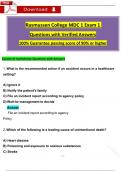
Rasmussen College MDC 1 Exam 1
Questions with Verified Answers
100% Guarantee passing score of 90% or higher
Consist of multichoice Questions with Answers
1. What is the recommended action if an accident occurs in a healthcare
setting?
A) Ignore it
B) Notify the patient's family
C) File an incident report according to agency policy
D) Wait for management to decide
Answer
File an incident report according to agency
Policy
2. Which of the following is a leading cause of unintentional death?
A) Heart disease
B) Poisoning and exposure to noxious substances
Jo
sh
C) Stroke
ua
,D) Cancer
Answer
Poisoning and exposure to noxious substances
3. What physiological changes can affect safety in older adults?
A) Increased muscle strength
B) Improved reflexes
C) Reduced muscle strength and joint mobility
D) Enhanced sensory perception
Answer
Reduced muscle strength and joint mobility
4. Which agency advocates for high-quality healthcare for all persons?
A) The Joint Commission
B) Institute of Medicine
C) American Nurses Association
D) Medicare
Answer
American Nurses Association
5. What is a key strategy to enhance patient safety according to the chapter?
A) Reducing staff training
Jo
sh
B) Utilizing technology effectively
ua
,C) Minimizing patient involvement
D) Ignoring patient feedback
Answer
Utilizing technology effectively
6. What is one source of carbon monoxide (CO) poisoning?
A) Refrigerator
B) Oven
C) Air conditioner
D) Dishwasher
Answer
Oven
7. Which developmental consideration is important for providing a safe envi-
ronment for preschool children?
A) Encouraging solitary play
B) Ensuring independence in all tasks
C) Creating structured environments for cooperative play
D) Allowing unrestricted access to all areas
Answer
Creating structured environ-
ments for cooperative play
Jo
sh
8. What is the main cause of injuries during the adolescent period?
ua
,A) Sports accidents
B) Poisoning
C) Motor vehicle accidents
D) Falls
Answer
Poisoning
9. Which of the following statements is true regarding poisoning in young
children?
A) It primarily results from physical injuries.
B) It often occurs due to improper storage of household chemicals.
C) It is mostly caused by recreational drugs.
D) It has decreased over the past 20 years.
Answer
It often occurs due to improper storage of household chemicals.
10. What is a characteristic of carbon monoxide (CO)?
A) Colorful and fragrant
B) Colorless, tasteless, and odorless
C) Heavy and visible
D) Easily detectable by smell
Jo
sh
Answer
ua
, Colorless, tasteless, and odorless
11. What are the most common burn injuries in children younger than 3 years?
A) Chemical burns
B) Electrical burns
C) Scalds from hot water, steam, and grease
D) Friction burns
Answer
Scalds from hot water, steam, and grease
12. What is the primary focus of the chapter?
A) Enhancing healthcare technology
B) Patient safety and injury prevention
C) Reducing healthcare costs
D) Improving patient nutrition
Answer
Patient safety and injury prevention
13. Which of the following is NOT a risk factor for injury mentioned in
the chapter?
A) Impaired communication
B) Increased physical stamina
Jo
sh
C) Lifestyle choices
ua
,D) Sensory and perceptual status
Answer
Increased physical stamina
14. What are "never events" as identified by Medicare?
A) Minor errors in patient care
B) Serious, preventable errors that result in serious injury or death
C) Routine medical procedures
D) Common patient complaints
Answer
Serious, preventable errors that result in serious injury or death
15. Which organization is responsible for publishing National Patient
Safety Goals?
A) Institute of Medicine
B) American Nurses Association
C) The Joint Commission
D) Quality and Safety Education for Nurses
Answer
The Joint Commission
16. What is a significant focus of safety interventions for older adults?
Jo
sh
A) Increased physical activity
ua
,B) Fall prevention
C) Dietary restrictions
D) Medication administration
Answer
Fall prevention
17. Which group is at the highest risk for injuries and deaths from home fires?
A) Adults aged 25-40
B) Older adults and children under 5 years
C) Teenagers
D) Middle-aged adults
Answer
Older adults and children under 5 years
18. Which safety measure can help reduce the risk of scalds or burns in
children?
A) Allowing children to cook unsupervised
B) Keeping pot handles facing outward
C) Always checking bath water temperature
D) Warming infant formula in the microwave
Answer
Always checking bath water temperature
Jo
sh
19. What is a key activity that reduces the possibility of fires in the home?
ua
, A) Ignoring smoke alarms
B) Having a warning system with working smoke alarms
C) Keeping flammable materials near heat sources
D) Developing a fire escape plan only when needed
Answer
Having a warning system with working smoke alarms
20. What should families do regarding their home fire escape plan?
A) Develop it but never practice it
B) Practice it at least twice a year
C) Only discuss it during family gatherings
D) Ignore it if they have smoke alarms
Answer
Practice it at least twice a year
21. Which of the following is an important activity to reduce the possibility of
fires in the home?
A) Only using candles for light
B) Having working smoke alarms and changing batteries regularly
C) Leaving old Christmas lights plugged in all year
D) Ignoring fire extinguisher maintenance
Answer
Jo
sh
Having working smoke alarms and changing batteries regularly
ua
Questions with Verified Answers
100% Guarantee passing score of 90% or higher
Consist of multichoice Questions with Answers
1. What is the recommended action if an accident occurs in a healthcare
setting?
A) Ignore it
B) Notify the patient's family
C) File an incident report according to agency policy
D) Wait for management to decide
Answer
File an incident report according to agency
Policy
2. Which of the following is a leading cause of unintentional death?
A) Heart disease
B) Poisoning and exposure to noxious substances
Jo
sh
C) Stroke
ua
,D) Cancer
Answer
Poisoning and exposure to noxious substances
3. What physiological changes can affect safety in older adults?
A) Increased muscle strength
B) Improved reflexes
C) Reduced muscle strength and joint mobility
D) Enhanced sensory perception
Answer
Reduced muscle strength and joint mobility
4. Which agency advocates for high-quality healthcare for all persons?
A) The Joint Commission
B) Institute of Medicine
C) American Nurses Association
D) Medicare
Answer
American Nurses Association
5. What is a key strategy to enhance patient safety according to the chapter?
A) Reducing staff training
Jo
sh
B) Utilizing technology effectively
ua
,C) Minimizing patient involvement
D) Ignoring patient feedback
Answer
Utilizing technology effectively
6. What is one source of carbon monoxide (CO) poisoning?
A) Refrigerator
B) Oven
C) Air conditioner
D) Dishwasher
Answer
Oven
7. Which developmental consideration is important for providing a safe envi-
ronment for preschool children?
A) Encouraging solitary play
B) Ensuring independence in all tasks
C) Creating structured environments for cooperative play
D) Allowing unrestricted access to all areas
Answer
Creating structured environ-
ments for cooperative play
Jo
sh
8. What is the main cause of injuries during the adolescent period?
ua
,A) Sports accidents
B) Poisoning
C) Motor vehicle accidents
D) Falls
Answer
Poisoning
9. Which of the following statements is true regarding poisoning in young
children?
A) It primarily results from physical injuries.
B) It often occurs due to improper storage of household chemicals.
C) It is mostly caused by recreational drugs.
D) It has decreased over the past 20 years.
Answer
It often occurs due to improper storage of household chemicals.
10. What is a characteristic of carbon monoxide (CO)?
A) Colorful and fragrant
B) Colorless, tasteless, and odorless
C) Heavy and visible
D) Easily detectable by smell
Jo
sh
Answer
ua
, Colorless, tasteless, and odorless
11. What are the most common burn injuries in children younger than 3 years?
A) Chemical burns
B) Electrical burns
C) Scalds from hot water, steam, and grease
D) Friction burns
Answer
Scalds from hot water, steam, and grease
12. What is the primary focus of the chapter?
A) Enhancing healthcare technology
B) Patient safety and injury prevention
C) Reducing healthcare costs
D) Improving patient nutrition
Answer
Patient safety and injury prevention
13. Which of the following is NOT a risk factor for injury mentioned in
the chapter?
A) Impaired communication
B) Increased physical stamina
Jo
sh
C) Lifestyle choices
ua
,D) Sensory and perceptual status
Answer
Increased physical stamina
14. What are "never events" as identified by Medicare?
A) Minor errors in patient care
B) Serious, preventable errors that result in serious injury or death
C) Routine medical procedures
D) Common patient complaints
Answer
Serious, preventable errors that result in serious injury or death
15. Which organization is responsible for publishing National Patient
Safety Goals?
A) Institute of Medicine
B) American Nurses Association
C) The Joint Commission
D) Quality and Safety Education for Nurses
Answer
The Joint Commission
16. What is a significant focus of safety interventions for older adults?
Jo
sh
A) Increased physical activity
ua
,B) Fall prevention
C) Dietary restrictions
D) Medication administration
Answer
Fall prevention
17. Which group is at the highest risk for injuries and deaths from home fires?
A) Adults aged 25-40
B) Older adults and children under 5 years
C) Teenagers
D) Middle-aged adults
Answer
Older adults and children under 5 years
18. Which safety measure can help reduce the risk of scalds or burns in
children?
A) Allowing children to cook unsupervised
B) Keeping pot handles facing outward
C) Always checking bath water temperature
D) Warming infant formula in the microwave
Answer
Always checking bath water temperature
Jo
sh
19. What is a key activity that reduces the possibility of fires in the home?
ua
, A) Ignoring smoke alarms
B) Having a warning system with working smoke alarms
C) Keeping flammable materials near heat sources
D) Developing a fire escape plan only when needed
Answer
Having a warning system with working smoke alarms
20. What should families do regarding their home fire escape plan?
A) Develop it but never practice it
B) Practice it at least twice a year
C) Only discuss it during family gatherings
D) Ignore it if they have smoke alarms
Answer
Practice it at least twice a year
21. Which of the following is an important activity to reduce the possibility of
fires in the home?
A) Only using candles for light
B) Having working smoke alarms and changing batteries regularly
C) Leaving old Christmas lights plugged in all year
D) Ignoring fire extinguisher maintenance
Answer
Jo
sh
Having working smoke alarms and changing batteries regularly
ua