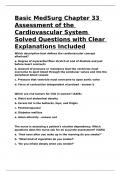
Basic MedSurg Chapter 33
Assessment of the
Cardiovascular System
Solved Questions with Clear
Explanations Included
Which description best defines the cardiovascular concept
afterload?
a. Degree of myocardial fiber stretch at end of diastole and just
before heart contracts
b. Amount of pressure or resistance that the ventricles must
overcome to eject blood through the semilunar valves and into the
peripheral blood vessels
c. Pressure that ventricle must overcome to open aortic valve
d. Force of contraction independent of preload - answer b
Which are risk factors for CVD in women? (SATA)
a. Waist and abdominal obesity
b. Excess fat in the buttocks, hips, and thighs
c. Postmenopausal
d. Diabetes mellitus
e. Asian ethnicity - answer acd
The nurse is assessing a patient's nicotine dependency. Which
questions does the nurse ask for an accurate assessment? (SATA)
a. "How soon after you wake up in the morning do you smoke?"
b. "What kind of cigarettes do you smoke?"
c. "Do you inhale deeply when you smoke?"
,d. "Do you find it difficult not to smoke in places where smoking is
prohibited?"
e. "Do you smoke when you are ill?"
f. "What happened the last time you tried to quit smoking" - answer
adef
The nurse is talking to a patient who has been trying to quit
smoking. HWich statement by the patient indicates an
understanding of cigarette usage as it relates to reducing
cardiovascular risks?
a. "I need to be completely cigarette-free for at least 3 years"
b. "I don't smoke as much as I used to I'm down to one pack a day."
c. "I started smoking a while ago, but I'll quit in a couple of years"
d. "I only smoke to relax, when I drink, or when I go out with
friends" - answer a
The nurse is providing health teaching for a patient at risk for heart
disease. Which factor is the most modifiable, controllable risk
factor?
a. Obesity
b. Diabetes mellitus
c. Ethnic background
d. Family history of cardiovascular disease - answer a
The nurse is giving a community presentation about heart disease in
women. What information does the nurse include in the
presentation? (SATA)
a. Dyspnea on exertion may be the first and only symptoms of heart
failure
b. Symptoms are subtle or atypical
c. Pain is often relieved by rest
, d. Having waist and abdominal obesity is a higher risk factor than
having fat in buttocks and thighs
e. Pain always responds to nitroglycerin
f. Common symptoms include back pain, indigestion, nausea,
vomiting, and anorexia - answer abdf
Which blood pressure reading require further assessment? (SATA)
a. 90 mm Hg systolic
b. 139 mm Hg Hg systolic
c. 115 mm Hg systolic
d 66 mm Hg diastolic
e. 100 mm Hg diastolic - answer abe
The nurse working in the public health department is reviewing data
for populations at risk fro CVD. Which group has the greatest need
for intervention to reduce CVD risk?
a. Government employees who make approximately $40,000 a year
b. Part-time fast-food workers who make approximately $9,000 a
year
c. Hospital-employed nurses who make approximately $52,000 a
year
d. Chain retail employees who make approximately $18,000 a year -
answer b
Which category of cardiovascular drugs increases heart rate and
contractility?
a. Diuretics
b. Beta blockers
c. Catecholamines
d. Benzodiazepines - answer c
Assessment of the
Cardiovascular System
Solved Questions with Clear
Explanations Included
Which description best defines the cardiovascular concept
afterload?
a. Degree of myocardial fiber stretch at end of diastole and just
before heart contracts
b. Amount of pressure or resistance that the ventricles must
overcome to eject blood through the semilunar valves and into the
peripheral blood vessels
c. Pressure that ventricle must overcome to open aortic valve
d. Force of contraction independent of preload - answer b
Which are risk factors for CVD in women? (SATA)
a. Waist and abdominal obesity
b. Excess fat in the buttocks, hips, and thighs
c. Postmenopausal
d. Diabetes mellitus
e. Asian ethnicity - answer acd
The nurse is assessing a patient's nicotine dependency. Which
questions does the nurse ask for an accurate assessment? (SATA)
a. "How soon after you wake up in the morning do you smoke?"
b. "What kind of cigarettes do you smoke?"
c. "Do you inhale deeply when you smoke?"
,d. "Do you find it difficult not to smoke in places where smoking is
prohibited?"
e. "Do you smoke when you are ill?"
f. "What happened the last time you tried to quit smoking" - answer
adef
The nurse is talking to a patient who has been trying to quit
smoking. HWich statement by the patient indicates an
understanding of cigarette usage as it relates to reducing
cardiovascular risks?
a. "I need to be completely cigarette-free for at least 3 years"
b. "I don't smoke as much as I used to I'm down to one pack a day."
c. "I started smoking a while ago, but I'll quit in a couple of years"
d. "I only smoke to relax, when I drink, or when I go out with
friends" - answer a
The nurse is providing health teaching for a patient at risk for heart
disease. Which factor is the most modifiable, controllable risk
factor?
a. Obesity
b. Diabetes mellitus
c. Ethnic background
d. Family history of cardiovascular disease - answer a
The nurse is giving a community presentation about heart disease in
women. What information does the nurse include in the
presentation? (SATA)
a. Dyspnea on exertion may be the first and only symptoms of heart
failure
b. Symptoms are subtle or atypical
c. Pain is often relieved by rest
, d. Having waist and abdominal obesity is a higher risk factor than
having fat in buttocks and thighs
e. Pain always responds to nitroglycerin
f. Common symptoms include back pain, indigestion, nausea,
vomiting, and anorexia - answer abdf
Which blood pressure reading require further assessment? (SATA)
a. 90 mm Hg systolic
b. 139 mm Hg Hg systolic
c. 115 mm Hg systolic
d 66 mm Hg diastolic
e. 100 mm Hg diastolic - answer abe
The nurse working in the public health department is reviewing data
for populations at risk fro CVD. Which group has the greatest need
for intervention to reduce CVD risk?
a. Government employees who make approximately $40,000 a year
b. Part-time fast-food workers who make approximately $9,000 a
year
c. Hospital-employed nurses who make approximately $52,000 a
year
d. Chain retail employees who make approximately $18,000 a year -
answer b
Which category of cardiovascular drugs increases heart rate and
contractility?
a. Diuretics
b. Beta blockers
c. Catecholamines
d. Benzodiazepines - answer c