Answer the following questions in the provided textbox.
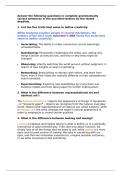
1. List the elements of art from class discussion. NOT from
textbook. There are 11:
Color: A component of light, it affects us directly by modifying our
thoughts, moods, actions, work habits, and even our health and
mental conditions. Dressing according to our color preferences is one
way we express ourselves. People surrounded by solid colors such as
orange or red, experiment nervousness and raised blood pressure. In
contrast, some blues have a below normal pressure pulse levels.
Light: Everything we see is made visible by the radiant energy we
call light. Light can be directed reflected, refracted, diffracted, or
diffused. As light changes, surfaces illuminated by it also appear to
change.
Line: Is a long, narrow mark, usually made by drawing with a tool or
brush. Lines can be of various thickness, but length always
predominates over height or depth.
Mass: A two-dimensional area is called a shape, but a three-
dimensional area is called a mass: The physical bulk of a solid body of
material that has height, width, and depth.
Pattern: It can be described as a repeating unit of shape or form, but
it can also be thought of as the "skeleton" that organizes the parts of
a composition.
Shape: Is the area within the outline of an object or figure, whether
two-dimensional or three-dimensional. We can group the infinite
variety of shapes into two general categories: Geometric (such as
circles, triangles, and squares) and Organic (irregular, often curving or
rounded, seem more relaxed and informal ).
Space: Is the indefinable, general receptacle of all things- the
seemingly empty space around us.
Texture: It refers to the tactile qualities of surfaces, or to the visual
representation of those qualities.
Time & Motion: Become major elements in visual media such as
film, video, and some works of sculpture. Time is the 4th dimension,
1. List the elements of art from class discussion. NOT from
textbook. There are 11:
Color: A component of light, it affects us directly by modifying our
thoughts, moods, actions, work habits, and even our health and
mental conditions. Dressing according to our color preferences is one
way we express ourselves. People surrounded by solid colors such as
orange or red, experiment nervousness and raised blood pressure. In
contrast, some blues have a below normal pressure pulse levels.
Light: Everything we see is made visible by the radiant energy we
call light. Light can be directed reflected, refracted, diffracted, or
diffused. As light changes, surfaces illuminated by it also appear to
change.
Line: Is a long, narrow mark, usually made by drawing with a tool or
brush. Lines can be of various thickness, but length always
predominates over height or depth.
Mass: A two-dimensional area is called a shape, but a three-
dimensional area is called a mass: The physical bulk of a solid body of
material that has height, width, and depth.
Pattern: It can be described as a repeating unit of shape or form, but
it can also be thought of as the "skeleton" that organizes the parts of
a composition.
Shape: Is the area within the outline of an object or figure, whether
two-dimensional or three-dimensional. We can group the infinite
variety of shapes into two general categories: Geometric (such as
circles, triangles, and squares) and Organic (irregular, often curving or
rounded, seem more relaxed and informal ).
Space: Is the indefinable, general receptacle of all things- the
seemingly empty space around us.
Texture: It refers to the tactile qualities of surfaces, or to the visual
representation of those qualities.
Time & Motion: Become major elements in visual media such as
film, video, and some works of sculpture. Time is the 4th dimension,