Marketing
Semester 1
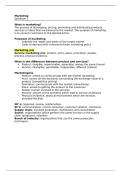
What is marketing?
The process of developing, pricing, promoting and distributing products,
services or ideas that are tailored to the market. The purpose of marketing
is to convert customers to the desired action.
Purposes of marketing
- Indentify the needs and wants of the target market
- Cater to demand with a demand-driven marketing policy
Marketing mix
Service marketing mix: product, price, place, promotion, people,
process, physical evidence.
What is the difference between product and services?
Product: tangible, imperishable, separable, always the same (homo)
Service: intangible, perishable, inseparable, different (hetero)
Marketingmix
- Product: meant to communicate with the market (branding)
- Price: covers all the decisions surrounding the exchange value of a
product (competitive pricing)
- Promotion: communicate with the market (advertising)
- Place: aimed to getting the product to the consumer
- People: human involved in the services
- Process: actions of the activities which lead to service of delivery
- Physicial evidence: physical environment which are services
provided (facility)
3R’ s: response, review, relationships
4C’s: communication, cost to consumer, customer solution, convience
Supply chain: involved production, distribution and consumption
Sector: organizations which perform the same function in the supply
chain (producers, retailers)
Banch of industry: organizations that use the same production
techniques
, Environment
DESTEP: demographic (age, gender, income), Economic (income,
inflation), socio-cultural (religion, sexuality), technological (new products,
developing), ecological (nature), political (laws, regulations)
Internal environment: inside an organization (money, buildings)
External environment: outside an organization (meso & macro)
Meso environment: market in which the company operates (customers,
suppliers, competition and other interest groups). Factors over which a
company can exercise indirect influence customers, intermediairs,
competitors, suppliers and public groups.
Macro environment: environmental factors over which an organization
has no direct influence, and which are not controllable (DESTEP)
developments and trends
Customer insights: combination of results with context and creativity,
which benefit organization and customer
Intermediary: organizations that operate as a link between producers
and consumers
UGC: user-generated content, online media content
Consumer market: individuals, own use (families or households)
Industrial market: organizations who buy and use products and sell it
with profit
Intermediary market: buy and resell with profit and without processing
products
Institutional market: society (hospitals)
Multiple sourcing: more suppliers to reduce dependency
Utility: products that satisfies the needs and wants of consumers,
quantity, time, specific place, product assortment.
Benchmarking: comparing with others
Competition
- Brand: similar products, different brands
- General: product with same need
- Product: the same products
- Need: customer priotise the one above the other one
Segmentation
Potential market: how big the market can be
Effective demand: the amount of goods there buying
Generic need: getting the customers need
FMCG: fast moving consumer goods, products who sell fast and are low
budget
CPG: consumer packaged goods, use it every day (food, drinks)
Durable consumer goods: long period items (furniture, electronics)
Product differentiation: be different with logo, marketing or services
Semester 1
What is marketing?
The process of developing, pricing, promoting and distributing products,
services or ideas that are tailored to the market. The purpose of marketing
is to convert customers to the desired action.
Purposes of marketing
- Indentify the needs and wants of the target market
- Cater to demand with a demand-driven marketing policy
Marketing mix
Service marketing mix: product, price, place, promotion, people,
process, physical evidence.
What is the difference between product and services?
Product: tangible, imperishable, separable, always the same (homo)
Service: intangible, perishable, inseparable, different (hetero)
Marketingmix
- Product: meant to communicate with the market (branding)
- Price: covers all the decisions surrounding the exchange value of a
product (competitive pricing)
- Promotion: communicate with the market (advertising)
- Place: aimed to getting the product to the consumer
- People: human involved in the services
- Process: actions of the activities which lead to service of delivery
- Physicial evidence: physical environment which are services
provided (facility)
3R’ s: response, review, relationships
4C’s: communication, cost to consumer, customer solution, convience
Supply chain: involved production, distribution and consumption
Sector: organizations which perform the same function in the supply
chain (producers, retailers)
Banch of industry: organizations that use the same production
techniques
, Environment
DESTEP: demographic (age, gender, income), Economic (income,
inflation), socio-cultural (religion, sexuality), technological (new products,
developing), ecological (nature), political (laws, regulations)
Internal environment: inside an organization (money, buildings)
External environment: outside an organization (meso & macro)
Meso environment: market in which the company operates (customers,
suppliers, competition and other interest groups). Factors over which a
company can exercise indirect influence customers, intermediairs,
competitors, suppliers and public groups.
Macro environment: environmental factors over which an organization
has no direct influence, and which are not controllable (DESTEP)
developments and trends
Customer insights: combination of results with context and creativity,
which benefit organization and customer
Intermediary: organizations that operate as a link between producers
and consumers
UGC: user-generated content, online media content
Consumer market: individuals, own use (families or households)
Industrial market: organizations who buy and use products and sell it
with profit
Intermediary market: buy and resell with profit and without processing
products
Institutional market: society (hospitals)
Multiple sourcing: more suppliers to reduce dependency
Utility: products that satisfies the needs and wants of consumers,
quantity, time, specific place, product assortment.
Benchmarking: comparing with others
Competition
- Brand: similar products, different brands
- General: product with same need
- Product: the same products
- Need: customer priotise the one above the other one
Segmentation
Potential market: how big the market can be
Effective demand: the amount of goods there buying
Generic need: getting the customers need
FMCG: fast moving consumer goods, products who sell fast and are low
budget
CPG: consumer packaged goods, use it every day (food, drinks)
Durable consumer goods: long period items (furniture, electronics)
Product differentiation: be different with logo, marketing or services