IT in Control
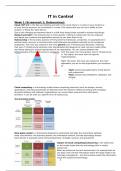
Week 1 (Screencast 1; Outsourcing):
Cloud (ISP 5.0) = the files and desktop are both in the cloud; there is no data on your location or
on your device anymore, its all situated in a cloud. This means that you can use a tablet at your
location -> Bring Your Own Device.
Due to this changing environment there is a shift from doing things yourself to outsourcing things:
Doing it yourself = the infrastructure is more specific, nothing is outsourced. You can organize
and adjust your systems and applications exactly as you want them to be.
Outsourcing = the business practice of hiring external individuals, companies, or organizations to
perform tasks, services, or functions that could otherwise be handled internally by the companies
employees. The more you outsource, the more generic your IT-infrastructure becomes, meaning
that your IT infrastructure becomes more standardized and designed to meet common needs rather
than being tailored to unique requirements of an organization. You can choose between the
following parts of the infrastructure to outsource: Left: the lower, the more generic your IT infrastructure
is. The higher, the more room for specific
implementation.
Right: the lower, the more you outsource, the more
dependent you are on the organization you outsource
to.
- SaaS: outsourcing applications (most generic
and outsourced).
- PaaS: outsourcing middleware, database, and
storage.
- IaaS: outsourcing systems and network (least
Cloud computing = a technology model where computing resources (such as storage, servers,
applications, and data processing) are delivered over the internet. Instead of owning and managing
physical hardware and software, organizations can access these resources from third-party
providers. It can be seen as a specific form of outsourcing.
The nine-plane model:
Nine-plane model = a framework designed to understand and align the interactions between
three core domains: the business domain, the information domain, and the technology domain.
Each domain is analyzed across three perspectives: strategic, tactical, and operational.
Impact of cloud computing/outsourcing = the yellow box
on the model shows that the technology pillar is mostly
outsourced.
When we outsource the tech environment, for example that we
use SaaS, then still the information within the SaaS needs to be
internally managed etc., and the business needs the information
out of the outsourced technology.
1
, Sourcing Delivery Alternatives:
Sourcing strategy = sourcing is a policy, a strategic choice. You strategy can for example be, ‘we
do outsourcing unless…’
Co-sourcing and multi-sourcing can be used for being more innovative. There are different types of
sourcing:
Sourcing Strategy: Definition: Advantages: Disadvantages:
In-sourcing The process of assigning tasks, - Direct control -> - Scale limitations.
functions, or projects to an competitive - Can raise costs and
organizations internal resources advantage. delay time to
rather than outsourcing them to - Freedom of choice. market.
external vendors or third parties. - Rapid innovation - Dependent on
In-sourcing utilizes internal through internal internal resources
capabilities for activities. expertise. and skills.
Captive division = a company - Company-specific
sets up and manages an knowledge.
outsourcing entity off-shore; a type
of in-sourcing.
Outsourcing Engaging an external organization - Economies of scale. - Less direct control.
for the design, development, - Purchased expertise. - Exit barriers.
maintenance, execution, and/or - You can focus on - Unknown supplier
offering of support of the service. companies core skills.
competencies. - More challenging
- Test trial of new business process
services. integration.
- Access to innovative - Increased
resources. governance
required.
Co-sourcing or multi- Often a combination of in-sourcing - Low time to market. - Project complexity.
sourcing and outsourcing, using a number - Diverse range of - Intellectual property
of organizations. This generally expertise. and copyright.
involves external organizations - It offers the flexibility - Culture clash
working together in designing, to maintain greater between companies.
developing, maintaining, and control.
operating a portion of a service.
The Cloud Cloud service providers let you - Cloud services are - Internal clouds are
rent technology and storage over easily defined. still complex.
the internet instead of owning it. - Simple to set-up a - Focusing too much
This way, companies don’t have to cloud service. on cloud might
manage everything themselves. - Easy to connect make it harder to
services to business see how IT activities
goals. impact business
- More control for the goals.
customer. - Tricky to combine
own in-house
systems with
external cloud
services.
- Security and
reliability concerns
of storing data in the
cloud.
Application Service Companies that deliver software - Access to expensive - Culture clash
Provider applications to customers over the and complex between companies.
internet (for example Gmail). software. - No access to
Instead of purchasing and - Low maintenance knowledge.
managing the software, customers work. - Often usage-based
can just access the applications. - Support and upgrades charging models.
included.
Multi-Vendor Sourcing This category involves sourcing - Less risk as the - Difficulty in
different services from different organization is not coordinating
2
, vendors, often representing tied to a single activities and
different sourcing options from vendor. services
above. - Access to specialized (governance) from
expertise from different vendors.
different organizations - Requires a clear
ensures a more understanding of the
complete support chain and vendors
model. role.
Partnership Formal arrangements between two - Low time to market. - Project complexity.
or more organizations to work - Market - Intellectual property
together on strategic initiatives expansion/entrance. and copyright
that leverage critical expertise or - Leveraged expertise. protection.
market opportunities. - Mutual benefits. - Culture clash
between companies.
Crowd Sourcing Obtain service ideas and problem - Provides innovative - Difficult to protect
solving by outsourcing the solutions from diverse new potential
problem through social networks crowd outside an intellectual property
and the internet to an unidentified organization. and research bias.
entity or the ‘crowd’. This may also - Can be a source of - Quality of ideas may
be considered as a new form of competitive be suspect.
collaborative alliance. advantage.
Outsourcing drivers and challenges:
The following list is an overview of the seven primary drivers of global sourcing. These are the
drivers that play a critical role in determining which sourcing type will be performed:
1. Economics: focuses on finding the best mix of resources to create high-quality products or
services at the lowest possible cost. It looks at cost reduction and efficiency. The pressure
from top management to reduce costs is a fundamental factor in this driver. This focus on
lowering costs fuels the interest in global sources because of the labour arbitrage benefits
of using resources housed in a lower-wage location.
Additionally, the structure of the business relationship (from simple contracts to complex
partnerships or investments) plays a key role in how the costs are managed.
2. Resource Management: this driver addresses the strategy on how to access the best
resources to meet the companies needs, whether that means the least costly, most
specialized, or scarce.
3. Decreasing Time to Market: this driver addresses an organizations ability to get its
product or service to the customer, in a timely manner, because that is critical to its
competitive success.
4. Flexible and Scalable Operations: these allow organizations to move and change with
the demands of the marketplace. Companies want the ability to easily scale their
operations up or down without being tied to long-term commitments.
5. Transformation and Innovation: this driver looks at how external resources can help
bring in new ideas, technologies, and processes that fuel growth and transformation within
the organization.
6. Regulatory and Legal Issues: focuses on the legal aspects of sourcing, such as
protecting intellectual property, adhering to regulations, and handling cross-border logistics,
all of which can influence decisions on where to source.
7. Enabling Mechanisms: highlights the importance of using technology, global
communication systems, and advisory services to help make sourcing more effective and
efficient.
Build vs Buy:
There are many reasons why organizations choose to outsource or in-source or deploy a
combination of both strategies. The figure below provides a list of outsourcing (buy) and in-sourcing
(build) motivations:
Buy (outsourcing) motivations: Build (in-sourcing) motivations:
Cost reduction. Competitive advantage.
Speed up time to market. Expertise available in-house.
Assist a rapid growth situation or overflow situation. May be less expensive than buying.
Share risk. No suitable vendors available.
Improve flexibility and scalability. Core competences.
3
, Leverage new Security, privacy, and control are critical.
skills/resources/management/process/technologies.
Avoid major capital investments. Can be completed on time.
Improve performance. Threat to intellectual property theft.
Enable innovation and transformation. Lower risk.
There is a lot of misalignment, for example, the board says: ‘our strategic focus is outsourcing’, but
on the lower level you have a large engineering department with guys who can build software on
their own. Therefore, on strategic level the preference is buying, and on the lower level in the
organization the preference is building.
Today, virtually any IT function can be outsourced such as:
- IT architecture: includes database management, data architecture, etc.
- IT infrastructure: elements of the IT infrastructure include computer center, network
management and operations, help desk operations, data entry, hardware maintenance and
service, cloud applications, servers, etc.
- Systems and software applications development and maintenance: coding, testing,
integration, maintenance, analytics, social media, etc.
- Web development and hosting: e-commerce front-end middleware and back-end
systems.
- Training, education, and certification: IT, customer and management personnel.
Outsourcing barriers and risks:
While there are many good reasons to outsource, there are also barriers and risks that need to be
overcome or mitigated especially in dealing with off-shore deals.
Off-shore deals = business agreements where a company outsources its services or operations to
a provider located in another country, often one with low labor costs. Examples of barriers and risks
include:
- Loss of control of confidential information.
- Function or process is too critical to outsource.
- Loss of flexibility due to inflexible contracts.
- Negative customer reaction.
- Poor outsourcing process or management.
- Service provider failure.
- Lack of intellectual property protection -> when it is outsourced you would like to keep in
control of your own intellectual property, but there is a risk that you are not able to protect
your intellectual property.
- Differences in culture and time zones relating to offshore deals.
- Regulatory and legal country differences.
- Lack of security and data protection.
Three service model:
There are three types of cloud service models:
1. Software as a Service (SaaS) = outsourcing applications; this is the most popular one.
SaaS lets customers use software applications that run on the providers cloud
infrastructure. These apps are accessed through a web browser or an interface on your
device (like using email online). The customer doesn’t manage anything like the server,
storage, or the software itself, except for some personal setting like email preferences. An
example is the application of Gmail or the application of Office365.
2. Platform as a Service (PaaS) = outsourcing database, storage & middleware.
PaaS gives customers the tools to build and deploy their own applications on the providers
4
Week 1 (Screencast 1; Outsourcing):
Cloud (ISP 5.0) = the files and desktop are both in the cloud; there is no data on your location or
on your device anymore, its all situated in a cloud. This means that you can use a tablet at your
location -> Bring Your Own Device.
Due to this changing environment there is a shift from doing things yourself to outsourcing things:
Doing it yourself = the infrastructure is more specific, nothing is outsourced. You can organize
and adjust your systems and applications exactly as you want them to be.
Outsourcing = the business practice of hiring external individuals, companies, or organizations to
perform tasks, services, or functions that could otherwise be handled internally by the companies
employees. The more you outsource, the more generic your IT-infrastructure becomes, meaning
that your IT infrastructure becomes more standardized and designed to meet common needs rather
than being tailored to unique requirements of an organization. You can choose between the
following parts of the infrastructure to outsource: Left: the lower, the more generic your IT infrastructure
is. The higher, the more room for specific
implementation.
Right: the lower, the more you outsource, the more
dependent you are on the organization you outsource
to.
- SaaS: outsourcing applications (most generic
and outsourced).
- PaaS: outsourcing middleware, database, and
storage.
- IaaS: outsourcing systems and network (least
Cloud computing = a technology model where computing resources (such as storage, servers,
applications, and data processing) are delivered over the internet. Instead of owning and managing
physical hardware and software, organizations can access these resources from third-party
providers. It can be seen as a specific form of outsourcing.
The nine-plane model:
Nine-plane model = a framework designed to understand and align the interactions between
three core domains: the business domain, the information domain, and the technology domain.
Each domain is analyzed across three perspectives: strategic, tactical, and operational.
Impact of cloud computing/outsourcing = the yellow box
on the model shows that the technology pillar is mostly
outsourced.
When we outsource the tech environment, for example that we
use SaaS, then still the information within the SaaS needs to be
internally managed etc., and the business needs the information
out of the outsourced technology.
1
, Sourcing Delivery Alternatives:
Sourcing strategy = sourcing is a policy, a strategic choice. You strategy can for example be, ‘we
do outsourcing unless…’
Co-sourcing and multi-sourcing can be used for being more innovative. There are different types of
sourcing:
Sourcing Strategy: Definition: Advantages: Disadvantages:
In-sourcing The process of assigning tasks, - Direct control -> - Scale limitations.
functions, or projects to an competitive - Can raise costs and
organizations internal resources advantage. delay time to
rather than outsourcing them to - Freedom of choice. market.
external vendors or third parties. - Rapid innovation - Dependent on
In-sourcing utilizes internal through internal internal resources
capabilities for activities. expertise. and skills.
Captive division = a company - Company-specific
sets up and manages an knowledge.
outsourcing entity off-shore; a type
of in-sourcing.
Outsourcing Engaging an external organization - Economies of scale. - Less direct control.
for the design, development, - Purchased expertise. - Exit barriers.
maintenance, execution, and/or - You can focus on - Unknown supplier
offering of support of the service. companies core skills.
competencies. - More challenging
- Test trial of new business process
services. integration.
- Access to innovative - Increased
resources. governance
required.
Co-sourcing or multi- Often a combination of in-sourcing - Low time to market. - Project complexity.
sourcing and outsourcing, using a number - Diverse range of - Intellectual property
of organizations. This generally expertise. and copyright.
involves external organizations - It offers the flexibility - Culture clash
working together in designing, to maintain greater between companies.
developing, maintaining, and control.
operating a portion of a service.
The Cloud Cloud service providers let you - Cloud services are - Internal clouds are
rent technology and storage over easily defined. still complex.
the internet instead of owning it. - Simple to set-up a - Focusing too much
This way, companies don’t have to cloud service. on cloud might
manage everything themselves. - Easy to connect make it harder to
services to business see how IT activities
goals. impact business
- More control for the goals.
customer. - Tricky to combine
own in-house
systems with
external cloud
services.
- Security and
reliability concerns
of storing data in the
cloud.
Application Service Companies that deliver software - Access to expensive - Culture clash
Provider applications to customers over the and complex between companies.
internet (for example Gmail). software. - No access to
Instead of purchasing and - Low maintenance knowledge.
managing the software, customers work. - Often usage-based
can just access the applications. - Support and upgrades charging models.
included.
Multi-Vendor Sourcing This category involves sourcing - Less risk as the - Difficulty in
different services from different organization is not coordinating
2
, vendors, often representing tied to a single activities and
different sourcing options from vendor. services
above. - Access to specialized (governance) from
expertise from different vendors.
different organizations - Requires a clear
ensures a more understanding of the
complete support chain and vendors
model. role.
Partnership Formal arrangements between two - Low time to market. - Project complexity.
or more organizations to work - Market - Intellectual property
together on strategic initiatives expansion/entrance. and copyright
that leverage critical expertise or - Leveraged expertise. protection.
market opportunities. - Mutual benefits. - Culture clash
between companies.
Crowd Sourcing Obtain service ideas and problem - Provides innovative - Difficult to protect
solving by outsourcing the solutions from diverse new potential
problem through social networks crowd outside an intellectual property
and the internet to an unidentified organization. and research bias.
entity or the ‘crowd’. This may also - Can be a source of - Quality of ideas may
be considered as a new form of competitive be suspect.
collaborative alliance. advantage.
Outsourcing drivers and challenges:
The following list is an overview of the seven primary drivers of global sourcing. These are the
drivers that play a critical role in determining which sourcing type will be performed:
1. Economics: focuses on finding the best mix of resources to create high-quality products or
services at the lowest possible cost. It looks at cost reduction and efficiency. The pressure
from top management to reduce costs is a fundamental factor in this driver. This focus on
lowering costs fuels the interest in global sources because of the labour arbitrage benefits
of using resources housed in a lower-wage location.
Additionally, the structure of the business relationship (from simple contracts to complex
partnerships or investments) plays a key role in how the costs are managed.
2. Resource Management: this driver addresses the strategy on how to access the best
resources to meet the companies needs, whether that means the least costly, most
specialized, or scarce.
3. Decreasing Time to Market: this driver addresses an organizations ability to get its
product or service to the customer, in a timely manner, because that is critical to its
competitive success.
4. Flexible and Scalable Operations: these allow organizations to move and change with
the demands of the marketplace. Companies want the ability to easily scale their
operations up or down without being tied to long-term commitments.
5. Transformation and Innovation: this driver looks at how external resources can help
bring in new ideas, technologies, and processes that fuel growth and transformation within
the organization.
6. Regulatory and Legal Issues: focuses on the legal aspects of sourcing, such as
protecting intellectual property, adhering to regulations, and handling cross-border logistics,
all of which can influence decisions on where to source.
7. Enabling Mechanisms: highlights the importance of using technology, global
communication systems, and advisory services to help make sourcing more effective and
efficient.
Build vs Buy:
There are many reasons why organizations choose to outsource or in-source or deploy a
combination of both strategies. The figure below provides a list of outsourcing (buy) and in-sourcing
(build) motivations:
Buy (outsourcing) motivations: Build (in-sourcing) motivations:
Cost reduction. Competitive advantage.
Speed up time to market. Expertise available in-house.
Assist a rapid growth situation or overflow situation. May be less expensive than buying.
Share risk. No suitable vendors available.
Improve flexibility and scalability. Core competences.
3
, Leverage new Security, privacy, and control are critical.
skills/resources/management/process/technologies.
Avoid major capital investments. Can be completed on time.
Improve performance. Threat to intellectual property theft.
Enable innovation and transformation. Lower risk.
There is a lot of misalignment, for example, the board says: ‘our strategic focus is outsourcing’, but
on the lower level you have a large engineering department with guys who can build software on
their own. Therefore, on strategic level the preference is buying, and on the lower level in the
organization the preference is building.
Today, virtually any IT function can be outsourced such as:
- IT architecture: includes database management, data architecture, etc.
- IT infrastructure: elements of the IT infrastructure include computer center, network
management and operations, help desk operations, data entry, hardware maintenance and
service, cloud applications, servers, etc.
- Systems and software applications development and maintenance: coding, testing,
integration, maintenance, analytics, social media, etc.
- Web development and hosting: e-commerce front-end middleware and back-end
systems.
- Training, education, and certification: IT, customer and management personnel.
Outsourcing barriers and risks:
While there are many good reasons to outsource, there are also barriers and risks that need to be
overcome or mitigated especially in dealing with off-shore deals.
Off-shore deals = business agreements where a company outsources its services or operations to
a provider located in another country, often one with low labor costs. Examples of barriers and risks
include:
- Loss of control of confidential information.
- Function or process is too critical to outsource.
- Loss of flexibility due to inflexible contracts.
- Negative customer reaction.
- Poor outsourcing process or management.
- Service provider failure.
- Lack of intellectual property protection -> when it is outsourced you would like to keep in
control of your own intellectual property, but there is a risk that you are not able to protect
your intellectual property.
- Differences in culture and time zones relating to offshore deals.
- Regulatory and legal country differences.
- Lack of security and data protection.
Three service model:
There are three types of cloud service models:
1. Software as a Service (SaaS) = outsourcing applications; this is the most popular one.
SaaS lets customers use software applications that run on the providers cloud
infrastructure. These apps are accessed through a web browser or an interface on your
device (like using email online). The customer doesn’t manage anything like the server,
storage, or the software itself, except for some personal setting like email preferences. An
example is the application of Gmail or the application of Office365.
2. Platform as a Service (PaaS) = outsourcing database, storage & middleware.
PaaS gives customers the tools to build and deploy their own applications on the providers
4