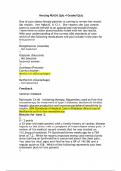
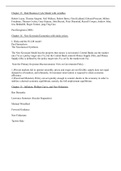
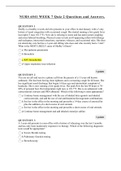
Herzing NU636 Quiz 4 Graded Quiz
One of your obese female patients is coming to review her recent lab results. Her HgbA1C is 12.1. She reports she just cannot seem to commit herself to an appropriate nutritional lifestyle. There were no other abnormalities noted with her lab results. With your understanding of the current ADA standards of care which of the following medications will you include in the plan for this patient? Rosiglitazone (Avandia) , Not Selected Glipizide (Glucotrol) , Not Selected Incorrect answer: Acarbose (Precose) Correct Answer: Metformin (Glucophage) Metformin (Glucophage) , Not Selected Feedback General Feedback Rationale: Ch 46 – initiating therapy; Biguanides; used as first-line monotherapy for treatment of type 2 diabetes; Metformin inhibits hepatic glucose production and improves peripheral sensitivity to insulin; ADA Standards of Medical Care in Diabetes directs use of Metformin as first-line monotherapy Results for item 2. 2 0 / 2 points A 52-year-old male patient with a family history of cardiac disease reports to the clinic with a complaint of intermittent chest pain. A review of his medical record reveals that he was started on 112.5mcg of synthetic T4 (Synthroid) three weeks ago for a TSH level of 7.2. While he reports improved energy and mental clarity since starting on Synthroid he is concerned about the chest pain. You take his vital signs and find he has a BP of 142/86 and a regular pulse at 128. Which of the following represents your best treatment plan for this patient? Make no changes in the Synthroid dose, order a TSH and an EKG , Not Selected Decrease the Synthroid dose, order a TSH and an EKG , Not Selected Incorrect answer: Order a stress test because of his family history Correct Answer: Decrease the Synthroid dose, order a TSH and an EKG Discontinue Synthroid as chest pain is an adverse event , Not Selected Feedback General Feedback Rationale: Ch 47 – initiating therapy; thyroid hormone and symptoms and signs of hyperthyroidism – excess thyroid hormone can cause palpitations and arrhythmias; thyroid hormone replacement therapy is a life long intervention therefore it is not appropriate to outright discontinue it Results for item 3. 3 2 / 2 points Your 73-year-old patient reports a history thyroid hormone replacement therapy since 19 years of age secondary to having a partial thyroidectomy. The patient is on Synthroid. As an astute advanced practice nurse you understand that chronic treatment with a thyroid hormone can result in the development of which of the following? Correct answer: Osteoporosis Tachycardia , Not Selected Insomnia , Not Selected Sweating , Not Selected Feedback General Feedback Rationale: Ch 47 – hypothyroidism; initiating therapy; monitoring patient response; drug information – intake of excessive thyroid hormone results in the risk of hyperthyroidism, arrhythmias and osteoporosis Results for item 4. 4 0 / 2 points Lab results reveal that your 67-year-old male patient with type 2 diabetes has a HgbA1C of 6.7%. Presently the patient is on 1000mg of Glucophage BID. With this lab value which of the following interventions does the advanced practice nurse anticipate for the patient’s treatment plan? Incorrect answer: Add a sulfonylurea drug (Diabenese) Correct Answer: Make no change in Glucophage dose Decrease Glucophage to 500mg BID , Not Selected Make no change in Glucophage dose , Not Selected Add NPH insulin BID , Not Selected Feedback General Feedback Rationale: Ch 46 – initiating therapy; goals of therapy – glycemic control goal is for a HgbA1C < or = 6.9% Results for item 5. 5 0 / 2 points Lab results reveal that 82-year-old male with type 2 diabetes has a HgbA1C of 10.9%. He is presently taking glipizide (Glucotrol). In addition to his type 2 diabetes he has renal insufficiency and moderate cardiac ischemia. Which of the following interventions is most appropriate for management of the patient’s diabetes? Add sitagliptin (Januvia) , Not Selected Discontinue Glucotrol start insulin , Not Selected Incorrect answer: Add metformin (Glucophage) Correct Answer: Discontinue Glucotrol start insulin Add pioglitazone (Actos) , Not Selected Feedback General Feedback Rationale: Ch 46 – initiating therapy; insulin – indicated for patients not controlled on oral anti-diabetic agents; no need to continue the Glucotrol it did not get the patient to appropriate blood glucose goal; Januvia and Glucophage are contraindicated for a patient with renal insufficiency; Actos places the patient at risk for heart failure Results for item 6. 6 0 / 2 points You have a 93-year-old female who is on 88mcg of Synthroid daily for hypothyroidism. There are numerous drug interactions associated with this form of thyroid hormone therapy. With full understanding of the potential drug:drug interactions, which of the following medications would not be problematic if prescribed for this patient? Incorrect answer: Amitriptyline (Elvail) Correct Answer: Amoxicillin Anti-coagulants , Not Selected Amoxicillin , Not Selected Antacids , Not Selected Feedback General Feedback Rationale: Ch 47 – hypothyroidism; patient education – drug information; Synthroid is a synthetic T4 that demonstrates numerous drug interactions – anti-coagulants, antacids, tricyclic anti-depressants, PPIs, metformin, estrogens, statins, calcium, iron, multi-vitamins, etc. Results for item 7. 7 0 / 2 points The thiazolidinediones are one of the drug classes used to treat type 2 diabetes. Included in this category of drug are Avandia and Actos. This class of drugs is contraindicated for use in which of the following patients? Incorrect answer: Older adults Correct Answer: Heart failure patients Obese patients , Not Selected Alcoholics , Not Selected Heart failure patients , Not Selected Feedback General Feedback Rationale: Ch 46 – initiating therapy; thiazolidinediones (TZDs) can lead to exacerbated heart failure secondary to causing fluid retention; they are contraindicated in patients with heart failure Results for item 8. 8 2 / 2 points You are seeing a new older African-American male patient who comes into the office wanting to have his blood pressure checked. The patient has a long-standing history of poorly controlled hypertension secondary to not being seen by a provider or obtaining medication. He does not monitor his BP and his reading today is 197/86. Reports he drinks a 12 pack of beer daily. He reports an allergy to ‘Sulfa’ drugs breaking out in a miserable rash. You do a urine dip in the office and note it is positive for 1+ glucose and protein. Based on these findings you suspect the patient has undiagnosed diabetes type 2. You order labs and the results come back with a random glucose value of 193, HgbA1C 8.5, a serum creatinine of 1.6mg/dL (ref range for a male is 0.70 – 1.2mg/dL for a male) and elevated LFTs (2-3x above normal range). You negotiate with the patient a medication regimen for both his newly diagnosed diabetes and his long- standing hypertension. Which of the following is the appropriate medication regimen for this patient? Metformin and calcium channel blocker , Not Selected Correct answer: Victoza and ACE inhibitor Metformin and ACE inhibitor , Not Selected Victoza and calcium channel blocker , Not Selected Feedback General Feedback Rationale: Ch 46 – initiating therapy; pramlintide – safe with renal and liver disease; biguanides – although guidelines recommend this is first-line therapy in type 2 diabetes it is contraindicated in a patient with renal dysfunction; the sulfonylureas are ruled out due to the reported sulfa allergy; with elevated LFTs you avoid the thiazolidinediones. presence of diabetes negates the issue of race when considering options for hypertensive management due to the demonstrated benefit of ACE inhibitors on renal function in diabetic patients Results for item 9. 9 2 / 2 points The African-American male patient from the prior question has limited financial resources. Understanding the need to assess the patient’s social determinants of health you engage the office staff in efforts to find resources for the patient to obtain his Victoza. From your experience you know that a valuable resource for this medication is which of the following? A prescription payment plan , Not Selected The $4 list at Walmart , Not Selected Correct answer: A patient assistance program The $10 list at Walmart , Not Selected
Written for
- Institution
-
Herzing University
- Course
-
NU 636
Document information
- Uploaded on
- January 6, 2025
- Number of pages
- 16
- Written in
- 2024/2025
- Type
- Exam (elaborations)
- Contains
- Questions & answers
Subjects

Also available in package deal