

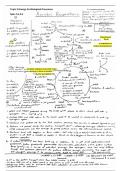
Topic 5 Energy for Biological Processes Pi = inorganic phosphate
Spec 5.1-5.5
3C 3C
Depending on
The Q,
ATP
is CONTINUALLY
. 3C broken down/produced
2C
2C
2C
Complete oxidation of pyruvate in 2&3
removes C atoms to produce 4C
CO 2, ATP and NADH
^acceptor
,Respiration may not start immediately as yeast needs to acclimatise, i.e. adjust to the conditions.
,CORE PRACTICAL 9: Investigate factors affecting the rate of aerobic or anaerobic respiration using a
respirometer, taking into account the safe and ethical use of organisms.
- Set up a respirometer.
- Put 60g of soda lime into the boiling tube to absorb
the CO 2 produced by the organism (only in aerobic
respiration as anaerobic measures CO 2 released).
- (Put 5cm3 of glucose solution to the boiling tube with
yeast so that respiratory substrate concentration will
not be a limiting factor of anaerobic respiration. Add
a thin layer of vegetable oil to the surface of the
mixture to provide a barrier to oxygen.)
- Put a known mass of one type of organism into the
boiling tube and replace the bung. Record the mass.
- Put a drop of coloured fluid into the glass tubing using a dropping pipette. Use the syringe to
draw the fluid onto the scale at the end furthest away from the respirometer.
- Close the tap to isolate the respirometer from the atmosphere and syringe to avoid any changes
in atmospheric pressure.
- A drop in temperature or rise in atmospheric pressure would change movement towards
the respirometer.
- A reduction in gas volume will reduce the pressure inside the boiling tube. As it becomes lower
than atmospheric pressure, the coloured fluid will move towards the respirometer. (An increase
in gas volume and hence movement away from respirometer occurs in anaerobic respiration.)
- Record the distance travelled by the coloured fluid at 1 min intervals for 5 mins.
- Calculate the volume of gas removed/released using the tube diameter and hence the mean
rate of oxygen uptake/carbon dioxide release per min per gram in mm3 min−1 g−1.
- A control respirometer with glass beads can be used simultaneously to increase the accuracy of
the experimental data. Movement towards the control respirometer would be subtracted from
the results while movement away would be added to the results.
- Control variables
- Temperature can be controlled using a water bath.
- The stage of development of organisms can be controlled by matching organisms
between groups for the stage of development.
- Atmospheric pressure can be controlled by using a control respirometer.
- The volume of sodium lime.
- Respiratory substrate concentration.
- Sometimes the mass of the organism.
rate of reactionat (t +10 ℃)
- Q10= is calculated where the effect of temperature is being
rate of reaction at t ℃
investigated.
- Ethical use of organisms
- Animals may suffer which could be ethically unacceptable as suffering cannot be
justified.
- Woodlice have relatively simple nervous systems so they may be less likely to
experience distress.
- Hence, the duration of the investigation should be as short as possible.
Organisms should be allowed to take breaks between repeats.
, Spec 5.6 Photosynthetic pigments
Spec i. Definition of absorption and action spectra.
- Absorption spectrum: a graph of the amount of light absorbed by a photosynthetic pigment
against the wavelength of light.
- Action spectrum: a graph of the rate of photosynthesis against the wavelength of light.
- Absorption spectrum and action spectrum show that chlorophyll is used in
photosynthesis as the peak and troughs follow a similar pattern.
At 400-500 wavelengths of light:
Most of the pigments are chlorophyll a and b
which absorb similar wavelengths of light.
Chlorophyll a absorbs slightly shorter
wavelengths of light than chlorophyll b.
Carotenoids absorb a wide range of short
wavelength light, including more blue, blue-
green light. They absorb wavelengths of light
that would not be used by the plant. Some of
this energy is passed to chlorophyll. Carotenoids
help protect chlorophyll from damage by very
intense light.
CORE PRACTICAL 10: Investigate the effects of different wavelengths of light on the rate of
photosynthesis. (red filter for max rate of photosynthesis and thus investigations not about wavelength)
- Photosynthometer
- Place a piece of pondweed into a beaker of water and remove any bubbles by gently
rubbing a finger over the surface of the pondweed underwater.
- Cover one side of the beaker with aluminium foil, so light can only enter the beaker from
the other side which is wrapped with a colourless filter for the control or a coloured filter.
- Add 5 mL of sodium hydrogencarbonate to the water and leave for 5 mins to increase
carbon dioxide concentration to ensure carbon dioxide is not a limiting factor.
- Place a lamp at a distance of 30 cm away from the beaker.
- Fill the capillary tubing with water and place the funnel end of the tubing into the beaker
and over the cut end of the pondweed.
- Record the volume of gas produced in the capillary tubing in 5 mins in a suitable table.
- Allow a 5 min break in between repeats for the pondweed to return to its normal rate of
photosynthesis.
- Control variables
- Species, age and size of plant.
- Temperature: Monitor the temperature of the water bath set at 25℃ with a
thermometer. Add warm water if the temperature is too low and add cold water if
the temperature is too high.
- Light intensity: Set the lamp at the same distance of 30 cm from the setup for all
repeats using a ruler. Place the setup in a dark room to ensure there is no
ambient light.
- Carbon dioxide concentration: Add sodium hydrogencarbonate of 5 mL to all
repeats.
- Volume of water in beaker: Use a scaled beaker to ensure there is only 80 mL of
water in the beaker for all repeats.
- pH: Use buffer solution.
Spec 5.1-5.5
3C 3C
Depending on
The Q,
ATP
is CONTINUALLY
. 3C broken down/produced
2C
2C
2C
Complete oxidation of pyruvate in 2&3
removes C atoms to produce 4C
CO 2, ATP and NADH
^acceptor
,Respiration may not start immediately as yeast needs to acclimatise, i.e. adjust to the conditions.
,CORE PRACTICAL 9: Investigate factors affecting the rate of aerobic or anaerobic respiration using a
respirometer, taking into account the safe and ethical use of organisms.
- Set up a respirometer.
- Put 60g of soda lime into the boiling tube to absorb
the CO 2 produced by the organism (only in aerobic
respiration as anaerobic measures CO 2 released).
- (Put 5cm3 of glucose solution to the boiling tube with
yeast so that respiratory substrate concentration will
not be a limiting factor of anaerobic respiration. Add
a thin layer of vegetable oil to the surface of the
mixture to provide a barrier to oxygen.)
- Put a known mass of one type of organism into the
boiling tube and replace the bung. Record the mass.
- Put a drop of coloured fluid into the glass tubing using a dropping pipette. Use the syringe to
draw the fluid onto the scale at the end furthest away from the respirometer.
- Close the tap to isolate the respirometer from the atmosphere and syringe to avoid any changes
in atmospheric pressure.
- A drop in temperature or rise in atmospheric pressure would change movement towards
the respirometer.
- A reduction in gas volume will reduce the pressure inside the boiling tube. As it becomes lower
than atmospheric pressure, the coloured fluid will move towards the respirometer. (An increase
in gas volume and hence movement away from respirometer occurs in anaerobic respiration.)
- Record the distance travelled by the coloured fluid at 1 min intervals for 5 mins.
- Calculate the volume of gas removed/released using the tube diameter and hence the mean
rate of oxygen uptake/carbon dioxide release per min per gram in mm3 min−1 g−1.
- A control respirometer with glass beads can be used simultaneously to increase the accuracy of
the experimental data. Movement towards the control respirometer would be subtracted from
the results while movement away would be added to the results.
- Control variables
- Temperature can be controlled using a water bath.
- The stage of development of organisms can be controlled by matching organisms
between groups for the stage of development.
- Atmospheric pressure can be controlled by using a control respirometer.
- The volume of sodium lime.
- Respiratory substrate concentration.
- Sometimes the mass of the organism.
rate of reactionat (t +10 ℃)
- Q10= is calculated where the effect of temperature is being
rate of reaction at t ℃
investigated.
- Ethical use of organisms
- Animals may suffer which could be ethically unacceptable as suffering cannot be
justified.
- Woodlice have relatively simple nervous systems so they may be less likely to
experience distress.
- Hence, the duration of the investigation should be as short as possible.
Organisms should be allowed to take breaks between repeats.
, Spec 5.6 Photosynthetic pigments
Spec i. Definition of absorption and action spectra.
- Absorption spectrum: a graph of the amount of light absorbed by a photosynthetic pigment
against the wavelength of light.
- Action spectrum: a graph of the rate of photosynthesis against the wavelength of light.
- Absorption spectrum and action spectrum show that chlorophyll is used in
photosynthesis as the peak and troughs follow a similar pattern.
At 400-500 wavelengths of light:
Most of the pigments are chlorophyll a and b
which absorb similar wavelengths of light.
Chlorophyll a absorbs slightly shorter
wavelengths of light than chlorophyll b.
Carotenoids absorb a wide range of short
wavelength light, including more blue, blue-
green light. They absorb wavelengths of light
that would not be used by the plant. Some of
this energy is passed to chlorophyll. Carotenoids
help protect chlorophyll from damage by very
intense light.
CORE PRACTICAL 10: Investigate the effects of different wavelengths of light on the rate of
photosynthesis. (red filter for max rate of photosynthesis and thus investigations not about wavelength)
- Photosynthometer
- Place a piece of pondweed into a beaker of water and remove any bubbles by gently
rubbing a finger over the surface of the pondweed underwater.
- Cover one side of the beaker with aluminium foil, so light can only enter the beaker from
the other side which is wrapped with a colourless filter for the control or a coloured filter.
- Add 5 mL of sodium hydrogencarbonate to the water and leave for 5 mins to increase
carbon dioxide concentration to ensure carbon dioxide is not a limiting factor.
- Place a lamp at a distance of 30 cm away from the beaker.
- Fill the capillary tubing with water and place the funnel end of the tubing into the beaker
and over the cut end of the pondweed.
- Record the volume of gas produced in the capillary tubing in 5 mins in a suitable table.
- Allow a 5 min break in between repeats for the pondweed to return to its normal rate of
photosynthesis.
- Control variables
- Species, age and size of plant.
- Temperature: Monitor the temperature of the water bath set at 25℃ with a
thermometer. Add warm water if the temperature is too low and add cold water if
the temperature is too high.
- Light intensity: Set the lamp at the same distance of 30 cm from the setup for all
repeats using a ruler. Place the setup in a dark room to ensure there is no
ambient light.
- Carbon dioxide concentration: Add sodium hydrogencarbonate of 5 mL to all
repeats.
- Volume of water in beaker: Use a scaled beaker to ensure there is only 80 mL of
water in the beaker for all repeats.
- pH: Use buffer solution.



