Week 1
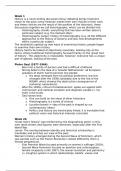
History is a never-ending discussion (Geyl: debating brings historians
closer to the past; every historian makes their own choices in their work
and these choices are the result of the position of the historian), these
discussions together we call historiography, which can be divided into:
- Historiography (small): everything that has been written about a
particular subject (e.g. the Vietnam War);
- Historiography (large): history of historiography (e.g. all the different
approaches to the history of slavery) and also new developments
within a particular subject.
The revolutions opened up new ways of examining history; people began
to examine their own history.
History had to be looked at objectively (neutrally, looking only at the
facts), where traditional historiography focused mainly on the 'great men
of history'. This objectivity is impossible, however: everyone has a unique
pair of glasses, looking at the past.
Pieter Geyl (1877-1966)
- Born into a family of doctors and had a difficult childhood
- Strong belief in the idea of a 'Greater Netherlands': all European
speakers of Dutch had to become one people
o His ideas emerged from his political preference, but this
changed after the 1930s (probably due to the rise of the
NSDAP, which showed the destructive consequences of
(extreme) nationalism)
- After the 1930s, critical of totalitarianism: spoke out against both
communism and national socialism and dogmatic people (= my
truth is the truth)
- Geyl shows that:
o One can build on the ideas of other historians
o Historiography is a series of choices
o Location-based (= idea of the past is shaped by our
contemporary ideas)
o Politics and history are inextricably linked; it is inevitable that
political vision and historical interests coincided
Week 2A
'Great men's history' was reinforced by the biographical genre: in this,
men (both writers and figures) were dominant, especially after the First
World War.
Lerner: The overlap between identity and historical scholarship is
inevitable and enriches our view of the past.
Women's history emerged during the Second Wave of Feminism, which
saw periods such as the French Revolution viewed differently (from a
female perspective).
- First Feminist Wave focused primarily on women's suffrage (1919);
- Second Wave Feminism focused on abortion and contraception,
female incapacity (until 1957), the sexual revolution and patriarchy
(= (roughly) system in which relationships, beliefs, values and
, similar aspects of a society are determined by men and in which
gender inequality is hidden)
Gender history focuses primarily on the historical and social roles
(distribution) between masculinity and femininity and how these have
changed.
Gerda Lerner (1920-2013)
- Born in Vienna, fled to the United States after the Anschluss:
captivity had a major impact on her life
- Had difficulty getting a job because she was a woman, Jewish, and
communist; opposed the history curriculum
- Without history a group is limited: without history no identity no
visibility no role in political and social life
- Was a PhD candidate at Columbia University in 1963, wrote the book
Black Women in White America (1972): emerged from her affinity
with the marginalized population groups; tried to give them their
own history
- Taught a course specializing in women's history at Sarah Lawrence
College, which professionalized women's history
- Lerner shows that:
o Historians have begun to reframe the 'who' question within
history, shifting the emphasis (e.g. on women), which has led
to different perspectives and new questions being asked
Historians act primarily on behalf of the nation state (= nationalistic
ideology): these developments are through violence and war ( war is the
driving force in history); grew large after the French Revolution. Was also
called a 'league of nations' before this.
Social history emerged in the nineteenth century: it emerged from
Marxism and focused on the working class (e.g. Thompson, The Making of
the English Working Class (1963), which discussed craftsmen and the
consequences of industrialisation). EP Thompson shows that workers can
use agency (= being able to act autonomously within the (aversive)
circumstances given to them) to shape their own lives, which stems from
liberal individualism.
Week 2B
Subaltern studies are emerging: a branch of social history that examines
relations between those in power and those without power, often in
former colonies.
There is criticism of the nation state:
- The nation state is fragile and artificial: most nations are relatively
new, making them incomparable to the past; 'national history' is not
real: conclusions are drawn on a local scale and are maintained on a
national scale
o Benedict Anderson, Imagined Communities: one creates a
sense of national identity (e.g. through education), this
History is a never-ending discussion (Geyl: debating brings historians
closer to the past; every historian makes their own choices in their work
and these choices are the result of the position of the historian), these
discussions together we call historiography, which can be divided into:
- Historiography (small): everything that has been written about a
particular subject (e.g. the Vietnam War);
- Historiography (large): history of historiography (e.g. all the different
approaches to the history of slavery) and also new developments
within a particular subject.
The revolutions opened up new ways of examining history; people began
to examine their own history.
History had to be looked at objectively (neutrally, looking only at the
facts), where traditional historiography focused mainly on the 'great men
of history'. This objectivity is impossible, however: everyone has a unique
pair of glasses, looking at the past.
Pieter Geyl (1877-1966)
- Born into a family of doctors and had a difficult childhood
- Strong belief in the idea of a 'Greater Netherlands': all European
speakers of Dutch had to become one people
o His ideas emerged from his political preference, but this
changed after the 1930s (probably due to the rise of the
NSDAP, which showed the destructive consequences of
(extreme) nationalism)
- After the 1930s, critical of totalitarianism: spoke out against both
communism and national socialism and dogmatic people (= my
truth is the truth)
- Geyl shows that:
o One can build on the ideas of other historians
o Historiography is a series of choices
o Location-based (= idea of the past is shaped by our
contemporary ideas)
o Politics and history are inextricably linked; it is inevitable that
political vision and historical interests coincided
Week 2A
'Great men's history' was reinforced by the biographical genre: in this,
men (both writers and figures) were dominant, especially after the First
World War.
Lerner: The overlap between identity and historical scholarship is
inevitable and enriches our view of the past.
Women's history emerged during the Second Wave of Feminism, which
saw periods such as the French Revolution viewed differently (from a
female perspective).
- First Feminist Wave focused primarily on women's suffrage (1919);
- Second Wave Feminism focused on abortion and contraception,
female incapacity (until 1957), the sexual revolution and patriarchy
(= (roughly) system in which relationships, beliefs, values and
, similar aspects of a society are determined by men and in which
gender inequality is hidden)
Gender history focuses primarily on the historical and social roles
(distribution) between masculinity and femininity and how these have
changed.
Gerda Lerner (1920-2013)
- Born in Vienna, fled to the United States after the Anschluss:
captivity had a major impact on her life
- Had difficulty getting a job because she was a woman, Jewish, and
communist; opposed the history curriculum
- Without history a group is limited: without history no identity no
visibility no role in political and social life
- Was a PhD candidate at Columbia University in 1963, wrote the book
Black Women in White America (1972): emerged from her affinity
with the marginalized population groups; tried to give them their
own history
- Taught a course specializing in women's history at Sarah Lawrence
College, which professionalized women's history
- Lerner shows that:
o Historians have begun to reframe the 'who' question within
history, shifting the emphasis (e.g. on women), which has led
to different perspectives and new questions being asked
Historians act primarily on behalf of the nation state (= nationalistic
ideology): these developments are through violence and war ( war is the
driving force in history); grew large after the French Revolution. Was also
called a 'league of nations' before this.
Social history emerged in the nineteenth century: it emerged from
Marxism and focused on the working class (e.g. Thompson, The Making of
the English Working Class (1963), which discussed craftsmen and the
consequences of industrialisation). EP Thompson shows that workers can
use agency (= being able to act autonomously within the (aversive)
circumstances given to them) to shape their own lives, which stems from
liberal individualism.
Week 2B
Subaltern studies are emerging: a branch of social history that examines
relations between those in power and those without power, often in
former colonies.
There is criticism of the nation state:
- The nation state is fragile and artificial: most nations are relatively
new, making them incomparable to the past; 'national history' is not
real: conclusions are drawn on a local scale and are maintained on a
national scale
o Benedict Anderson, Imagined Communities: one creates a
sense of national identity (e.g. through education), this