Workshop 2A: Introduction: the roots of our profession
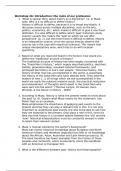
1. 'What is special then, about history as a discipline?' ( p. 1) Maza
asks. Why is it so difficult to define history?
History is difficult to define, because it is so broad and elastic. It
discusses issues across multiple disciplines, such as the arts,
politics, economics, etc., which makes it difficult to give it one fixed
definition. It is also difficult to define which 'past' historians study
exactly; usually this means the "past on which we can offer
perspective" (p. 1), but this time frame is difficult to define. History
is an interpretive science, since we cannot directly observe the
sources (as is the case with empirical sciences). This means that
unique interpretations arise, which has to do with location-
specificity.
2. Based on what you read and heard in the lecture, how would you
define the 'traditional' account of history?
The traditional account of history has been largely concerned with
the “Great Men’s History,” which largely described politics, sketched
battles, generated ideas, revealed national frameworks, and
portrayed the history of one’s own people. “Universal history, the
history of what man has accomplished in this world, is essentially
the history of the Great Men who have labored here. They were the
leaders of men […]; all things which we see accomplished in the
world are really the outward material result, the practical realization
and embodiment, of Thoughts which dwelt in the Great Men who
were sent into the world.” (Thomas Carlyle, On Heroes, Hero-
Worship, & the Heroic in History , 1840)
3. According to Maza, history is 'what the present needs to know about
the past' (p. 6). Explain what Maza means by this statement. Use
Pieter Geyl as an example.
Maza emphasizes the importance of applying past events to the
present and how they can play a relevant role in this: it is not only
important to understand past events, but also to be able to see how
they are essential to the present. Geyl plays a role in this, since his
idea was that history is a constant debate between the 'old' and the
'new': historical interpretations must be constantly revised in order
to retain their relevant context.
4. Maza 's manual colored by the author's background?
Maza has mainly historical knowledge about European and North
American history and therefore (logically) has little or no knowledge
about the African, Asian, Australian and Latin American past (p. 9).
The book therefore has fewer examples from the history of these
peoples and continents, which involuntarily colors the handbook
with an American or European tint.
5. What is the difference between past, history and historiography?
, The difference between the past, history and historiography is that
the past does not need to contain a relevant context: the 'past' can
also be one minute ago. History, on the other hand, needs a certain
context to contain 'usefulness' and there must also be enough space
in between to philosophize about or to be able to form perspectives.
Historiography (small) is the collection of everything that has been
written about one historical subject, for example the Vietnam War,
so much more precise than 'history' in general.
6. What is the use of studying historiography? Use Pieter Geyl as an
example.
By studying historiography, a subject remains alive, as Maza puts it:
otherwise it would remain a memory and slowly but surely fade into
the background. Geyl argues that by studying historiography, the
different points of view are addressed, which emphasizes once again
that there is no one 'correct' conclusion or truth to be tied to a
historical phenomenon; it only offers a new perspective.
Historiography is a never-ending discussion.
1. 'What is special then, about history as a discipline?' ( p. 1) Maza
asks. Why is it so difficult to define history?
History is difficult to define, because it is so broad and elastic. It
discusses issues across multiple disciplines, such as the arts,
politics, economics, etc., which makes it difficult to give it one fixed
definition. It is also difficult to define which 'past' historians study
exactly; usually this means the "past on which we can offer
perspective" (p. 1), but this time frame is difficult to define. History
is an interpretive science, since we cannot directly observe the
sources (as is the case with empirical sciences). This means that
unique interpretations arise, which has to do with location-
specificity.
2. Based on what you read and heard in the lecture, how would you
define the 'traditional' account of history?
The traditional account of history has been largely concerned with
the “Great Men’s History,” which largely described politics, sketched
battles, generated ideas, revealed national frameworks, and
portrayed the history of one’s own people. “Universal history, the
history of what man has accomplished in this world, is essentially
the history of the Great Men who have labored here. They were the
leaders of men […]; all things which we see accomplished in the
world are really the outward material result, the practical realization
and embodiment, of Thoughts which dwelt in the Great Men who
were sent into the world.” (Thomas Carlyle, On Heroes, Hero-
Worship, & the Heroic in History , 1840)
3. According to Maza, history is 'what the present needs to know about
the past' (p. 6). Explain what Maza means by this statement. Use
Pieter Geyl as an example.
Maza emphasizes the importance of applying past events to the
present and how they can play a relevant role in this: it is not only
important to understand past events, but also to be able to see how
they are essential to the present. Geyl plays a role in this, since his
idea was that history is a constant debate between the 'old' and the
'new': historical interpretations must be constantly revised in order
to retain their relevant context.
4. Maza 's manual colored by the author's background?
Maza has mainly historical knowledge about European and North
American history and therefore (logically) has little or no knowledge
about the African, Asian, Australian and Latin American past (p. 9).
The book therefore has fewer examples from the history of these
peoples and continents, which involuntarily colors the handbook
with an American or European tint.
5. What is the difference between past, history and historiography?
, The difference between the past, history and historiography is that
the past does not need to contain a relevant context: the 'past' can
also be one minute ago. History, on the other hand, needs a certain
context to contain 'usefulness' and there must also be enough space
in between to philosophize about or to be able to form perspectives.
Historiography (small) is the collection of everything that has been
written about one historical subject, for example the Vietnam War,
so much more precise than 'history' in general.
6. What is the use of studying historiography? Use Pieter Geyl as an
example.
By studying historiography, a subject remains alive, as Maza puts it:
otherwise it would remain a memory and slowly but surely fade into
the background. Geyl argues that by studying historiography, the
different points of view are addressed, which emphasizes once again
that there is no one 'correct' conclusion or truth to be tied to a
historical phenomenon; it only offers a new perspective.
Historiography is a never-ending discussion.