1
Vector Fields Along Curves
Given a curve, 𝛾(𝑡), on a smooth manifold 𝑀 and a vector 𝑉0 ∈ 𝑇𝛾(𝑡0 ) 𝑀 we
want to be able to say what it means to transport 𝑉0 in a “parallel” fashion along
the curve 𝛾(𝑡) to a vector 𝑉1 ∈ 𝑇𝛾(𝑡1 ) 𝑀. This notion of “parallel transport” will
become important when we discuss the Riemann curvature tensor on 𝑀. it’s also
important in the discussion of geodesic curves on a manifold.
Def. Let 𝑀 be a smooth manifold and 𝛾: 𝐼 → 𝑀 be a smooth curve in 𝑀
where 𝐼 is an interval in ℝ. We call 𝑉 a vector field along 𝜸 if for each
𝑡 ∈ 𝐼, 𝑉 (𝑡) ∈ 𝑇𝛾(𝑡) 𝑀 and 𝑉 defines a smooth map 𝐼 → 𝑇𝑀. We
denote the set of all smooth vector fields on 𝑀 along 𝛾 by 𝜒𝛾 (𝑀).
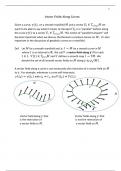
A vector field along a curve is not necessarily the restriction of a vector field on 𝑀
to 𝛾. For example, whenever a curve self-intersects:
𝛾 (𝑡0 ) = 𝛾(𝑡1 ) with 𝑡0 ≠ 𝑡1 , but 𝑉(𝑡0 ) ≠ 𝑉(𝑡1 ).
𝑀
𝛾
𝑀
𝛾
Vector field along 𝛾 that Vector fields along 𝛾 that
is the restriction of is not the restriction of
a vector field on 𝑀. a vector field on 𝑀.
, 2
We defined a connection on 𝑀 as a map, ∇: 𝜒(𝑀) × 𝜒(𝑀) → 𝜒(𝑀).
Now we want to define a map 𝐷𝑡 : 𝜒𝛾 (𝑀) → 𝜒𝛾 (𝑀).
Def. Let 𝑀 be a smooth manifold with a connection ∇ and 𝛾: 𝐼 → 𝑀 a smooth
curve on 𝑀, then the unique map 𝐷𝑡 : 𝜒𝛾 (𝑀) → 𝜒𝛾 (𝑀) such that:
1) 𝐷𝑡 (𝑉 + 𝑊 ) = 𝐷𝑡 (𝑉) + 𝐷𝑡 (𝑊 )
𝑑𝑓
2) 𝐷𝑡 (𝑓𝑉) = ( )𝑉 + (𝑓)(𝐷𝑡 (𝑉))
𝑑𝑡
3) If 𝑉 extends to a vector field 𝑌 ∈ 𝜒(𝑀), then 𝐷𝑡 (𝑉) = ∇𝛾′ (𝑡) (𝑌)
is called the covariant derivative along 𝜸.
If 𝐷𝑡 exists, we can use properties 1, 2, and 3 to find a formula for it. Let 𝑈 be a
coordinate patch on 𝑀 with coordinates (𝑥 1 , … , 𝑥 𝑛 ). For any 𝑉 ∈ 𝜒𝛾 (𝑀) we
can write:
𝜕
𝑉 = 𝑣 𝑖 𝜕𝑖 = 𝑣 𝑖 ; 𝑣𝑖 ∈ 𝐶∞ (𝐼).
𝜕𝑥 𝑖
By conditions 1 and 2:
𝑖 𝑖 𝑖 𝑖 𝑑𝑣 𝑖
𝐷𝑡 (𝑉) = 𝐷𝑡 (𝑣 𝜕𝑖 ) = 𝑣̇ 𝜕𝑖 + 𝑣 𝐷𝑡 (𝜕𝑖 ) where 𝑣̇ = .
𝑑𝑡
If we write 𝛾 (𝑡) = (𝛾 1 (𝑡), 𝛾 2 (𝑡), … , 𝛾 𝑛 (𝑡)), i.e., 𝑥 𝑗 = 𝛾 𝑗 (𝑡),
then:
𝑛
𝛾 ′ (𝑡) = ∑ 𝛾̇ 𝑗 𝜕𝑗 .
𝑗=1
By condition 3:
𝑛
𝐷𝑡 (𝜕𝑗 ) = ∇𝛾′ (𝑡) (𝜕𝑗 ) = ∑(𝛾̇ 𝑖 ) ∇𝜕𝑖 (𝜕𝑗 ) = 𝛾̇ 𝑖 (Γ𝑖𝑗𝑘 )(𝜕𝑘 ).
𝑖=1
, 3
Thus we have:
𝐷𝑡 (𝑉 ) = (𝑣̇ 𝑗 )𝜕𝑗 + (Γ𝑖𝑗𝑘 (𝛾̇ 𝑖 )(𝑣 𝑗 )𝜕𝑘 ) = (𝑣̇ 𝑘 + Γ𝑖𝑗𝑘 (𝛾̇ 𝑖 )(𝑣 𝑗 )) 𝜕𝑘 .
To show that 𝐷𝑡 exists, one can start with this formula and show it satisfies
conditions 1, 2, and 3.
Def. Let 𝑀 be a smooth manifold with a connection ∇ and let 𝛾: 𝐼 → 𝑀 be a
smooth curve on 𝑀. A vector field 𝑉 along 𝛾 is called parallel if 𝐷𝑡 (𝑉 ) = 0 for
all 𝑡 ∈ 𝐼.
Proposition: Let 𝑀 be a smooth manifold with a connection ∇ and let
𝛾: 𝐼 → 𝑀 be a smooth curve on 𝑀, where 𝐼 is a
compact (i.e. closed and bounded) interval of ℝ.
Let 𝑡0 ∈ 𝐼, set 𝑝 = 𝛾 (𝑡0 ), and let 𝑉0 be any vector in 𝑇𝑝 𝑀.
There exists a unique vector field of 𝑀 along 𝛾 that is parallel and
has 𝑉 (𝑡0 ) = 𝑉0 .
𝑀
𝑉0
𝛾
𝑝
In this case, we are parallel transporting the vector 𝑉0 along 𝛾. That is, 𝑉 (𝑡) is
the parallel transport of 𝑉0 along 𝛾. The existence and uniqueness of this vector
field along 𝛾 comes from the existence of a unique solution to a system of
differential equations. Specifically, if 𝑉 (𝑡) = (𝑣 1 (𝑡), … , 𝑣 𝑛 (𝑡)), then we need
to show there is a unique 𝑉 (𝑡) such that:
𝑣̇ 𝑘 + Γ𝑘𝑖𝑗 𝛾̇ 𝑖 𝑣𝑗 = 0 for 𝑘 = 1, … , 𝑛 with 𝑉 (𝑡0 ) = (𝑣 1 (𝑡0 ), … , 𝑣 𝑛 (𝑡0 ))
This comes from a theorem in differential equations.
Vector Fields Along Curves
Given a curve, 𝛾(𝑡), on a smooth manifold 𝑀 and a vector 𝑉0 ∈ 𝑇𝛾(𝑡0 ) 𝑀 we
want to be able to say what it means to transport 𝑉0 in a “parallel” fashion along
the curve 𝛾(𝑡) to a vector 𝑉1 ∈ 𝑇𝛾(𝑡1 ) 𝑀. This notion of “parallel transport” will
become important when we discuss the Riemann curvature tensor on 𝑀. it’s also
important in the discussion of geodesic curves on a manifold.
Def. Let 𝑀 be a smooth manifold and 𝛾: 𝐼 → 𝑀 be a smooth curve in 𝑀
where 𝐼 is an interval in ℝ. We call 𝑉 a vector field along 𝜸 if for each
𝑡 ∈ 𝐼, 𝑉 (𝑡) ∈ 𝑇𝛾(𝑡) 𝑀 and 𝑉 defines a smooth map 𝐼 → 𝑇𝑀. We
denote the set of all smooth vector fields on 𝑀 along 𝛾 by 𝜒𝛾 (𝑀).
A vector field along a curve is not necessarily the restriction of a vector field on 𝑀
to 𝛾. For example, whenever a curve self-intersects:
𝛾 (𝑡0 ) = 𝛾(𝑡1 ) with 𝑡0 ≠ 𝑡1 , but 𝑉(𝑡0 ) ≠ 𝑉(𝑡1 ).
𝑀
𝛾
𝑀
𝛾
Vector field along 𝛾 that Vector fields along 𝛾 that
is the restriction of is not the restriction of
a vector field on 𝑀. a vector field on 𝑀.
, 2
We defined a connection on 𝑀 as a map, ∇: 𝜒(𝑀) × 𝜒(𝑀) → 𝜒(𝑀).
Now we want to define a map 𝐷𝑡 : 𝜒𝛾 (𝑀) → 𝜒𝛾 (𝑀).
Def. Let 𝑀 be a smooth manifold with a connection ∇ and 𝛾: 𝐼 → 𝑀 a smooth
curve on 𝑀, then the unique map 𝐷𝑡 : 𝜒𝛾 (𝑀) → 𝜒𝛾 (𝑀) such that:
1) 𝐷𝑡 (𝑉 + 𝑊 ) = 𝐷𝑡 (𝑉) + 𝐷𝑡 (𝑊 )
𝑑𝑓
2) 𝐷𝑡 (𝑓𝑉) = ( )𝑉 + (𝑓)(𝐷𝑡 (𝑉))
𝑑𝑡
3) If 𝑉 extends to a vector field 𝑌 ∈ 𝜒(𝑀), then 𝐷𝑡 (𝑉) = ∇𝛾′ (𝑡) (𝑌)
is called the covariant derivative along 𝜸.
If 𝐷𝑡 exists, we can use properties 1, 2, and 3 to find a formula for it. Let 𝑈 be a
coordinate patch on 𝑀 with coordinates (𝑥 1 , … , 𝑥 𝑛 ). For any 𝑉 ∈ 𝜒𝛾 (𝑀) we
can write:
𝜕
𝑉 = 𝑣 𝑖 𝜕𝑖 = 𝑣 𝑖 ; 𝑣𝑖 ∈ 𝐶∞ (𝐼).
𝜕𝑥 𝑖
By conditions 1 and 2:
𝑖 𝑖 𝑖 𝑖 𝑑𝑣 𝑖
𝐷𝑡 (𝑉) = 𝐷𝑡 (𝑣 𝜕𝑖 ) = 𝑣̇ 𝜕𝑖 + 𝑣 𝐷𝑡 (𝜕𝑖 ) where 𝑣̇ = .
𝑑𝑡
If we write 𝛾 (𝑡) = (𝛾 1 (𝑡), 𝛾 2 (𝑡), … , 𝛾 𝑛 (𝑡)), i.e., 𝑥 𝑗 = 𝛾 𝑗 (𝑡),
then:
𝑛
𝛾 ′ (𝑡) = ∑ 𝛾̇ 𝑗 𝜕𝑗 .
𝑗=1
By condition 3:
𝑛
𝐷𝑡 (𝜕𝑗 ) = ∇𝛾′ (𝑡) (𝜕𝑗 ) = ∑(𝛾̇ 𝑖 ) ∇𝜕𝑖 (𝜕𝑗 ) = 𝛾̇ 𝑖 (Γ𝑖𝑗𝑘 )(𝜕𝑘 ).
𝑖=1
, 3
Thus we have:
𝐷𝑡 (𝑉 ) = (𝑣̇ 𝑗 )𝜕𝑗 + (Γ𝑖𝑗𝑘 (𝛾̇ 𝑖 )(𝑣 𝑗 )𝜕𝑘 ) = (𝑣̇ 𝑘 + Γ𝑖𝑗𝑘 (𝛾̇ 𝑖 )(𝑣 𝑗 )) 𝜕𝑘 .
To show that 𝐷𝑡 exists, one can start with this formula and show it satisfies
conditions 1, 2, and 3.
Def. Let 𝑀 be a smooth manifold with a connection ∇ and let 𝛾: 𝐼 → 𝑀 be a
smooth curve on 𝑀. A vector field 𝑉 along 𝛾 is called parallel if 𝐷𝑡 (𝑉 ) = 0 for
all 𝑡 ∈ 𝐼.
Proposition: Let 𝑀 be a smooth manifold with a connection ∇ and let
𝛾: 𝐼 → 𝑀 be a smooth curve on 𝑀, where 𝐼 is a
compact (i.e. closed and bounded) interval of ℝ.
Let 𝑡0 ∈ 𝐼, set 𝑝 = 𝛾 (𝑡0 ), and let 𝑉0 be any vector in 𝑇𝑝 𝑀.
There exists a unique vector field of 𝑀 along 𝛾 that is parallel and
has 𝑉 (𝑡0 ) = 𝑉0 .
𝑀
𝑉0
𝛾
𝑝
In this case, we are parallel transporting the vector 𝑉0 along 𝛾. That is, 𝑉 (𝑡) is
the parallel transport of 𝑉0 along 𝛾. The existence and uniqueness of this vector
field along 𝛾 comes from the existence of a unique solution to a system of
differential equations. Specifically, if 𝑉 (𝑡) = (𝑣 1 (𝑡), … , 𝑣 𝑛 (𝑡)), then we need
to show there is a unique 𝑉 (𝑡) such that:
𝑣̇ 𝑘 + Γ𝑘𝑖𝑗 𝛾̇ 𝑖 𝑣𝑗 = 0 for 𝑘 = 1, … , 𝑛 with 𝑉 (𝑡0 ) = (𝑣 1 (𝑡0 ), … , 𝑣 𝑛 (𝑡0 ))
This comes from a theorem in differential equations.