1
The Curvature Tensor
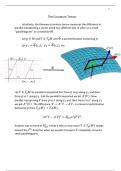
Intuitively, the Riemann curvature tensor measures the difference in
parallel transporting a vector along two different sets of sides on a small
“parallelogram” on a manifold 𝑀.
⃗⃗⃗ a parametrization containing 𝑝.
Let 𝑝 ∈ 𝑀 and 𝑉 ∈ 𝑇𝑝 𝑀 and Φ
Let 𝛾1 = ⃗Φ
⃗⃗ (𝑐1 ), 𝛾2 = ⃗Φ
⃗⃗ (𝑐2 ), etc.
𝐴′′(𝑉)
𝐴′(𝑉)
𝛾3 𝑟
(𝛽1 , … , 𝛽𝑛 ) 𝑐3 𝑠
𝛾4 𝛾2
𝑐4 ⃗Φ
⃗⃗ 𝛾1 𝑞
𝑐2
𝑝
𝑐1
𝑉
(𝛼1 , … , 𝛼𝑛 )
Let 𝑉 ∈ 𝑇𝑝 𝑀 be parallel transported first from 𝑝 to 𝑞 along 𝛾1 and then
from 𝑞 to 𝑟 along 𝛾2 . Call the parallel transported vector 𝐴′ (𝑉 ). Now
parallel transporting 𝑉 from 𝑝 to 𝑠 along 𝛾4 and then from 𝑠 to 𝑟 along 𝛾3
we get 𝐴′′ (𝑉 ). The difference, 𝑉 → 𝐴′′ 𝑉 − 𝐴′ 𝑉, is a linear transformation
defined at 𝑝 from 𝑇𝑝 (𝑀 ) → 𝑇𝑟 (𝑀).
𝑖
(𝐴′′ 𝑉 − 𝐴′ 𝑉)𝑖 = 𝑅𝑗𝑘𝑙 𝛼 𝑗 𝛽𝑘 𝑉 𝑙 .
𝑖
Another way to think of 𝑅𝑗𝑘𝑙 is that it tells us how much 𝑉 ∈ 𝑇𝑝 (𝑀) swings
toward the 𝑖 𝑡ℎ direction when we parallel transport 𝑉 completely around a
small parallelogram.
, 2
Let (𝑀, 𝑔) be a Riemannian manifold.
𝑖
Def. The Riemann curvature tensor, 𝑅𝑗𝑘𝑙 , on a coordinate patch,
𝑖 𝑖 𝑖
𝑈 ⊆ 𝑀, is defined by: 𝑋;𝑘;𝑗 − 𝑋;𝑗;𝑘 = 𝑅𝑗𝑘𝑙 𝑋 𝑙 where 𝑋 is a vector field
over 𝑈.
Proposition:
𝑖 𝜕Γ𝑖𝑙𝑘 𝜕Γ𝑖𝑙𝑗 𝑖 ℎ
𝑅𝑗𝑘𝑙 = − 𝜕𝑥 𝑘 + Γℎ𝑗 𝑖
Γ𝑙𝑘 − Γℎ𝑘 Γ𝑙𝑗ℎ .
𝜕𝑥 𝑗
𝑖 𝑖
This formula follows from a direct calculation of 𝑋;𝑘;𝑗 − 𝑋;𝑗;𝑘
𝑖 𝜕𝑋 𝑖 𝑖 𝑙
starting with 𝑋;𝑗 = 𝑗 + Γ𝑙𝑗 𝑋.
𝜕𝑥
𝑖 𝜕 𝜕𝑋 𝑖
𝑋;𝑗;𝑘 = 𝜕𝑥 𝑘 (𝜕𝑥 𝑗 + Γ𝑙𝑗𝑖 𝑋 𝑙 ) + Γ𝑚𝑘
𝑖
𝑋;𝑗𝑚 − Γ𝑗𝑘
ℎ 𝑖
𝑋;ℎ
𝜕2 𝑋 𝑖 𝜕Γ𝑖𝑗𝑙 𝜕𝑋 𝑙
= 𝜕𝑥 𝑘 𝜕𝑥 𝑗 + 𝜕𝑥 𝑘 𝑋 𝑙 + Γ𝑙𝑗𝑖 𝜕𝑥 𝑘
𝜕𝑋 𝑚 𝜕𝑋 𝑖
𝑖
+Γ𝑚𝑘 ( 𝜕𝑥 𝑗 + Γ𝑙𝑗𝑚 𝑋 𝑙 ) − ℎ
Γ𝑗𝑘 𝑖 𝑙
(𝜕𝑥 ℎ + Γ𝑙ℎ 𝑋 ).
𝑖
Now calculate 𝑋;𝑘;𝑗 and subtract.
, 3
𝑖
Proposition: 𝑅𝑗𝑘𝑙 is a tensor of type (1, 3).
𝑖
Idea of proof: This follows from the transformation properties of Γ𝑗𝑘 .
Proposition: On a Riemannian manifold, the curvature tensor satisfies
𝑖 𝑖 𝑖
𝑅𝑗𝑘𝑙 + 𝑅𝑘𝑙𝑗 + 𝑅𝑙𝑗𝑘 =0
𝑖 𝑖 𝑖
𝑅𝑗𝑘𝑙;ℎ + 𝑅𝑗𝑙ℎ;𝑘 + 𝑅𝑗ℎ𝑘;𝑙 =0.
These are called Bianchi identities.
𝑖
Notice that from the definition of 𝑅𝑗𝑘𝑙 we have the following relationship:
𝑖 𝑖
𝑅𝑗𝑘𝑙 = −𝑅𝑘𝑗𝑙 .
𝑖 𝑖 𝑖
In particular if 𝑗 = 𝑘, then we have: 𝑅𝑗𝑗𝑙 = −𝑅𝑗𝑗𝑙 ⟹ 𝑅𝑗𝑗𝑙 = 0.
𝑖
By contracting the metric tensor 𝑔𝑖𝑚 with 𝑅𝑗𝑘𝑙 we get a (0, 4) tensor:
𝑖
𝑅𝑗𝑘𝑙𝑚 = 𝑔𝑖𝑚 𝑅𝑗𝑘𝑙 .
Def. 𝑅𝑗𝑘𝑙𝑚 is called the Riemann covariant curvature tensor.
The Curvature Tensor
Intuitively, the Riemann curvature tensor measures the difference in
parallel transporting a vector along two different sets of sides on a small
“parallelogram” on a manifold 𝑀.
⃗⃗⃗ a parametrization containing 𝑝.
Let 𝑝 ∈ 𝑀 and 𝑉 ∈ 𝑇𝑝 𝑀 and Φ
Let 𝛾1 = ⃗Φ
⃗⃗ (𝑐1 ), 𝛾2 = ⃗Φ
⃗⃗ (𝑐2 ), etc.
𝐴′′(𝑉)
𝐴′(𝑉)
𝛾3 𝑟
(𝛽1 , … , 𝛽𝑛 ) 𝑐3 𝑠
𝛾4 𝛾2
𝑐4 ⃗Φ
⃗⃗ 𝛾1 𝑞
𝑐2
𝑝
𝑐1
𝑉
(𝛼1 , … , 𝛼𝑛 )
Let 𝑉 ∈ 𝑇𝑝 𝑀 be parallel transported first from 𝑝 to 𝑞 along 𝛾1 and then
from 𝑞 to 𝑟 along 𝛾2 . Call the parallel transported vector 𝐴′ (𝑉 ). Now
parallel transporting 𝑉 from 𝑝 to 𝑠 along 𝛾4 and then from 𝑠 to 𝑟 along 𝛾3
we get 𝐴′′ (𝑉 ). The difference, 𝑉 → 𝐴′′ 𝑉 − 𝐴′ 𝑉, is a linear transformation
defined at 𝑝 from 𝑇𝑝 (𝑀 ) → 𝑇𝑟 (𝑀).
𝑖
(𝐴′′ 𝑉 − 𝐴′ 𝑉)𝑖 = 𝑅𝑗𝑘𝑙 𝛼 𝑗 𝛽𝑘 𝑉 𝑙 .
𝑖
Another way to think of 𝑅𝑗𝑘𝑙 is that it tells us how much 𝑉 ∈ 𝑇𝑝 (𝑀) swings
toward the 𝑖 𝑡ℎ direction when we parallel transport 𝑉 completely around a
small parallelogram.
, 2
Let (𝑀, 𝑔) be a Riemannian manifold.
𝑖
Def. The Riemann curvature tensor, 𝑅𝑗𝑘𝑙 , on a coordinate patch,
𝑖 𝑖 𝑖
𝑈 ⊆ 𝑀, is defined by: 𝑋;𝑘;𝑗 − 𝑋;𝑗;𝑘 = 𝑅𝑗𝑘𝑙 𝑋 𝑙 where 𝑋 is a vector field
over 𝑈.
Proposition:
𝑖 𝜕Γ𝑖𝑙𝑘 𝜕Γ𝑖𝑙𝑗 𝑖 ℎ
𝑅𝑗𝑘𝑙 = − 𝜕𝑥 𝑘 + Γℎ𝑗 𝑖
Γ𝑙𝑘 − Γℎ𝑘 Γ𝑙𝑗ℎ .
𝜕𝑥 𝑗
𝑖 𝑖
This formula follows from a direct calculation of 𝑋;𝑘;𝑗 − 𝑋;𝑗;𝑘
𝑖 𝜕𝑋 𝑖 𝑖 𝑙
starting with 𝑋;𝑗 = 𝑗 + Γ𝑙𝑗 𝑋.
𝜕𝑥
𝑖 𝜕 𝜕𝑋 𝑖
𝑋;𝑗;𝑘 = 𝜕𝑥 𝑘 (𝜕𝑥 𝑗 + Γ𝑙𝑗𝑖 𝑋 𝑙 ) + Γ𝑚𝑘
𝑖
𝑋;𝑗𝑚 − Γ𝑗𝑘
ℎ 𝑖
𝑋;ℎ
𝜕2 𝑋 𝑖 𝜕Γ𝑖𝑗𝑙 𝜕𝑋 𝑙
= 𝜕𝑥 𝑘 𝜕𝑥 𝑗 + 𝜕𝑥 𝑘 𝑋 𝑙 + Γ𝑙𝑗𝑖 𝜕𝑥 𝑘
𝜕𝑋 𝑚 𝜕𝑋 𝑖
𝑖
+Γ𝑚𝑘 ( 𝜕𝑥 𝑗 + Γ𝑙𝑗𝑚 𝑋 𝑙 ) − ℎ
Γ𝑗𝑘 𝑖 𝑙
(𝜕𝑥 ℎ + Γ𝑙ℎ 𝑋 ).
𝑖
Now calculate 𝑋;𝑘;𝑗 and subtract.
, 3
𝑖
Proposition: 𝑅𝑗𝑘𝑙 is a tensor of type (1, 3).
𝑖
Idea of proof: This follows from the transformation properties of Γ𝑗𝑘 .
Proposition: On a Riemannian manifold, the curvature tensor satisfies
𝑖 𝑖 𝑖
𝑅𝑗𝑘𝑙 + 𝑅𝑘𝑙𝑗 + 𝑅𝑙𝑗𝑘 =0
𝑖 𝑖 𝑖
𝑅𝑗𝑘𝑙;ℎ + 𝑅𝑗𝑙ℎ;𝑘 + 𝑅𝑗ℎ𝑘;𝑙 =0.
These are called Bianchi identities.
𝑖
Notice that from the definition of 𝑅𝑗𝑘𝑙 we have the following relationship:
𝑖 𝑖
𝑅𝑗𝑘𝑙 = −𝑅𝑘𝑗𝑙 .
𝑖 𝑖 𝑖
In particular if 𝑗 = 𝑘, then we have: 𝑅𝑗𝑗𝑙 = −𝑅𝑗𝑗𝑙 ⟹ 𝑅𝑗𝑗𝑙 = 0.
𝑖
By contracting the metric tensor 𝑔𝑖𝑚 with 𝑅𝑗𝑘𝑙 we get a (0, 4) tensor:
𝑖
𝑅𝑗𝑘𝑙𝑚 = 𝑔𝑖𝑚 𝑅𝑗𝑘𝑙 .
Def. 𝑅𝑗𝑘𝑙𝑚 is called the Riemann covariant curvature tensor.