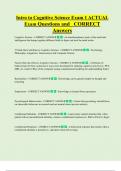
Intro to Cognitive Science Exam 1 ACTUAL
Exam Questions and CORRECT
Answers
Cognitive Science - CORRECT ANSWER - An interdisciplinary study of the mind and
intelligence that brings together different fields to figure out how the mind works
5 Fields that Contribute to Cognitive Science - CORRECT ANSWER - Psychology,
Philosophy, Linguistics, Neuroscience and Computer Science
Factors that Gave Rise to Cognitive Science - CORRECT ANSWER - (1) Demise of
behaviorism (2) New, noninvasive ways were developed for studying cognitive activity (ex. PET,
MRI, etc.) and (3) Rise of the computer (using computational modeling for understanding brain)
Rationalism - CORRECT ANSWER - Knowledge can be gained simply by thought and
reasoning
Empiricism - CORRECT ANSWER - Knowledge is learned from experience
Psychological Behaviorism - CORRECT ANSWER - Claims that psychology should focus
on observable behaviors in research and not mental states (private entities)
Conditioned Stimulus - CORRECT ANSWER - A previously neutral stimulus that, when
paired with an unconditioned stimulus, creates a conditioned response (ex. Bell in Pavlov's dogs)
Conditioned Response - CORRECT ANSWER - A behavioral response that results when a
conditioned stimulus is present (ex. salivation when bell is rung)
, How behaviorism explains learning - CORRECT ANSWER - All learning takes place
through conditioning of a desired behavior and reinforcement of that behavior when its
performed
Demise of Behaviorism - CORRECT ANSWER - Tolman's rats experiment
Details of Tolman's rats experiment - CORRECT ANSWER - Behaviorists Tolman and
Honzik tested rats' navigation of mazes (three groups) Group 1 given continuous reward for
positive behavior, Group 2 never rewarded, Group 3 not rewarded for first 10 days but rewarded
thereafter; Group 3 learned to navigate once rewarded, but learned faster than group 1- results
showed that rats are capable of latent learning and reinforcement is not required for learning
Latent Learning - CORRECT ANSWER - The ability to store information for later use
without any process of reinforcement
CRUM - CORRECT ANSWER - Computational-representational understanding of the
mind; central hypothesis of cognitive science
Concepts of CRUM - CORRECT ANSWER - Thinking is best understood in terms of
representational structures in the mind and computational procedures that operate on those
structures (representation + computation = thought); All other views of thought are examples of
CRUM
Behaviorist View of Language Acquisition - CORRECT ANSWER - Children learn
language by being positively reinforced when they produce correct verbal expression and
negatively reinforced when they produce errors. Process is repeated over time, and children learn
to produce complex words and sentences
Arguments Against Behaviorist View of Language Acquisition - CORRECT ANSWER -
Language is learned (1) without explicit teaching (2) language is learned under varying
circumstances and (3) in a limited amount of time; children are not always corrected on grammar
errors and when they are, it has no apparent effect,
Exam Questions and CORRECT
Answers
Cognitive Science - CORRECT ANSWER - An interdisciplinary study of the mind and
intelligence that brings together different fields to figure out how the mind works
5 Fields that Contribute to Cognitive Science - CORRECT ANSWER - Psychology,
Philosophy, Linguistics, Neuroscience and Computer Science
Factors that Gave Rise to Cognitive Science - CORRECT ANSWER - (1) Demise of
behaviorism (2) New, noninvasive ways were developed for studying cognitive activity (ex. PET,
MRI, etc.) and (3) Rise of the computer (using computational modeling for understanding brain)
Rationalism - CORRECT ANSWER - Knowledge can be gained simply by thought and
reasoning
Empiricism - CORRECT ANSWER - Knowledge is learned from experience
Psychological Behaviorism - CORRECT ANSWER - Claims that psychology should focus
on observable behaviors in research and not mental states (private entities)
Conditioned Stimulus - CORRECT ANSWER - A previously neutral stimulus that, when
paired with an unconditioned stimulus, creates a conditioned response (ex. Bell in Pavlov's dogs)
Conditioned Response - CORRECT ANSWER - A behavioral response that results when a
conditioned stimulus is present (ex. salivation when bell is rung)
, How behaviorism explains learning - CORRECT ANSWER - All learning takes place
through conditioning of a desired behavior and reinforcement of that behavior when its
performed
Demise of Behaviorism - CORRECT ANSWER - Tolman's rats experiment
Details of Tolman's rats experiment - CORRECT ANSWER - Behaviorists Tolman and
Honzik tested rats' navigation of mazes (three groups) Group 1 given continuous reward for
positive behavior, Group 2 never rewarded, Group 3 not rewarded for first 10 days but rewarded
thereafter; Group 3 learned to navigate once rewarded, but learned faster than group 1- results
showed that rats are capable of latent learning and reinforcement is not required for learning
Latent Learning - CORRECT ANSWER - The ability to store information for later use
without any process of reinforcement
CRUM - CORRECT ANSWER - Computational-representational understanding of the
mind; central hypothesis of cognitive science
Concepts of CRUM - CORRECT ANSWER - Thinking is best understood in terms of
representational structures in the mind and computational procedures that operate on those
structures (representation + computation = thought); All other views of thought are examples of
CRUM
Behaviorist View of Language Acquisition - CORRECT ANSWER - Children learn
language by being positively reinforced when they produce correct verbal expression and
negatively reinforced when they produce errors. Process is repeated over time, and children learn
to produce complex words and sentences
Arguments Against Behaviorist View of Language Acquisition - CORRECT ANSWER -
Language is learned (1) without explicit teaching (2) language is learned under varying
circumstances and (3) in a limited amount of time; children are not always corrected on grammar
errors and when they are, it has no apparent effect,