1
Complete Metric Spaces
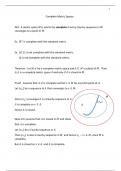
Def. A metric space 𝑀 is said to be complete if every Cauchy sequence in 𝑀
converges to a point in 𝑀.
Ex. ℝ𝑛 is complete with the standard metric
Ex. (0,1) is not complete with the standard metric.
ℚ is not complete with the standard metric.
Theorem: Let 𝑀, 𝑑 be a complete metric space and 𝐴 ⊆ 𝑀 a subset of 𝑀. Then
𝐴, 𝑑 is a complete metric space if and only if 𝐴 is closed in 𝑀.
Proof. Assume that 𝐴, 𝑑 is complete and let 𝑥 ∈ 𝑀 be any limit point of 𝐴.
Let {𝑥𝑛 } be a sequence in 𝐴 that converges to 𝑥 ∈ 𝑀.
𝑀
Since {𝑥𝑛 } converges it is a Cauchy sequence in 𝐴.
{𝑥𝑛 }
𝐴 is complete so 𝑥 ∈ 𝐴. 𝐴
Hence 𝐴 is closed.
Now let’s assume that 𝐴 is closed in 𝑀 and show
that 𝐴 is complete.
Let {𝑥𝑛 } be a Cauchy sequence in 𝐴.
Then {𝑥𝑛 } is also a Cauchy sequence in 𝑀, and hence 𝑥𝑛 → 𝑥 ∈ 𝑀, since 𝑀 is
complete.
But 𝐴 is closed so 𝑥 ∈ 𝐴, and 𝐴 is complete.
, 2
Ex. [0,1], [0, ∞), ℤ, and [1,5] ∪ {16} are all complete metric spaces with the
standard metric on ℝ.
Notice that if 𝑀 is complete and totally bounded then every totally bounded
sequence in 𝑀 has a convergent subsequence.
In particular, any closed, bounded subset of ℝ (i.e. compact subsets of ℝ) is both
complete and totally bounded. Thus, for example, every sequence in [𝑎, 𝑏] has a
convergent subsequence.
How you measure distances can determine whether a metric space is complete.
For example, you can have two metric spaces with the same underlying points but
one is complete and the other isn’t.
Ex. Let 𝑀1 = [1, ∞) with 𝑑1 (𝑥, 𝑦) = |𝑥 − 𝑦|
1 1
𝑀2 = [1, ∞) with 𝑑2 (𝑥, 𝑦) = | 𝑥 − 𝑦 | .
The sequence {1,2,3,4, … } is a Cauchy sequence in 𝑀2 (but not in 𝑀1 ), but doesn’t
converge in 𝑀2.
Thus 𝑀1 is a complete metric space (a closed subset of ℝ with the standard
metric), but 𝑀2 is not complete because it has a Cauchy sequence that does not
converge in 𝑀2.
Complete Metric Spaces
Def. A metric space 𝑀 is said to be complete if every Cauchy sequence in 𝑀
converges to a point in 𝑀.
Ex. ℝ𝑛 is complete with the standard metric
Ex. (0,1) is not complete with the standard metric.
ℚ is not complete with the standard metric.
Theorem: Let 𝑀, 𝑑 be a complete metric space and 𝐴 ⊆ 𝑀 a subset of 𝑀. Then
𝐴, 𝑑 is a complete metric space if and only if 𝐴 is closed in 𝑀.
Proof. Assume that 𝐴, 𝑑 is complete and let 𝑥 ∈ 𝑀 be any limit point of 𝐴.
Let {𝑥𝑛 } be a sequence in 𝐴 that converges to 𝑥 ∈ 𝑀.
𝑀
Since {𝑥𝑛 } converges it is a Cauchy sequence in 𝐴.
{𝑥𝑛 }
𝐴 is complete so 𝑥 ∈ 𝐴. 𝐴
Hence 𝐴 is closed.
Now let’s assume that 𝐴 is closed in 𝑀 and show
that 𝐴 is complete.
Let {𝑥𝑛 } be a Cauchy sequence in 𝐴.
Then {𝑥𝑛 } is also a Cauchy sequence in 𝑀, and hence 𝑥𝑛 → 𝑥 ∈ 𝑀, since 𝑀 is
complete.
But 𝐴 is closed so 𝑥 ∈ 𝐴, and 𝐴 is complete.
, 2
Ex. [0,1], [0, ∞), ℤ, and [1,5] ∪ {16} are all complete metric spaces with the
standard metric on ℝ.
Notice that if 𝑀 is complete and totally bounded then every totally bounded
sequence in 𝑀 has a convergent subsequence.
In particular, any closed, bounded subset of ℝ (i.e. compact subsets of ℝ) is both
complete and totally bounded. Thus, for example, every sequence in [𝑎, 𝑏] has a
convergent subsequence.
How you measure distances can determine whether a metric space is complete.
For example, you can have two metric spaces with the same underlying points but
one is complete and the other isn’t.
Ex. Let 𝑀1 = [1, ∞) with 𝑑1 (𝑥, 𝑦) = |𝑥 − 𝑦|
1 1
𝑀2 = [1, ∞) with 𝑑2 (𝑥, 𝑦) = | 𝑥 − 𝑦 | .
The sequence {1,2,3,4, … } is a Cauchy sequence in 𝑀2 (but not in 𝑀1 ), but doesn’t
converge in 𝑀2.
Thus 𝑀1 is a complete metric space (a closed subset of ℝ with the standard
metric), but 𝑀2 is not complete because it has a Cauchy sequence that does not
converge in 𝑀2.