1
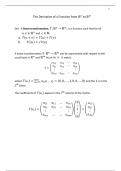
The Derivative of a Function from ℝ𝑛 to ℝ𝑚
Def. A linear transformation, 𝑇: ℝ𝑛 → ℝ𝑚 , is a function such that for all
𝑢, 𝑣 ∈ ℝ𝑛 and 𝑐 ∈ ℝ:
a. 𝑇(𝑢 + 𝑣 ) = 𝑇 (𝑢) + 𝑇(𝑣)
b. 𝑇(𝑐𝑢) = 𝑐𝑇(𝑢)
A linear transformation 𝑇: ℝ𝑛 → ℝ𝑚 can be represented with respect to the
usual basis in ℝ𝑛 and ℝ𝑚 by an 𝑚 × 𝑛 matrix.
𝑎11 𝑎12 ⋯ 𝑎1𝑛
𝑎21 𝑎22 ⋯ 𝑎2𝑛
𝑇=( ⋮ )
⋮ ⋮
𝑎𝑚1 𝑎𝑚2 ⋯ 𝑎𝑚𝑛
where 𝑇(𝑒𝑖 ) = ∑𝑚
𝑗=1 𝑎𝑗𝑖 𝑒𝑗 , 𝑒𝑗 = (0, 0, … , 1, 0, 0, … ,0) and the 1 is in the
𝑗𝑡ℎ place.
The coefficients of 𝑇(𝑒𝑖 ) appear in the 𝑖 𝑡ℎ column of the matrix.
𝑎11 𝑎12 … 𝑎1𝑛 0 𝑎1𝑖
𝑎21 𝑎22 … 𝑎2𝑛 ⋮ 𝑎2𝑖
𝑇(𝑒𝑖 ) = ( ⋮ ) 1 = ( ⋮ ).
⋮
𝑎𝑚1 … … 𝑎𝑚𝑛 ⋮ 𝑎𝑚𝑖
0
( )
, 2
Ex. Let 𝑇: ℝ2 → ℝ4 and 𝑆: ℝ4 → ℝ3 be linear transformations. Suppose:
𝑇(1, 0) = (0, 2, 3, 1) 𝑆(1, 0, 0, 0) = (1, 2, 3)
𝑇(0, 1) = (2, −1, −1, 2) 𝑆(0, 1, 0, 0) = (−1, 3, 1)
𝑆(0, 0, 1, 0) = (2, 3, 1)
𝑆(0, 0, 0, 1) = (0, 1, 2).
Find a matrix representation of 𝑆 and 𝑇 with respect to the standard basis, then
find a matrix representation of 𝑆 ∘ 𝑇: ℝ2 → ℝ3 .
0 2
1 −1 2 0
2 −1
𝑇=( ); 𝑆 = (2 3 3 1).
3 −1
3 1 1 2
1 2
The matrix representation of the composition, 𝑆 ∘ 𝑇, is gotten by matrix
multiplication.
0 2
1 −1 2 0 4 1
2 −1
𝑆 ∘ 𝑇 = (2 3 3 1 ) ( ) = (16 0).
3 −1
3 1 1 2 7 8
1 2
The Derivative of a Function from ℝ𝑛 to ℝ𝑚
Def. A linear transformation, 𝑇: ℝ𝑛 → ℝ𝑚 , is a function such that for all
𝑢, 𝑣 ∈ ℝ𝑛 and 𝑐 ∈ ℝ:
a. 𝑇(𝑢 + 𝑣 ) = 𝑇 (𝑢) + 𝑇(𝑣)
b. 𝑇(𝑐𝑢) = 𝑐𝑇(𝑢)
A linear transformation 𝑇: ℝ𝑛 → ℝ𝑚 can be represented with respect to the
usual basis in ℝ𝑛 and ℝ𝑚 by an 𝑚 × 𝑛 matrix.
𝑎11 𝑎12 ⋯ 𝑎1𝑛
𝑎21 𝑎22 ⋯ 𝑎2𝑛
𝑇=( ⋮ )
⋮ ⋮
𝑎𝑚1 𝑎𝑚2 ⋯ 𝑎𝑚𝑛
where 𝑇(𝑒𝑖 ) = ∑𝑚
𝑗=1 𝑎𝑗𝑖 𝑒𝑗 , 𝑒𝑗 = (0, 0, … , 1, 0, 0, … ,0) and the 1 is in the
𝑗𝑡ℎ place.
The coefficients of 𝑇(𝑒𝑖 ) appear in the 𝑖 𝑡ℎ column of the matrix.
𝑎11 𝑎12 … 𝑎1𝑛 0 𝑎1𝑖
𝑎21 𝑎22 … 𝑎2𝑛 ⋮ 𝑎2𝑖
𝑇(𝑒𝑖 ) = ( ⋮ ) 1 = ( ⋮ ).
⋮
𝑎𝑚1 … … 𝑎𝑚𝑛 ⋮ 𝑎𝑚𝑖
0
( )
, 2
Ex. Let 𝑇: ℝ2 → ℝ4 and 𝑆: ℝ4 → ℝ3 be linear transformations. Suppose:
𝑇(1, 0) = (0, 2, 3, 1) 𝑆(1, 0, 0, 0) = (1, 2, 3)
𝑇(0, 1) = (2, −1, −1, 2) 𝑆(0, 1, 0, 0) = (−1, 3, 1)
𝑆(0, 0, 1, 0) = (2, 3, 1)
𝑆(0, 0, 0, 1) = (0, 1, 2).
Find a matrix representation of 𝑆 and 𝑇 with respect to the standard basis, then
find a matrix representation of 𝑆 ∘ 𝑇: ℝ2 → ℝ3 .
0 2
1 −1 2 0
2 −1
𝑇=( ); 𝑆 = (2 3 3 1).
3 −1
3 1 1 2
1 2
The matrix representation of the composition, 𝑆 ∘ 𝑇, is gotten by matrix
multiplication.
0 2
1 −1 2 0 4 1
2 −1
𝑆 ∘ 𝑇 = (2 3 3 1 ) ( ) = (16 0).
3 −1
3 1 1 2 7 8
1 2