1
Partial Derivatives and Derivatives
Let 𝑓: ℝ𝑛 → ℝ and 𝑎 ∈ ℝ𝑛 . We define the 𝒊𝒕𝒉 partial derivative of
𝒇 at 𝒂 as
𝑓(𝑎1 , 𝑎2 , … , 𝑎𝑖 + ℎ, … , 𝑎𝑛 ) − 𝑓 (𝑎1 , 𝑎2 , … , 𝑎𝑛 )
𝐷𝑖 𝑓(𝑎 ) = lim
ℎ→0 ℎ
as long as the limit exists.
Notice that this is just the ordinary derivative of
𝑔(𝑥 ) = 𝑓(𝑎1 , 𝑎2 , … , 𝑥, … , 𝑎𝑛 ) when 𝑥 = 𝑎𝑖 .
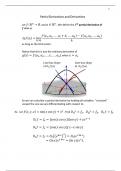
Line has slope Line has slope
of 𝐷1 𝑓(𝑎) of 𝐷2 𝑓(𝑎)
So we can calculate a partial derivative by holding all variables “constant”
except the one we are differentiating with respect to.
Ex. Let 𝑓 (𝑥, 𝑦, 𝑧) = sin(𝑥 cos 𝑦) + 𝑥 𝑧 . Find 𝐷1 𝑓 = 𝑓𝑥 , 𝐷2 𝑓 = 𝑓𝑦 , 𝐷3 𝑓 = 𝑓𝑧 .
𝐷1 𝑓 = 𝑓𝑥 = [cos(𝑥 cos 𝑦)](cos 𝑦) + 𝑧𝑥 𝑧−1
𝐷2 𝑓 = 𝑓𝑦 = [cos(𝑥 cos 𝑦)] (−𝑥 sin 𝑦)
𝑧
𝐷3 𝑓 = 𝑓𝑧 = 𝐷3 ((𝑒 ln 𝑥 ) ) = 𝐷3 (𝑒 𝑧 ln 𝑥 )
= (ln 𝑥)𝑒 𝑧 ln 𝑥 = (ln 𝑥)(𝑥 𝑧 ).
, 2
Theorem: If 𝐷𝑖,𝑗 𝑓 and 𝐷𝑗,𝑖 𝑓 are both continuous in an open set
containing 𝑎, then
𝐷𝑖,𝑗 𝑓(𝑎 ) = 𝐷𝑗,𝑖 𝑓 (𝑎 ).
Ex. A function can have a partial derivative everywhere yet not necessarily be
continuous everywhere (in contrast to the statement that if a function has a
derivative at a point, then it is continuous at that point).
Let:
𝑥𝑦 2
𝑓(𝑥, 𝑦) = 𝑥 2+𝑦4 if (𝑥, 𝑦) ≠ (0, 0)
=0 if (𝑥, 𝑦) = (0, 0)
A direct calculation using the quotient rule shows if
(𝑥, 𝑦) ≠ (0, 0), then:
𝑦 2 (𝑦 4 − 𝑥 2 )
𝑓𝑥 =
(𝑥 2 + 𝑦 4 )2
2𝑥𝑦(𝑥 2 − 𝑦 4 )
𝑓𝑦 =
(𝑥 2 + 𝑦 4 )2
If (𝑥, 𝑦) = (0, 0), then:
𝑓(0 + ℎ, 0) − 𝑓 (0, 0) 𝑓(ℎ, 0) − 𝑓(0, 0)
𝑓𝑥 (0, 0) = lim = lim =0
ℎ→0 ℎ ℎ→0 ℎ
𝑓(0, 0 + ℎ) − 𝑓(0, 0) 𝑓 (0, ℎ) − 𝑓(0, 0)
𝑓𝑦 (0, 0) = lim = lim = 0.
ℎ→0 ℎ ℎ→0 ℎ
Thus, 𝑓𝑥 and 𝑓𝑦 exist everywhere.
Partial Derivatives and Derivatives
Let 𝑓: ℝ𝑛 → ℝ and 𝑎 ∈ ℝ𝑛 . We define the 𝒊𝒕𝒉 partial derivative of
𝒇 at 𝒂 as
𝑓(𝑎1 , 𝑎2 , … , 𝑎𝑖 + ℎ, … , 𝑎𝑛 ) − 𝑓 (𝑎1 , 𝑎2 , … , 𝑎𝑛 )
𝐷𝑖 𝑓(𝑎 ) = lim
ℎ→0 ℎ
as long as the limit exists.
Notice that this is just the ordinary derivative of
𝑔(𝑥 ) = 𝑓(𝑎1 , 𝑎2 , … , 𝑥, … , 𝑎𝑛 ) when 𝑥 = 𝑎𝑖 .
Line has slope Line has slope
of 𝐷1 𝑓(𝑎) of 𝐷2 𝑓(𝑎)
So we can calculate a partial derivative by holding all variables “constant”
except the one we are differentiating with respect to.
Ex. Let 𝑓 (𝑥, 𝑦, 𝑧) = sin(𝑥 cos 𝑦) + 𝑥 𝑧 . Find 𝐷1 𝑓 = 𝑓𝑥 , 𝐷2 𝑓 = 𝑓𝑦 , 𝐷3 𝑓 = 𝑓𝑧 .
𝐷1 𝑓 = 𝑓𝑥 = [cos(𝑥 cos 𝑦)](cos 𝑦) + 𝑧𝑥 𝑧−1
𝐷2 𝑓 = 𝑓𝑦 = [cos(𝑥 cos 𝑦)] (−𝑥 sin 𝑦)
𝑧
𝐷3 𝑓 = 𝑓𝑧 = 𝐷3 ((𝑒 ln 𝑥 ) ) = 𝐷3 (𝑒 𝑧 ln 𝑥 )
= (ln 𝑥)𝑒 𝑧 ln 𝑥 = (ln 𝑥)(𝑥 𝑧 ).
, 2
Theorem: If 𝐷𝑖,𝑗 𝑓 and 𝐷𝑗,𝑖 𝑓 are both continuous in an open set
containing 𝑎, then
𝐷𝑖,𝑗 𝑓(𝑎 ) = 𝐷𝑗,𝑖 𝑓 (𝑎 ).
Ex. A function can have a partial derivative everywhere yet not necessarily be
continuous everywhere (in contrast to the statement that if a function has a
derivative at a point, then it is continuous at that point).
Let:
𝑥𝑦 2
𝑓(𝑥, 𝑦) = 𝑥 2+𝑦4 if (𝑥, 𝑦) ≠ (0, 0)
=0 if (𝑥, 𝑦) = (0, 0)
A direct calculation using the quotient rule shows if
(𝑥, 𝑦) ≠ (0, 0), then:
𝑦 2 (𝑦 4 − 𝑥 2 )
𝑓𝑥 =
(𝑥 2 + 𝑦 4 )2
2𝑥𝑦(𝑥 2 − 𝑦 4 )
𝑓𝑦 =
(𝑥 2 + 𝑦 4 )2
If (𝑥, 𝑦) = (0, 0), then:
𝑓(0 + ℎ, 0) − 𝑓 (0, 0) 𝑓(ℎ, 0) − 𝑓(0, 0)
𝑓𝑥 (0, 0) = lim = lim =0
ℎ→0 ℎ ℎ→0 ℎ
𝑓(0, 0 + ℎ) − 𝑓(0, 0) 𝑓 (0, ℎ) − 𝑓(0, 0)
𝑓𝑦 (0, 0) = lim = lim = 0.
ℎ→0 ℎ ℎ→0 ℎ
Thus, 𝑓𝑥 and 𝑓𝑦 exist everywhere.