1
The Inverse Function Theorem and the Implicit Function Theorem
In first year calculus, we learn that if 𝑓: ℝ → ℝ is continuously
differentiable and 𝑓′(𝑎) ≠ 0, then there is an open interval, 𝑉, containing 𝑎
such that 𝑓 ′ (𝑥 ) > 0 or 𝑓 ′ (𝑥 ) < 0 for all 𝑥 ∈ 𝑉.
If 𝑓 ′ (𝑥 ) > 0, then 𝑓 is strictly increasing on 𝑉. If 𝑓 ′ (𝑥 ) < 0, then 𝑓 is strictly
decreasing on 𝑉. Therefore, 𝑓 is 1-1 on 𝑉 and has an inverse function on
𝑓(𝑉 ) = 𝑊. In addition, if 𝑦 ∈ 𝑊 then,
1
(𝑓 −1 )′ (𝑦) = .
𝑓 ′ (𝑓 −1 (𝑦))
We would like to develop a similar theorem for 𝑓: ℝ𝑛 → ℝ𝑛 .
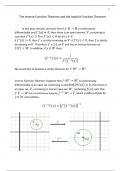
Inverse Function Theorem: Suppose that 𝑓: ℝ𝑛 → ℝ𝑛 is continuously
differentiable in an open set containing 𝑎 and det(𝐷𝑓 (𝑎 )) ≠ 0, then there is
an open set, 𝑉, containing 𝑎 and an open set, 𝑊, containing 𝑓(𝑎) such that
𝑓: 𝑉 → 𝑊 has a continuous inverse, 𝑓 −1 : 𝑊 → 𝑉, which is differentiable for
𝑦 ∈ 𝑊 and satisfies:
−1
(𝑓 −1 )′ (𝑦) = [𝑓 ′ (𝑓 −1 (𝑦))] .
𝑉 𝑓
𝑎
𝑊
𝑓 −1 𝑓(𝑎)
, 2
Ex. Let 𝐹: ℝ2 → ℝ2 by 𝐹 (𝑠, 𝑡 ) = (𝑠 2 − 𝑡 2 , 2𝑠𝑡). Show that there exists
an open set, 𝑉, containing (2, 3) and an open set, 𝑊, containing
𝐹 (2, 3) = (−5, 12) such that 𝐹 has a continuously differentiable
inverse 𝐹 −1 : 𝑊 → 𝑉. Find 𝐷𝐹 −1 (−5, 12) and show 𝐹 does not have an
inverse globally.
2𝑠 −2𝑡
𝐷𝐹 (𝑠, 𝑡 ) = ( )
2𝑡 2𝑠
so 𝐹 (𝑠, 𝑡 ) is continuously differentiable everywhere since all of the partial
derivatives are continuous everywhere.
4 −6
𝐷𝐹 (2, 3) = ( )
6 4
det(𝐷𝐹 (2, 3)) = 16 + 36 = 52 ≠ 0
So by the inverse function theorem, there exist open sets, 𝑉 and 𝑊,
containing (2, 3) and (−5, 12) such that 𝐹 −1 : 𝑊 → 𝑉 and 𝐹 −1 is
continuously differentiable.
𝐷𝐹 −1 (−5, 12) = [𝐷𝐹 (2, 3)]−1
1 4 6
𝐷𝐹 −1 (−5, 12) = ( )
52 −6 4
1 2 3
𝐷𝐹 −1 (−5, 12) = ( )
26 −3 2
For 𝐹 to have a global inverse, it would need to be 1-1 on all of ℝ2 . But
𝐹 (−1, −1) = (0, 2) and 𝐹 (1, 1) = (0, 2), so 𝐹 is not globally 1-1 and hence
has no global inverse.
The inverse function theorem only guarantees a local inverse. In fact, 𝑓 can have
a local inverse at every point and not have a global inverse.
The Inverse Function Theorem and the Implicit Function Theorem
In first year calculus, we learn that if 𝑓: ℝ → ℝ is continuously
differentiable and 𝑓′(𝑎) ≠ 0, then there is an open interval, 𝑉, containing 𝑎
such that 𝑓 ′ (𝑥 ) > 0 or 𝑓 ′ (𝑥 ) < 0 for all 𝑥 ∈ 𝑉.
If 𝑓 ′ (𝑥 ) > 0, then 𝑓 is strictly increasing on 𝑉. If 𝑓 ′ (𝑥 ) < 0, then 𝑓 is strictly
decreasing on 𝑉. Therefore, 𝑓 is 1-1 on 𝑉 and has an inverse function on
𝑓(𝑉 ) = 𝑊. In addition, if 𝑦 ∈ 𝑊 then,
1
(𝑓 −1 )′ (𝑦) = .
𝑓 ′ (𝑓 −1 (𝑦))
We would like to develop a similar theorem for 𝑓: ℝ𝑛 → ℝ𝑛 .
Inverse Function Theorem: Suppose that 𝑓: ℝ𝑛 → ℝ𝑛 is continuously
differentiable in an open set containing 𝑎 and det(𝐷𝑓 (𝑎 )) ≠ 0, then there is
an open set, 𝑉, containing 𝑎 and an open set, 𝑊, containing 𝑓(𝑎) such that
𝑓: 𝑉 → 𝑊 has a continuous inverse, 𝑓 −1 : 𝑊 → 𝑉, which is differentiable for
𝑦 ∈ 𝑊 and satisfies:
−1
(𝑓 −1 )′ (𝑦) = [𝑓 ′ (𝑓 −1 (𝑦))] .
𝑉 𝑓
𝑎
𝑊
𝑓 −1 𝑓(𝑎)
, 2
Ex. Let 𝐹: ℝ2 → ℝ2 by 𝐹 (𝑠, 𝑡 ) = (𝑠 2 − 𝑡 2 , 2𝑠𝑡). Show that there exists
an open set, 𝑉, containing (2, 3) and an open set, 𝑊, containing
𝐹 (2, 3) = (−5, 12) such that 𝐹 has a continuously differentiable
inverse 𝐹 −1 : 𝑊 → 𝑉. Find 𝐷𝐹 −1 (−5, 12) and show 𝐹 does not have an
inverse globally.
2𝑠 −2𝑡
𝐷𝐹 (𝑠, 𝑡 ) = ( )
2𝑡 2𝑠
so 𝐹 (𝑠, 𝑡 ) is continuously differentiable everywhere since all of the partial
derivatives are continuous everywhere.
4 −6
𝐷𝐹 (2, 3) = ( )
6 4
det(𝐷𝐹 (2, 3)) = 16 + 36 = 52 ≠ 0
So by the inverse function theorem, there exist open sets, 𝑉 and 𝑊,
containing (2, 3) and (−5, 12) such that 𝐹 −1 : 𝑊 → 𝑉 and 𝐹 −1 is
continuously differentiable.
𝐷𝐹 −1 (−5, 12) = [𝐷𝐹 (2, 3)]−1
1 4 6
𝐷𝐹 −1 (−5, 12) = ( )
52 −6 4
1 2 3
𝐷𝐹 −1 (−5, 12) = ( )
26 −3 2
For 𝐹 to have a global inverse, it would need to be 1-1 on all of ℝ2 . But
𝐹 (−1, −1) = (0, 2) and 𝐹 (1, 1) = (0, 2), so 𝐹 is not globally 1-1 and hence
has no global inverse.
The inverse function theorem only guarantees a local inverse. In fact, 𝑓 can have
a local inverse at every point and not have a global inverse.