1
Functions of Bounded Variation: Jordan’s Theorem
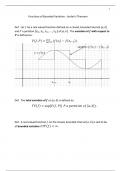
Def. Let 𝑓 be a real valued function defined on a closed, bounded interval [𝑎, 𝑏]
and 𝑃 a partition {𝑥0 , 𝑥1 , 𝑥2 , … , 𝑥𝑘 } of [𝑎, 𝑏]. The variation of 𝒇 with respect to
𝑷 is defined as:
𝑉 (𝑓, 𝑃 ) = ∑𝑘𝑖=1 |𝑓(𝑥𝑖 ) − 𝑓(𝑥𝑖−1 )|.
Length= |𝑓 (𝑥𝑖 ) − 𝑓(𝑥𝑖−1 )|
𝑦 = 𝑓(𝑥)
𝑥𝑖−1 𝑥𝑖
Def. The total variation of 𝒇 on [𝑎, 𝑏] is defined as:
𝑇𝑉(𝑓) = sup{𝑉 (𝑓, 𝑃)| 𝑃 𝑎 𝑝𝑎𝑟𝑡𝑖𝑡𝑖𝑜𝑛 𝑜𝑓 [𝑎, 𝑏]} .
Def. A real valued function 𝑓 on the closed, bounded interval [𝑎, 𝑏] is said to be
of bounded variation if 𝑇𝑉(𝑓) < ∞.
, 2
Ex. If 𝑓 is an increasing function on [𝑎, 𝑏], then 𝑓 is of bounded variation and
𝑇𝑉(𝑓) = 𝑓 (𝑏) − 𝑓(𝑎).
Given any partition 𝑃 of [𝑎, 𝑏 ]: 𝑉 (𝑓, 𝑃 ) = ∑𝑘𝑖=1 |𝑓 (𝑥𝑖 ) − 𝑓(𝑥𝑖−1 )|
Since 𝑓 is increasing 𝑓(𝑥𝑖 ) − 𝑓(𝑥𝑖−1 ) ≥ 0
so |𝑓 (𝑥𝑖 ) − 𝑓(𝑥𝑖−1 )| = 𝑓(𝑥𝑖 ) − 𝑓(𝑥𝑖−1 ).
𝑉 (𝑓, 𝑃 ) = ∑𝑘𝑖=1 |𝑓(𝑥𝑖 ) − 𝑓(𝑥𝑖−1 )|
= (𝑓(𝑥1 ) − 𝑓(𝑥0 )) + (𝑓(𝑥2 ) − 𝑓 (𝑥1 )) + ⋯ (𝑓(𝑥𝑘 ) − 𝑓(𝑥𝑘−1 ))
= 𝑓(𝑥𝑘 ) − 𝑓(𝑥0 ) = 𝑓(𝑏) − 𝑓(𝑎 ).
Thus 𝑇𝑉 (𝑓) = sup 𝑉 (𝑓, 𝑃 ) = 𝑓(𝑏) − 𝑓(𝑎).
𝑃
Def. A real valued function on [𝑎, 𝑏] is called Lipschitz if there exists a 𝑐 ∈ ℝ
such that
|𝑓 (𝑥 ) − 𝑓 (𝑦)| ≤ 𝑐|𝑥 − 𝑦|, for all 𝑥, 𝑦 ∈ [𝑎, 𝑏].
Notice that any Lipschitz function is uniformly continuous on [𝑎, 𝑏].
𝜖
We can see this by choosing 𝛿 = .
𝑐
𝜖
Thus if |𝑥 − 𝑦| < 𝛿 = then
𝑐
𝜖
|𝑓 (𝑥 ) − 𝑓 (𝑦)| ≤ 𝑐|𝑥 − 𝑦| < 𝑐𝛿 = 𝑐 ( ) = 𝜖 .
𝑐
Functions of Bounded Variation: Jordan’s Theorem
Def. Let 𝑓 be a real valued function defined on a closed, bounded interval [𝑎, 𝑏]
and 𝑃 a partition {𝑥0 , 𝑥1 , 𝑥2 , … , 𝑥𝑘 } of [𝑎, 𝑏]. The variation of 𝒇 with respect to
𝑷 is defined as:
𝑉 (𝑓, 𝑃 ) = ∑𝑘𝑖=1 |𝑓(𝑥𝑖 ) − 𝑓(𝑥𝑖−1 )|.
Length= |𝑓 (𝑥𝑖 ) − 𝑓(𝑥𝑖−1 )|
𝑦 = 𝑓(𝑥)
𝑥𝑖−1 𝑥𝑖
Def. The total variation of 𝒇 on [𝑎, 𝑏] is defined as:
𝑇𝑉(𝑓) = sup{𝑉 (𝑓, 𝑃)| 𝑃 𝑎 𝑝𝑎𝑟𝑡𝑖𝑡𝑖𝑜𝑛 𝑜𝑓 [𝑎, 𝑏]} .
Def. A real valued function 𝑓 on the closed, bounded interval [𝑎, 𝑏] is said to be
of bounded variation if 𝑇𝑉(𝑓) < ∞.
, 2
Ex. If 𝑓 is an increasing function on [𝑎, 𝑏], then 𝑓 is of bounded variation and
𝑇𝑉(𝑓) = 𝑓 (𝑏) − 𝑓(𝑎).
Given any partition 𝑃 of [𝑎, 𝑏 ]: 𝑉 (𝑓, 𝑃 ) = ∑𝑘𝑖=1 |𝑓 (𝑥𝑖 ) − 𝑓(𝑥𝑖−1 )|
Since 𝑓 is increasing 𝑓(𝑥𝑖 ) − 𝑓(𝑥𝑖−1 ) ≥ 0
so |𝑓 (𝑥𝑖 ) − 𝑓(𝑥𝑖−1 )| = 𝑓(𝑥𝑖 ) − 𝑓(𝑥𝑖−1 ).
𝑉 (𝑓, 𝑃 ) = ∑𝑘𝑖=1 |𝑓(𝑥𝑖 ) − 𝑓(𝑥𝑖−1 )|
= (𝑓(𝑥1 ) − 𝑓(𝑥0 )) + (𝑓(𝑥2 ) − 𝑓 (𝑥1 )) + ⋯ (𝑓(𝑥𝑘 ) − 𝑓(𝑥𝑘−1 ))
= 𝑓(𝑥𝑘 ) − 𝑓(𝑥0 ) = 𝑓(𝑏) − 𝑓(𝑎 ).
Thus 𝑇𝑉 (𝑓) = sup 𝑉 (𝑓, 𝑃 ) = 𝑓(𝑏) − 𝑓(𝑎).
𝑃
Def. A real valued function on [𝑎, 𝑏] is called Lipschitz if there exists a 𝑐 ∈ ℝ
such that
|𝑓 (𝑥 ) − 𝑓 (𝑦)| ≤ 𝑐|𝑥 − 𝑦|, for all 𝑥, 𝑦 ∈ [𝑎, 𝑏].
Notice that any Lipschitz function is uniformly continuous on [𝑎, 𝑏].
𝜖
We can see this by choosing 𝛿 = .
𝑐
𝜖
Thus if |𝑥 − 𝑦| < 𝛿 = then
𝑐
𝜖
|𝑓 (𝑥 ) − 𝑓 (𝑦)| ≤ 𝑐|𝑥 − 𝑦| < 𝑐𝛿 = 𝑐 ( ) = 𝜖 .
𝑐