

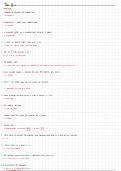
Test Q 's
Multiple choice
Combination and
deoxyribose nitrogenous base
1
.
of
↳ nucleoside
Nitrogenous base pentose phosphate
+
2. +
sugar group
↳ nucleotide
3. 2 nucleotides
joined by a
phosphate group linking the 2
sugars
nucleotide
↳
poly
identical would
4. 2 DNA 's w/ length →
what Tm be ?
would
↳ DNA w/ high AT content melt
faster
5. DNA pot 111 adds nucleotides to the
'
end the RNA primer
↳ 3
of
b. Obs made
griffiths
↳ mouse died when
injected w/ combination
of heat killed virulent 111s and
living avirulent HIR
7 General consensus in proharotic DNA where RNA
polymerase often binds is
.
sequence
↳ TATAAT
E. Coli
8. terms
accuratly reflect of replication of chromosome
→
nature
↳ bidirectional and fixed pt of . initiation
9 . Proteins or enzymes that do NOT function at origin of replication in E. Coli
↳ DNA
ligase
'
Terms
'
10 .
relating to split genes
↳ introns and extrons
11 . Complexes formed when primary RNA transcripts bind to proteins
↳ hn RNP 's
12 . Describes DNA
( Att ) ( Atb )
↳ double stranded ,
anti -
parallel ,
= variable ,
=
,
( Ctc ) ( CTT )
12 .
Which subunit of prokaryotic RNA
polymerase plays regulatory function during the initiation
of
RNA transcription
↳ 6
13 .
Primary structure of a protein is a . . .
↳ amino acid
sequence
14 DNA replicated would
.
conservatively , after 2
generations there be . . .
↳ I old band & 1 new band
15 . All known bacterial DNA polymerases
have polymerization activity
'
↳ 5 to 3 '
activity
' '
↳ 3 to 5 exonuclease
, 16 .
Role of Dna A protein in bacterial DNA replication is to
↳ unwind double helix
17 .
Okasaki fragments are a
consequence of
↳ inability of DNA polymerase to polymerise in 3' to 5
'
direction
18 .
Griffith's experiment showed that . . .
cells introduce trait
↳ a Chem . component of a new
19 . NOT consistent w/ Charagaff 's findings
↳ ( ( + G) =
( A -1T )
( NOT TRUE . - . CTG =/ A -1T )
20 .
Rate of complementary DNA strands is affected by . . .
1. conc .
Of DNA
2.
length of DNA molecule
( more stable moi if G C content T then A T content )
G C
- -
3.
.
-
content
4.
%
of repetitive DNA
Multiple choice
Combination and
deoxyribose nitrogenous base
1
.
of
↳ nucleoside
Nitrogenous base pentose phosphate
+
2. +
sugar group
↳ nucleotide
3. 2 nucleotides
joined by a
phosphate group linking the 2
sugars
nucleotide
↳
poly
identical would
4. 2 DNA 's w/ length →
what Tm be ?
would
↳ DNA w/ high AT content melt
faster
5. DNA pot 111 adds nucleotides to the
'
end the RNA primer
↳ 3
of
b. Obs made
griffiths
↳ mouse died when
injected w/ combination
of heat killed virulent 111s and
living avirulent HIR
7 General consensus in proharotic DNA where RNA
polymerase often binds is
.
sequence
↳ TATAAT
E. Coli
8. terms
accuratly reflect of replication of chromosome
→
nature
↳ bidirectional and fixed pt of . initiation
9 . Proteins or enzymes that do NOT function at origin of replication in E. Coli
↳ DNA
ligase
'
Terms
'
10 .
relating to split genes
↳ introns and extrons
11 . Complexes formed when primary RNA transcripts bind to proteins
↳ hn RNP 's
12 . Describes DNA
( Att ) ( Atb )
↳ double stranded ,
anti -
parallel ,
= variable ,
=
,
( Ctc ) ( CTT )
12 .
Which subunit of prokaryotic RNA
polymerase plays regulatory function during the initiation
of
RNA transcription
↳ 6
13 .
Primary structure of a protein is a . . .
↳ amino acid
sequence
14 DNA replicated would
.
conservatively , after 2
generations there be . . .
↳ I old band & 1 new band
15 . All known bacterial DNA polymerases
have polymerization activity
'
↳ 5 to 3 '
activity
' '
↳ 3 to 5 exonuclease
, 16 .
Role of Dna A protein in bacterial DNA replication is to
↳ unwind double helix
17 .
Okasaki fragments are a
consequence of
↳ inability of DNA polymerase to polymerise in 3' to 5
'
direction
18 .
Griffith's experiment showed that . . .
cells introduce trait
↳ a Chem . component of a new
19 . NOT consistent w/ Charagaff 's findings
↳ ( ( + G) =
( A -1T )
( NOT TRUE . - . CTG =/ A -1T )
20 .
Rate of complementary DNA strands is affected by . . .
1. conc .
Of DNA
2.
length of DNA molecule
( more stable moi if G C content T then A T content )
G C
- -
3.
.
-
content
4.
%
of repetitive DNA


