ACLS Pre-Course Self-Assessment Questions & Answers, 100% Correct, Latest Complete Solution
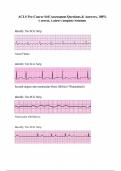
Identify The ECG Strip Atrial Flutter Identify The ECG Strip Second-degree atrioventricular block (Mobitz I Wenckebach) Identify The ECG Strip Ventricular fibrillation Identify The ECG Strip Second-degree atrioventricular block (Mobitz I Wenckebach) Identify The ECG Strip Monomorphic ventricular tachycardia Identify The ECG Strip Second-degree atrioventricular block (Mobitz II block) Identify The ECG Strip Ventricular fibrillation Identify The ECG Strip Ventricular fibrillation Identify The ECG Strip Atrial fibrillation Identify The ECG Strip Pulseless electrical activity Identify The ECG Strip Sinus Bradycardia Identify The ECG Strip Supraventricular Tachycardia Identify The ECG Strip Sinus Tachycardia Identify The ECG Strip Third-degree Atrioventricular block Identify The ECG Strip Normal Sinus Rhythm Identify The ECG Strip Polymorphic Ventricular Tachycardia Identify The ECG Strip Agonal Rhythm/Asystole Identify The ECG Strip Second-degree Atrioventricular Block (Mobitz II Block) Identify The ECG Strip Sinus Bradycardia Identify The ECG Strip Supraventricular Tachycardia A monitored patient in the ICU developed a sudden onset of narrow-complex tachycardia at a rate of 220/min. The patient's blood pressure is 128/58 mm Hg, the PETCO2 is 38 mm Hg, and the pulse oximetry reading is 98%. There is vascular access in the left arm, and the patient has not been given any vasoactive drugs. A 12-lead ECG confirms a supraventricular tachycardia with no evidence of ischemia or infarction. The heart rate has not responded to vagal maneuvers. What is your next action? Administer amiodarone 300 mg IV push Administer adenosine 6 mg IV push Perform synchronized cardioversion at 200 J Perform synchronized cardioversion at 50 J Administer adenosine 6 mg IV push You are caring for a 66-year-old man with a history of a large intracerebral hemorrhage 2 months ago. He is being evaluated for another acute stroke. The CT scan is negative for hemorrhage. The patient is receiving oxygen via nasal cannula at 2 L/min, and an IV has been established. His blood pressure is 180/100 mm Hg. Which drug do you anticipate giving to this patient? Aspirin rtPA Glucose (D50) Nicardipine Aspirin A patient is in pulseless ventricular tachycardia. Two shocks and 1 dose of epinephrine have been given. Which drug should be given next? Epinephrine 3 mg Lidocaine 0.5 mg/kg Amiodarone 300 mg Adenosine 6 mg Amiodarone 300 mg A patient with possible STEMI has ongoing chest discomfort. What is a contraindication to nitrate administration? Heart rate less than 90/min Use of a phosphodiesterase inhibitor within the previous 24 hours Anterior wall myocardial infarction Systolic blood pressure greater than 180 mm Hg Use of a phosphodiesterase inhibitor within the previous 24 hours A patient is in cardiac arrest. High-quality chest compressions are being given. The patient is intubated, and an IV has been started. The rhythm is asystole. What is the first drug/dose to administer? Dopamine 2 to 20 mcg/kg per minute IV/IO Atropine 1 mg IV/IO Epinephrine 1 mg IV/IO Atropine 0.5 mg IV/IO Epinephrine 1 mg IV/IO A patient is in refractory ventricular fibrillation. High-quality CPR is in progress. One dose of epinephrine was given after the second shock. An antiarrhythmic drug was given immediately after the third shock. You are the team leader. Which medication do you order next? Epinephrine 1 mg A second dose of the antiarrhythmic drug Epinephrine 3 mg Sodium bicarbonate 50 mEq Epinephrine 1 mg Which intervention is most appropriate for the treatment of a patient in asystole? Atropine Transcutaneous pacing Defibrillation Epinephrine Epinephrine A patient with sinus bradycardia and a heart rate of 42/min has diaphoresis and a blood pressure of 80/60 mm Hg. What is the initial dose of atropine? 0.1 mg 1 mg 3 mg 0.5 mg 1 mg A patient with STEMI has ongoing chest discomfort. Heparin 4000 units IV bolus and a heparin infusion of 1000 units per hour are being administered. The patient did not take aspirin because he has a history of gastritis, which was treated 5 years ago. What is your next action? Give enteric-coated aspirin 325 mg rectally Give aspirin 162 to 325 mg to chew Give enteric-coated aspirin 75 mg orally Give clopidogrel 300 mg orally Give aspirin 162 to 325 mg to chew
Written for
- Institution
- ACLS Heartcode
- Course
- ACLS Heartcode
Document information
- Uploaded on
- December 31, 2024
- Number of pages
- 22
- Written in
- 2024/2025
- Type
- Exam (elaborations)
- Contains
- Questions & answers
Subjects
- acls
- acls pre course
-
acls pre course self assessment

Also available in package deal