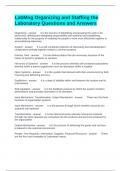
LabMng Organizing and Staffing the
Laboratory Questions and Answers
Organizing - answer It is the process of identifying and grouping the work to be
performed, defining and delegating responsibility and authority and establishing
relationship for the purpose of enabling the people to work most effectively together in
accomplishing objectives
System - answer It is a self-contained collection of interacting and interdependent
components working together toward a common purpose
Primary Task - answer It is the defined duties that are necessary because of the
nature of system's products or services
Hierarchy of Systems - answer It is the process whereby self-contained subsystems
develop within a parent organization such as laboratory within a hospital
Open Systems - answer It is the system that interacts with their environment by both
receiving and delivering services
Equilibrium - answer It is a state of stability within and between the system and its
environment
Self-regulation - answer It is the feedback process by which the system monitors
performance and provides information to its members
Input Mechanism, Transformation, Output Mechanism - answer These are the three
functions of organization systems
Input Mechanism - answer It is the process through which needed resources are
acquired and replaced
Transformation - answer It is the internal process whereby resources received
through the input channels are converted into the products and services produced by
the organization
Output Mechanism - answer It is the process of delivering the goods and services
produced to the external environment
People, Test Requests, Information, Supplies, Financial Resources - answer These
are the five cited examples of Laboratory Inputs
, Personnel, Instruments, Expertise - answer These are the three cited examples of
Laboratory Transformation
Test Results, Salaries, Wastes - answer These are the three cited examples of
Laboratory Output
Formal Bureaucracy, Informal Groups - answer These are the two cited structures of
organizations
Formal Bureaucracy - answer The officially sanctioned lines of authority assigned by
the owners of the organization
Informal Groups - answer alliances that are neither formally structured nor
organizationally determined
Bureaucratic, Situational - answer These are the two models of relationships
between people
Bureaucratic Model - answer It focuses entirely on the relationship between people
and rely on the hierarchy's formal chain commande
Centralized, Decentralized - answer These are the two kinds of Bureaucratic Models
Centralized System - answer This is the concentration of authority at the higher
levels of the organization
Decentralized System - answer This distributes or delegates decision making to the
lower level managers
Situational Models - answer This tailors the organization structure to the specific job
needs dictated by the work situation
Matrix Scheme - answer It grades crucial variables in each unit by grouping them
according to the task to be performed, the types of personnel needed and the history of
each section
Routine Strategy - answer It is a variable referring to the work consist of repetitive
tasks and needs a minimally trained work
Engineering Strategy - answer It is a variable referring to the non-repetitive work that
requires an independent judgment and is performed by a professionally prepared staff
Craft Strategy - answer It is a variable referring to the products are unique and
workers are extremely skilled but the basic production process for each item is similar
Laboratory Questions and Answers
Organizing - answer It is the process of identifying and grouping the work to be
performed, defining and delegating responsibility and authority and establishing
relationship for the purpose of enabling the people to work most effectively together in
accomplishing objectives
System - answer It is a self-contained collection of interacting and interdependent
components working together toward a common purpose
Primary Task - answer It is the defined duties that are necessary because of the
nature of system's products or services
Hierarchy of Systems - answer It is the process whereby self-contained subsystems
develop within a parent organization such as laboratory within a hospital
Open Systems - answer It is the system that interacts with their environment by both
receiving and delivering services
Equilibrium - answer It is a state of stability within and between the system and its
environment
Self-regulation - answer It is the feedback process by which the system monitors
performance and provides information to its members
Input Mechanism, Transformation, Output Mechanism - answer These are the three
functions of organization systems
Input Mechanism - answer It is the process through which needed resources are
acquired and replaced
Transformation - answer It is the internal process whereby resources received
through the input channels are converted into the products and services produced by
the organization
Output Mechanism - answer It is the process of delivering the goods and services
produced to the external environment
People, Test Requests, Information, Supplies, Financial Resources - answer These
are the five cited examples of Laboratory Inputs
, Personnel, Instruments, Expertise - answer These are the three cited examples of
Laboratory Transformation
Test Results, Salaries, Wastes - answer These are the three cited examples of
Laboratory Output
Formal Bureaucracy, Informal Groups - answer These are the two cited structures of
organizations
Formal Bureaucracy - answer The officially sanctioned lines of authority assigned by
the owners of the organization
Informal Groups - answer alliances that are neither formally structured nor
organizationally determined
Bureaucratic, Situational - answer These are the two models of relationships
between people
Bureaucratic Model - answer It focuses entirely on the relationship between people
and rely on the hierarchy's formal chain commande
Centralized, Decentralized - answer These are the two kinds of Bureaucratic Models
Centralized System - answer This is the concentration of authority at the higher
levels of the organization
Decentralized System - answer This distributes or delegates decision making to the
lower level managers
Situational Models - answer This tailors the organization structure to the specific job
needs dictated by the work situation
Matrix Scheme - answer It grades crucial variables in each unit by grouping them
according to the task to be performed, the types of personnel needed and the history of
each section
Routine Strategy - answer It is a variable referring to the work consist of repetitive
tasks and needs a minimally trained work
Engineering Strategy - answer It is a variable referring to the non-repetitive work that
requires an independent judgment and is performed by a professionally prepared staff
Craft Strategy - answer It is a variable referring to the products are unique and
workers are extremely skilled but the basic production process for each item is similar