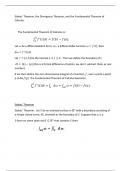
Stokes’ Theorem, the Divergence Theorem, and the Fundamental Theorem of
Calculus
The Fundamental Theorem of Calculus is:
𝑏
∫𝑎 𝑓 ′ (𝑡 )𝑑𝑡 = 𝑓(𝑏) − 𝑓(𝑎).
Let 𝜔 be a differentiable 0-form, i.e., a differentiable function 𝜔 = 𝑓 (𝑡 ), then
𝑑𝜔 = 𝑓 ′ (𝑡 )𝑑𝑡.
Let 𝐼 = [𝑎, 𝑏 ] be the interval 𝑎 ≤ 𝑡 ≤ 𝑏. Then we define the boundary of 𝐼,
𝜕𝐼 = {𝑏 } − {𝑎} (this is a formal difference of points, we don’t subtract them as real
number).
If we then define the zero dimensional integral of a function, 𝑓, over a point a point
𝑝 to be 𝑓(𝑝) the Fundamental Theorem of Calculus becomes:
𝑏
∫𝑎 𝑓 ′ (𝑡)𝑑𝑡 = ∫𝐼 𝑑𝜔 = ∫𝜕𝐼 𝜔 = 𝑓 (𝑏) − 𝑓(𝑎).
Stokes’ Theorem
Stokes’ Theorem: Let 𝑆 be an oriented surface in ℝ3 with a boundary consisting of
a simple closed curve, 𝜕𝑆, oriented as the boundary of 𝑆. Suppose that 𝜔 is a
1-form on some open set 𝐾 ⊆ ℝ3 that contains 𝑆 then:
∫𝝏𝑺 𝝎 = ∬𝑺 𝒅 𝝎.
, 2
Proof. Stokes’ theorem said ∬𝑆 (∇ × 𝐹⃗ ) ∙ 𝑑𝑆⃗ = ∫𝜕𝑆 𝐹⃗ ∙ 𝑑𝑠⃗.
⃗⃗ .
We can write 𝐹⃗ as: 𝐹⃗ (𝑥, 𝑦, 𝑧) = 𝐹1 (𝑥, 𝑦, 𝑧)𝑖⃗ + 𝐹2 (𝑥, 𝑦, 𝑧)𝑗⃗ + 𝐹3 (𝑥, 𝑦, 𝑧)𝑘
Let’s let 𝜔 = 𝐹⃗ ∙ 𝑑𝑠⃗ = 𝐹1 𝑑𝑥 + 𝐹2 𝑑𝑦 + 𝐹3 𝑑𝑧 and show that 𝑑𝜔 = (∇ × ⃗𝐹⃗) ∙ 𝑑𝑆⃗ .
Then we have:
𝑑𝜔 = 𝑑 (𝐹1 𝑑𝑥 + 𝐹2 𝑑𝑦 + 𝐹3 𝑑𝑧)
= 𝑑𝐹1 ∧ 𝑑𝑥+ 𝑑𝐹2 ∧ 𝑑𝑦 + 𝑑𝐹3 ∧ 𝑑𝑧
𝜕𝐹1 𝜕𝐹1 𝜕𝐹1 𝜕𝐹2 𝜕𝐹2 𝜕𝐹2
=( 𝑑𝑥 + 𝑑𝑦 + 𝑑𝑧) ∧ 𝑑𝑥 + ( 𝑑𝑥 + 𝑑𝑦 + 𝑑𝑧) ∧ 𝑑𝑦
𝜕𝑥 𝜕𝑦 𝜕𝑧 𝜕𝑥 𝜕𝑦 𝜕𝑧
𝜕𝐹 𝜕𝐹3 𝜕𝐹3
+ ( 𝜕𝑥3 𝑑𝑥 + 𝑑𝑦 + 𝑑𝑧) ∧ 𝑑𝑧
𝜕𝑦 𝜕𝑧
𝜕𝐹1 𝜕𝐹1 𝜕𝐹2 𝜕𝐹2
= 𝑑𝑦 ∧ 𝑑𝑥 + 𝑑𝑧 ∧ 𝑑𝑥 + 𝑑𝑥 ∧ 𝑑𝑦 + 𝑑𝑧 ∧ 𝑑𝑦
𝜕𝑦 𝜕𝑧 𝜕𝑥 𝜕𝑧
𝜕𝐹3 𝜕𝐹
+ 𝑑𝑥 ∧ 𝑑𝑧 + 𝜕𝑦3 𝑑𝑦 ∧ 𝑑𝑧
𝜕𝑥
𝜕𝐹2 𝜕𝐹1 𝜕𝐹3 𝜕𝐹2 𝜕𝐹1 𝜕𝐹3
𝑑𝜔 = ( − ) 𝑑𝑥𝑑𝑦 + ( − ) 𝑑𝑦𝑑𝑧 + ( − ) 𝑑𝑧𝑑𝑥.
𝜕𝑥 𝜕𝑦 𝜕𝑦 𝜕𝑧 𝜕𝑧 𝜕𝑥
We need to show that (∇ × 𝐹⃗ ) ∙ 𝑑𝑆⃗= 𝑑𝜔.
𝑖⃗ 𝑗⃗ 𝑘⃗⃗
𝜕𝐹3 𝜕𝐹2 𝜕𝐹1 𝜕𝐹3 𝜕𝐹2 𝜕𝐹1
∇ × 𝐹⃗ = | 𝜕 𝜕 𝜕
|=( − ) 𝑖⃗ + ( − )𝑗⃗ + ( − )𝑘⃗⃗.
𝜕𝑥 𝜕𝑦 𝜕𝑧 𝜕𝑦 𝜕𝑧 𝜕𝑧 𝜕𝑥 𝜕𝑥 𝜕𝑦
𝐹1 𝐹2 𝐹3
Calculus
The Fundamental Theorem of Calculus is:
𝑏
∫𝑎 𝑓 ′ (𝑡 )𝑑𝑡 = 𝑓(𝑏) − 𝑓(𝑎).
Let 𝜔 be a differentiable 0-form, i.e., a differentiable function 𝜔 = 𝑓 (𝑡 ), then
𝑑𝜔 = 𝑓 ′ (𝑡 )𝑑𝑡.
Let 𝐼 = [𝑎, 𝑏 ] be the interval 𝑎 ≤ 𝑡 ≤ 𝑏. Then we define the boundary of 𝐼,
𝜕𝐼 = {𝑏 } − {𝑎} (this is a formal difference of points, we don’t subtract them as real
number).
If we then define the zero dimensional integral of a function, 𝑓, over a point a point
𝑝 to be 𝑓(𝑝) the Fundamental Theorem of Calculus becomes:
𝑏
∫𝑎 𝑓 ′ (𝑡)𝑑𝑡 = ∫𝐼 𝑑𝜔 = ∫𝜕𝐼 𝜔 = 𝑓 (𝑏) − 𝑓(𝑎).
Stokes’ Theorem
Stokes’ Theorem: Let 𝑆 be an oriented surface in ℝ3 with a boundary consisting of
a simple closed curve, 𝜕𝑆, oriented as the boundary of 𝑆. Suppose that 𝜔 is a
1-form on some open set 𝐾 ⊆ ℝ3 that contains 𝑆 then:
∫𝝏𝑺 𝝎 = ∬𝑺 𝒅 𝝎.
, 2
Proof. Stokes’ theorem said ∬𝑆 (∇ × 𝐹⃗ ) ∙ 𝑑𝑆⃗ = ∫𝜕𝑆 𝐹⃗ ∙ 𝑑𝑠⃗.
⃗⃗ .
We can write 𝐹⃗ as: 𝐹⃗ (𝑥, 𝑦, 𝑧) = 𝐹1 (𝑥, 𝑦, 𝑧)𝑖⃗ + 𝐹2 (𝑥, 𝑦, 𝑧)𝑗⃗ + 𝐹3 (𝑥, 𝑦, 𝑧)𝑘
Let’s let 𝜔 = 𝐹⃗ ∙ 𝑑𝑠⃗ = 𝐹1 𝑑𝑥 + 𝐹2 𝑑𝑦 + 𝐹3 𝑑𝑧 and show that 𝑑𝜔 = (∇ × ⃗𝐹⃗) ∙ 𝑑𝑆⃗ .
Then we have:
𝑑𝜔 = 𝑑 (𝐹1 𝑑𝑥 + 𝐹2 𝑑𝑦 + 𝐹3 𝑑𝑧)
= 𝑑𝐹1 ∧ 𝑑𝑥+ 𝑑𝐹2 ∧ 𝑑𝑦 + 𝑑𝐹3 ∧ 𝑑𝑧
𝜕𝐹1 𝜕𝐹1 𝜕𝐹1 𝜕𝐹2 𝜕𝐹2 𝜕𝐹2
=( 𝑑𝑥 + 𝑑𝑦 + 𝑑𝑧) ∧ 𝑑𝑥 + ( 𝑑𝑥 + 𝑑𝑦 + 𝑑𝑧) ∧ 𝑑𝑦
𝜕𝑥 𝜕𝑦 𝜕𝑧 𝜕𝑥 𝜕𝑦 𝜕𝑧
𝜕𝐹 𝜕𝐹3 𝜕𝐹3
+ ( 𝜕𝑥3 𝑑𝑥 + 𝑑𝑦 + 𝑑𝑧) ∧ 𝑑𝑧
𝜕𝑦 𝜕𝑧
𝜕𝐹1 𝜕𝐹1 𝜕𝐹2 𝜕𝐹2
= 𝑑𝑦 ∧ 𝑑𝑥 + 𝑑𝑧 ∧ 𝑑𝑥 + 𝑑𝑥 ∧ 𝑑𝑦 + 𝑑𝑧 ∧ 𝑑𝑦
𝜕𝑦 𝜕𝑧 𝜕𝑥 𝜕𝑧
𝜕𝐹3 𝜕𝐹
+ 𝑑𝑥 ∧ 𝑑𝑧 + 𝜕𝑦3 𝑑𝑦 ∧ 𝑑𝑧
𝜕𝑥
𝜕𝐹2 𝜕𝐹1 𝜕𝐹3 𝜕𝐹2 𝜕𝐹1 𝜕𝐹3
𝑑𝜔 = ( − ) 𝑑𝑥𝑑𝑦 + ( − ) 𝑑𝑦𝑑𝑧 + ( − ) 𝑑𝑧𝑑𝑥.
𝜕𝑥 𝜕𝑦 𝜕𝑦 𝜕𝑧 𝜕𝑧 𝜕𝑥
We need to show that (∇ × 𝐹⃗ ) ∙ 𝑑𝑆⃗= 𝑑𝜔.
𝑖⃗ 𝑗⃗ 𝑘⃗⃗
𝜕𝐹3 𝜕𝐹2 𝜕𝐹1 𝜕𝐹3 𝜕𝐹2 𝜕𝐹1
∇ × 𝐹⃗ = | 𝜕 𝜕 𝜕
|=( − ) 𝑖⃗ + ( − )𝑗⃗ + ( − )𝑘⃗⃗.
𝜕𝑥 𝜕𝑦 𝜕𝑧 𝜕𝑦 𝜕𝑧 𝜕𝑧 𝜕𝑥 𝜕𝑥 𝜕𝑦
𝐹1 𝐹2 𝐹3