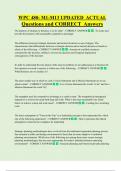
WPC 480: M1-M13 UPDATED ACTUAL
Questions and CORRECT Answers
The purpose of strategy in business is to do what? - CORRECT ANSWER - To create and
provide the business with sustainable competitive advantage
The difference between strategic decisions and tactical decisions is one of degree. The
characteristics that differentiate between a strategic decision and a tactical decision is based on
which of the following. - CORRECT ANSWER - Amount of available resources
consumed by the decision, Ability to reverse the decision and Temporal implication
consequences of the decision
In order to understand the true nature of the need or problem we are addressing as a business the
first question we need to answer is which one of the following: - CORRECT ANSWER -
What Business are we (really) in?
The most simple way in which to craft a Vision Statement and a Mission Statement are to use
which words? - CORRECT ANSWER - For a Vision Statement the words "to be" and for a
Mission Statement the word "by"
The metaphor used for competitive advantage is a castle's moat. The metaphorical managerial
imperative is to have the moat both deep and wide. What is the most sustainable way listed
below to achieve a deep and wide moat? - CORRECT ANSWER - Creating low switching
costs
The basic assumption of "Tone-at-the-Top" as a leadership concept is best represented by which
one of the following statements? - CORRECT ANSWER - That it represents the ethical
atmosphere created in the workplace by leadership
Strategic planning methodologies have evolved from the traditional sequential planning process
that assumed a stable and benign environment to those that are more adaptive to turbulent
planning environments. Which two of the following are among these more recent strategic
planning methodologies that are more appropriate for today's turbulent business operating
environment? - CORRECT ANSWER - Scenario planning and Future backwards planning
, The purpose of any organization is to do which one of the following? - CORRECT
ANSWER - Create value for its stakeholders
There are several stakeholder analysis frameworks. One of these, the salience stakeholder
analysis model, is based on three attributes. Which of the below are the three salience model
attributes? - CORRECT ANSWER - Power, Legitimacy and Urgency
Stakeholder management is an art. The most successful approach to optimizing value for all
stakeholders comes through which one of the following approaches? - CORRECT
ANSWER - Partnering
PESTEL analysis is a useful tool for grouping the various influences coming from an
organization's external environment. The acronym PESTEL refers to the Political, Ecological,
Social, Technological, Environmental and Legal environments. It this last statement true or false?
- CORRECT ANSWER - False
Porter's five forces consist of five elements - Threat of New Entrants, Bargaining Power of
Customers/Buyers, Bargaining Power of Suppliers, Threat of Substitutes and Rivalry Among
Existing Firms. Which of these five is the most important for understanding the effect on firm
profitability? - CORRECT ANSWER - Could be any of five elements since it depends on
the industry dynamics at any point in time
Strategic group mapping is based on two central ideas. Which of the below best describe these
two central ideas? - CORRECT ANSWER - The paired evaluative dimensions chosen to
finally represent strategic groups should be those that differentiate between the strategic groups
the most and The characteristics of the strategic groups demonstrate lesser within strategic group
variance than those that exist between strategic groups
Competitor analysis needs to be focused on the here and now. Is this statement true or false? -
CORRECT ANSWER - False
The Herfindahl-Hirschman Index (HHI) is a commonly accepted measure of market
concentration. In a highly concentrated market, if a proposed merger were to increase the HHI by
Questions and CORRECT Answers
The purpose of strategy in business is to do what? - CORRECT ANSWER - To create and
provide the business with sustainable competitive advantage
The difference between strategic decisions and tactical decisions is one of degree. The
characteristics that differentiate between a strategic decision and a tactical decision is based on
which of the following. - CORRECT ANSWER - Amount of available resources
consumed by the decision, Ability to reverse the decision and Temporal implication
consequences of the decision
In order to understand the true nature of the need or problem we are addressing as a business the
first question we need to answer is which one of the following: - CORRECT ANSWER -
What Business are we (really) in?
The most simple way in which to craft a Vision Statement and a Mission Statement are to use
which words? - CORRECT ANSWER - For a Vision Statement the words "to be" and for a
Mission Statement the word "by"
The metaphor used for competitive advantage is a castle's moat. The metaphorical managerial
imperative is to have the moat both deep and wide. What is the most sustainable way listed
below to achieve a deep and wide moat? - CORRECT ANSWER - Creating low switching
costs
The basic assumption of "Tone-at-the-Top" as a leadership concept is best represented by which
one of the following statements? - CORRECT ANSWER - That it represents the ethical
atmosphere created in the workplace by leadership
Strategic planning methodologies have evolved from the traditional sequential planning process
that assumed a stable and benign environment to those that are more adaptive to turbulent
planning environments. Which two of the following are among these more recent strategic
planning methodologies that are more appropriate for today's turbulent business operating
environment? - CORRECT ANSWER - Scenario planning and Future backwards planning
, The purpose of any organization is to do which one of the following? - CORRECT
ANSWER - Create value for its stakeholders
There are several stakeholder analysis frameworks. One of these, the salience stakeholder
analysis model, is based on three attributes. Which of the below are the three salience model
attributes? - CORRECT ANSWER - Power, Legitimacy and Urgency
Stakeholder management is an art. The most successful approach to optimizing value for all
stakeholders comes through which one of the following approaches? - CORRECT
ANSWER - Partnering
PESTEL analysis is a useful tool for grouping the various influences coming from an
organization's external environment. The acronym PESTEL refers to the Political, Ecological,
Social, Technological, Environmental and Legal environments. It this last statement true or false?
- CORRECT ANSWER - False
Porter's five forces consist of five elements - Threat of New Entrants, Bargaining Power of
Customers/Buyers, Bargaining Power of Suppliers, Threat of Substitutes and Rivalry Among
Existing Firms. Which of these five is the most important for understanding the effect on firm
profitability? - CORRECT ANSWER - Could be any of five elements since it depends on
the industry dynamics at any point in time
Strategic group mapping is based on two central ideas. Which of the below best describe these
two central ideas? - CORRECT ANSWER - The paired evaluative dimensions chosen to
finally represent strategic groups should be those that differentiate between the strategic groups
the most and The characteristics of the strategic groups demonstrate lesser within strategic group
variance than those that exist between strategic groups
Competitor analysis needs to be focused on the here and now. Is this statement true or false? -
CORRECT ANSWER - False
The Herfindahl-Hirschman Index (HHI) is a commonly accepted measure of market
concentration. In a highly concentrated market, if a proposed merger were to increase the HHI by