1
Taylor Series in 2 Variables
Recall from first year calculus that if 𝑓(𝑥) has an infinite number of derivatives
near a point 𝑥 = 𝑎, then we have:
′ (𝑎)(𝑥 𝑓′′(𝑎) 𝑓𝑛(𝑎)
𝑓(𝑥) = 𝑓(𝑎) + 𝑓 − 𝑎) + (𝑥 − 𝑎)2 + ⋯+ (𝑥 − 𝑎)𝑛 + 𝑅𝑛 (𝑥, 𝑎)
2! 𝑛!
𝑓 (𝑛+1) (𝑐)
where 𝑅𝑛 (𝑥, 𝑎) =
(𝑛+1)!
(𝑥 − 𝑎)𝑛+1 and 𝑐 is between 𝑥 and 𝑎.
This allows us to approximate the value of a function, 𝑓(𝑥), using an 𝑛-th
degree polynomial if we know the value of the function and its derivatives at
𝑥 = 𝑎. In addition, 𝑅𝑛 (𝑥, 𝑎) = error in the approximation, allows us to put an upper
bound on the error of this approximation.
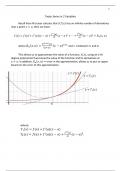
𝑦 = 𝑓(𝑥)
𝑦 = 𝑇2 (𝑥)
𝑦 = 𝑇1 (𝑥)
𝑎
where:
𝑇1 (𝑥 ) = 𝑓 (𝑎) + 𝑓′(𝑎)(𝑥 − 𝑎)
𝑓 ′′ (𝑎)
𝑇2 (𝑥 ) = 𝑓(𝑎) + 𝑓 ′ (𝑎)(𝑥 − 𝑎) + (𝑥 − 𝑎)2 .
2!
, 2
Ex. Approximate the value of 𝑒 .02 using a second order Taylor polynomial around 𝑎 = 0.
𝑓 (𝑥 ) = 𝑒 𝑥 𝑓(0) = 1
𝑓′(𝑥 ) = 𝑒 𝑥 𝑓′(0) = 1
𝑓′′(𝑥 ) = 𝑒 𝑥 𝑓′′(0) = 1
𝑓′′′(𝑥 ) = 𝑒 𝑥 𝑓′′′(0) = 1
𝑥 ′( 𝑓 ′′ (0)
𝑒 = 𝑓(0) + 𝑓 0)(𝑥 ) + (𝑥 2 ) + 𝑅2 (𝑥, 0)
2!
𝑓 ′′′ (𝑐) 𝑒𝑐
where 𝑅2 (𝑥, 0) = (𝑥 − 0)3 = 𝑥 3 and 0 < 𝑐 < 𝑥.
3! 3!
𝑥 𝑥2 𝑒𝑐
𝑒 =1+𝑥+ + 3! 𝑥 3
2!
So now we can plug in 𝑥 = .02
.02 (.02)2 .0004
𝑒 ≈ 1 + .02 + = 1 + .02 + = 1.0202
2! 2
The error is no bigger than:
𝑒𝑐 3
|𝑅2 (.02, 0)| = (. 02)3 ≤ (. 000008) = .000004.
3! 3!
Taylor Series in 2 Variables
Recall from first year calculus that if 𝑓(𝑥) has an infinite number of derivatives
near a point 𝑥 = 𝑎, then we have:
′ (𝑎)(𝑥 𝑓′′(𝑎) 𝑓𝑛(𝑎)
𝑓(𝑥) = 𝑓(𝑎) + 𝑓 − 𝑎) + (𝑥 − 𝑎)2 + ⋯+ (𝑥 − 𝑎)𝑛 + 𝑅𝑛 (𝑥, 𝑎)
2! 𝑛!
𝑓 (𝑛+1) (𝑐)
where 𝑅𝑛 (𝑥, 𝑎) =
(𝑛+1)!
(𝑥 − 𝑎)𝑛+1 and 𝑐 is between 𝑥 and 𝑎.
This allows us to approximate the value of a function, 𝑓(𝑥), using an 𝑛-th
degree polynomial if we know the value of the function and its derivatives at
𝑥 = 𝑎. In addition, 𝑅𝑛 (𝑥, 𝑎) = error in the approximation, allows us to put an upper
bound on the error of this approximation.
𝑦 = 𝑓(𝑥)
𝑦 = 𝑇2 (𝑥)
𝑦 = 𝑇1 (𝑥)
𝑎
where:
𝑇1 (𝑥 ) = 𝑓 (𝑎) + 𝑓′(𝑎)(𝑥 − 𝑎)
𝑓 ′′ (𝑎)
𝑇2 (𝑥 ) = 𝑓(𝑎) + 𝑓 ′ (𝑎)(𝑥 − 𝑎) + (𝑥 − 𝑎)2 .
2!
, 2
Ex. Approximate the value of 𝑒 .02 using a second order Taylor polynomial around 𝑎 = 0.
𝑓 (𝑥 ) = 𝑒 𝑥 𝑓(0) = 1
𝑓′(𝑥 ) = 𝑒 𝑥 𝑓′(0) = 1
𝑓′′(𝑥 ) = 𝑒 𝑥 𝑓′′(0) = 1
𝑓′′′(𝑥 ) = 𝑒 𝑥 𝑓′′′(0) = 1
𝑥 ′( 𝑓 ′′ (0)
𝑒 = 𝑓(0) + 𝑓 0)(𝑥 ) + (𝑥 2 ) + 𝑅2 (𝑥, 0)
2!
𝑓 ′′′ (𝑐) 𝑒𝑐
where 𝑅2 (𝑥, 0) = (𝑥 − 0)3 = 𝑥 3 and 0 < 𝑐 < 𝑥.
3! 3!
𝑥 𝑥2 𝑒𝑐
𝑒 =1+𝑥+ + 3! 𝑥 3
2!
So now we can plug in 𝑥 = .02
.02 (.02)2 .0004
𝑒 ≈ 1 + .02 + = 1 + .02 + = 1.0202
2! 2
The error is no bigger than:
𝑒𝑐 3
|𝑅2 (.02, 0)| = (. 02)3 ≤ (. 000008) = .000004.
3! 3!