1
Extrema of Functions of 2 Variables
For functions of one variable, we know how to find relative maxima and minima.
1. Find all critical numbers (𝑓 ′ (𝑎) = 0 or 𝑓′(𝑎) is undefined,
but "𝑎" is in the domain of 𝑓(𝑥))
2. Second derivative test:
𝑓 ′′ (𝑎) < 0 ⇒ local max
𝑓 ′′ (𝑎) > 0 ⇒ local min
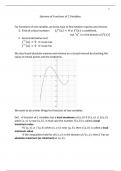
We also found absolute maxima and minima on a closed interval by checking the
value at critical points and the endpoints.
We want to do similar things for functions of two variables.
Def. A function of 2 variables has a local maximum at (𝑎, 𝑏) if 𝑓(𝑥, 𝑦) ≤ 𝑓(𝑎, 𝑏)
when (𝑥, 𝑦) is near (𝑎, 𝑏), in that case the number 𝑓(𝑎, 𝑏) is called a local
maximum value.
If 𝑓(𝑥, 𝑦) ≥ 𝑓(𝑎, 𝑏) when (𝑥, 𝑦) is near (𝑎, 𝑏), then 𝑓(𝑎, 𝑏) is called a local
minimum value.
If the inequalities hold for all (𝑥, 𝑦) in the domain of 𝑓(𝑥, 𝑦), then 𝑓 has an
absolute maximum (or minimum) at (𝑎, 𝑏).
, 2
Theorem: If 𝑓 has a local maximum or minimum at (𝑎, 𝑏) and the first
partial derivatives exist at (𝑎, 𝑏), then:
𝑓𝑥 (𝑎, 𝑏) = 0 and 𝑓𝑦 (𝑎, 𝑏) = 0.
This is the analogue to one variable where if 𝑎 is a local
maximum or minimum and 𝑓 ′ (𝑎) exists, then 𝑓 ′ (𝑎) = 0.
Proof: Let 𝑔(𝑥) = 𝑓(𝑥, 𝑏). If 𝑓 has a local max or min at (𝑎, 𝑏), then so
does 𝑔(𝑥). Thus, 𝑔′ (𝑎) = 0 but 𝑔′ (𝑎) = 𝑓𝑥 (𝑎, 𝑏) = 0.
By a similar argument, if 𝑓 has a local max or min at (𝑎, 𝑏), then
𝑓𝑦 (𝑎, 𝑏) = 0.
If we put 𝑓𝑥 (𝑎, 𝑏 ) = 𝑓𝑦 (𝑎, 𝑏) = 0 into the formula for the tangent plane
at (𝑎, 𝑏), we get the following equation:
𝑧 = 𝑓 (𝑎, 𝑏)
This is a plane parallel to the 𝑥𝑦 plane that is analogous to the horizontal
tangent line at a local max or min in one variable.
Def. A point, (𝑎, 𝑏), is called a critical point (or stationary point) of 𝑓 if
𝑓𝑥 (𝑎, 𝑏) = 0, 𝑓𝑦 (𝑎, 𝑏) = 0 or if one of the partial derivatives
doesn’t exist (but (𝑎, 𝑏) is in the domain of 𝑓).
So our theorem says that if 𝑓 has a local max/min at (𝑎, 𝑏), then (𝑎, 𝑏) is a critical
point. However, a critical point could be a local max/min or neither.
𝑓(𝑥 ) = 𝑥 2 𝑓(𝑥 ) = 𝑥 3
𝑓 ′ (0) = 0
𝑓 ′ (0) = 0 𝑥 = 0 is not a local
maximum or minimum
Extrema of Functions of 2 Variables
For functions of one variable, we know how to find relative maxima and minima.
1. Find all critical numbers (𝑓 ′ (𝑎) = 0 or 𝑓′(𝑎) is undefined,
but "𝑎" is in the domain of 𝑓(𝑥))
2. Second derivative test:
𝑓 ′′ (𝑎) < 0 ⇒ local max
𝑓 ′′ (𝑎) > 0 ⇒ local min
We also found absolute maxima and minima on a closed interval by checking the
value at critical points and the endpoints.
We want to do similar things for functions of two variables.
Def. A function of 2 variables has a local maximum at (𝑎, 𝑏) if 𝑓(𝑥, 𝑦) ≤ 𝑓(𝑎, 𝑏)
when (𝑥, 𝑦) is near (𝑎, 𝑏), in that case the number 𝑓(𝑎, 𝑏) is called a local
maximum value.
If 𝑓(𝑥, 𝑦) ≥ 𝑓(𝑎, 𝑏) when (𝑥, 𝑦) is near (𝑎, 𝑏), then 𝑓(𝑎, 𝑏) is called a local
minimum value.
If the inequalities hold for all (𝑥, 𝑦) in the domain of 𝑓(𝑥, 𝑦), then 𝑓 has an
absolute maximum (or minimum) at (𝑎, 𝑏).
, 2
Theorem: If 𝑓 has a local maximum or minimum at (𝑎, 𝑏) and the first
partial derivatives exist at (𝑎, 𝑏), then:
𝑓𝑥 (𝑎, 𝑏) = 0 and 𝑓𝑦 (𝑎, 𝑏) = 0.
This is the analogue to one variable where if 𝑎 is a local
maximum or minimum and 𝑓 ′ (𝑎) exists, then 𝑓 ′ (𝑎) = 0.
Proof: Let 𝑔(𝑥) = 𝑓(𝑥, 𝑏). If 𝑓 has a local max or min at (𝑎, 𝑏), then so
does 𝑔(𝑥). Thus, 𝑔′ (𝑎) = 0 but 𝑔′ (𝑎) = 𝑓𝑥 (𝑎, 𝑏) = 0.
By a similar argument, if 𝑓 has a local max or min at (𝑎, 𝑏), then
𝑓𝑦 (𝑎, 𝑏) = 0.
If we put 𝑓𝑥 (𝑎, 𝑏 ) = 𝑓𝑦 (𝑎, 𝑏) = 0 into the formula for the tangent plane
at (𝑎, 𝑏), we get the following equation:
𝑧 = 𝑓 (𝑎, 𝑏)
This is a plane parallel to the 𝑥𝑦 plane that is analogous to the horizontal
tangent line at a local max or min in one variable.
Def. A point, (𝑎, 𝑏), is called a critical point (or stationary point) of 𝑓 if
𝑓𝑥 (𝑎, 𝑏) = 0, 𝑓𝑦 (𝑎, 𝑏) = 0 or if one of the partial derivatives
doesn’t exist (but (𝑎, 𝑏) is in the domain of 𝑓).
So our theorem says that if 𝑓 has a local max/min at (𝑎, 𝑏), then (𝑎, 𝑏) is a critical
point. However, a critical point could be a local max/min or neither.
𝑓(𝑥 ) = 𝑥 2 𝑓(𝑥 ) = 𝑥 3
𝑓 ′ (0) = 0
𝑓 ′ (0) = 0 𝑥 = 0 is not a local
maximum or minimum