1
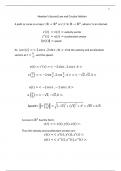
Newton’s Second Law and Circular Motion
A path or curve is a map 𝑐: ℝ → ℝ𝑛 or 𝑐: 𝐼 ⊆ ℝ → ℝ𝑛 , where 𝐼 is an interval.
𝑐′(𝑡) = 𝑣 (𝑡) = velocity vector
𝑐′′(𝑡) = 𝑎(𝑡) = acceleration vector
‖𝑣 (𝑡)‖ = speed
Ex. Let 𝑐 (𝑡) = < 2 cos 𝑡 , 2 sin 𝑡 , 4𝑡 >. Find the velocity and acceleration
𝜋
vectors at 𝑡 = , and the speed.
4
𝑣(𝑡) = 𝑐 ′ (𝑡) = < −2 sin 𝑡 , 2 cos 𝑡 , 4 >
𝜋 𝜋 𝜋
𝑣 ( ) = < −2 sin , 2 cos , 4 > = < −√2, √2, 4 >
4 4 4
𝑎(𝑡) = < −2 cos 𝑡 , − 2 sin 𝑡 , 0 >
𝜋
𝑎 ( ) = < −√2, −√2, 0 >.
4
𝜋 2 2
Speed= ‖𝑣 ( )‖ = √(−√2) + (√2) + 42 = √20 = 2√5.
4
A curve in ℝ3 has the form:
𝑐(𝑡) = < 𝑥 (𝑡), 𝑦(𝑡), 𝑧(𝑡) >.
Thus the velocity and acceleration vectors are:
𝑣 (𝑡) = < 𝑥 ′ (𝑡), 𝑦 ′ (𝑡), 𝑧 ′ (𝑡) >
𝑎(𝑡) = < 𝑥 ′′ (𝑡), 𝑦 ′′ (𝑡), 𝑧 ′′ (𝑡) >.
, 2
Def. A differentiable path, 𝑐, is said to be regular at 𝑡 = 𝑡0 if 𝑐 ′ (𝑡0 ) ≠ ⃗0. If
𝑐 ′ (𝑡) ≠ ⃗0 for all 𝑡, then we say 𝑐 is a regular path.
2
Ex. Where is the path 𝑐 (𝑡) = < 𝑡 2 , 𝑐𝑜𝑠𝑡 , 𝑒 𝑡 > regular?
2
𝑐 ′ (𝑡) = < 2𝑡, −𝑠𝑖𝑛𝑡 , 2𝑡𝑒 𝑡 >
⃗ only when 𝑡 = 0
𝑐 ′ (𝑡) = 0
So 𝑐(𝑡) is regular when 𝑡 ≠ 0.
Ex. The acceleration, initial velocity, and initial position of a particle traveling
through space are given by:
𝑎(𝑡) = < 2, −6, −4 >
𝑣 (0) = < −5, 1, 3 >
𝑟(0) = < 6, −2, −1 >
The particle’s trajectory (path), 𝑟(𝑡), intersects the 𝑦𝑧 plane exactly twice. Find
the intersection points.
𝑎(𝑡) = < 𝑥 ′′ (𝑡), 𝑦 ′′ (𝑡), 𝑧 ′′ (𝑡) > = < 2, −6, −4 >; thus by integration:
𝑥 ′ (𝑡) = 2𝑡 + 𝑐1
𝑦 ′ (𝑡) = −6𝑡 + 𝑐2
𝑧 ′ (𝑡) = −4𝑡 + 𝑐3
𝑣(0) = < 𝑥 ′ (0), 𝑦 ′ (0), 𝑧 ′ (0) > = < −5, 1, 3 >; thus we have:
−5 = 𝑥 ′ (0) = 2(0) + 𝑐1 ⇒ 𝑐1 = −5
1 = 𝑦 ′ (0) = −6(0) + 𝑐2 ⇒ 𝑐2 = 1
3 = 𝑧 ′ (0) = −4(0) + 𝑐3 ⇒ 𝑐3 = 3
Newton’s Second Law and Circular Motion
A path or curve is a map 𝑐: ℝ → ℝ𝑛 or 𝑐: 𝐼 ⊆ ℝ → ℝ𝑛 , where 𝐼 is an interval.
𝑐′(𝑡) = 𝑣 (𝑡) = velocity vector
𝑐′′(𝑡) = 𝑎(𝑡) = acceleration vector
‖𝑣 (𝑡)‖ = speed
Ex. Let 𝑐 (𝑡) = < 2 cos 𝑡 , 2 sin 𝑡 , 4𝑡 >. Find the velocity and acceleration
𝜋
vectors at 𝑡 = , and the speed.
4
𝑣(𝑡) = 𝑐 ′ (𝑡) = < −2 sin 𝑡 , 2 cos 𝑡 , 4 >
𝜋 𝜋 𝜋
𝑣 ( ) = < −2 sin , 2 cos , 4 > = < −√2, √2, 4 >
4 4 4
𝑎(𝑡) = < −2 cos 𝑡 , − 2 sin 𝑡 , 0 >
𝜋
𝑎 ( ) = < −√2, −√2, 0 >.
4
𝜋 2 2
Speed= ‖𝑣 ( )‖ = √(−√2) + (√2) + 42 = √20 = 2√5.
4
A curve in ℝ3 has the form:
𝑐(𝑡) = < 𝑥 (𝑡), 𝑦(𝑡), 𝑧(𝑡) >.
Thus the velocity and acceleration vectors are:
𝑣 (𝑡) = < 𝑥 ′ (𝑡), 𝑦 ′ (𝑡), 𝑧 ′ (𝑡) >
𝑎(𝑡) = < 𝑥 ′′ (𝑡), 𝑦 ′′ (𝑡), 𝑧 ′′ (𝑡) >.
, 2
Def. A differentiable path, 𝑐, is said to be regular at 𝑡 = 𝑡0 if 𝑐 ′ (𝑡0 ) ≠ ⃗0. If
𝑐 ′ (𝑡) ≠ ⃗0 for all 𝑡, then we say 𝑐 is a regular path.
2
Ex. Where is the path 𝑐 (𝑡) = < 𝑡 2 , 𝑐𝑜𝑠𝑡 , 𝑒 𝑡 > regular?
2
𝑐 ′ (𝑡) = < 2𝑡, −𝑠𝑖𝑛𝑡 , 2𝑡𝑒 𝑡 >
⃗ only when 𝑡 = 0
𝑐 ′ (𝑡) = 0
So 𝑐(𝑡) is regular when 𝑡 ≠ 0.
Ex. The acceleration, initial velocity, and initial position of a particle traveling
through space are given by:
𝑎(𝑡) = < 2, −6, −4 >
𝑣 (0) = < −5, 1, 3 >
𝑟(0) = < 6, −2, −1 >
The particle’s trajectory (path), 𝑟(𝑡), intersects the 𝑦𝑧 plane exactly twice. Find
the intersection points.
𝑎(𝑡) = < 𝑥 ′′ (𝑡), 𝑦 ′′ (𝑡), 𝑧 ′′ (𝑡) > = < 2, −6, −4 >; thus by integration:
𝑥 ′ (𝑡) = 2𝑡 + 𝑐1
𝑦 ′ (𝑡) = −6𝑡 + 𝑐2
𝑧 ′ (𝑡) = −4𝑡 + 𝑐3
𝑣(0) = < 𝑥 ′ (0), 𝑦 ′ (0), 𝑧 ′ (0) > = < −5, 1, 3 >; thus we have:
−5 = 𝑥 ′ (0) = 2(0) + 𝑐1 ⇒ 𝑐1 = −5
1 = 𝑦 ′ (0) = −6(0) + 𝑐2 ⇒ 𝑐2 = 1
3 = 𝑧 ′ (0) = −4(0) + 𝑐3 ⇒ 𝑐3 = 3