1
Vector Fields
⃗: 𝐴 ⊆
Def. A vector field in ℝ𝑛 is a map 𝐹 ℝ𝑛 → ℝ𝑛 that assigns to each
point 𝑥 = (𝑥1 , 𝑥2 , 𝑥3 , … , 𝑥𝑛 ) ∈ 𝐴, a vector𝐹⃗ (𝑥) ∈ ℝ𝑛 .
If 𝑛 = 2, we call 𝐹⃗ a vector field in the plane.
If 𝑛 = 3, we call 𝐹⃗ a vector field in space.
We can always write a vector field in space in the form:
𝐹⃗ (𝑥, 𝑦, 𝑧) = 𝐹1 (𝑥, 𝑦, 𝑧)𝑖⃗ + 𝐹2 (𝑥, 𝑦, 𝑧)𝑗⃗ + 𝐹3 (𝑥, 𝑦, 𝑧)𝑘⃗⃗
or
𝐹⃗ (𝑥, 𝑦, 𝑧) = < 𝐹1 (𝑥, 𝑦, 𝑧), 𝐹2 (𝑥, 𝑦, 𝑧), 𝐹3 (𝑥, 𝑦, 𝑧) >.
Notice that this is different from real-valued functions from ℝ3 → ℝ (which we
will sometimes call a scalar field).
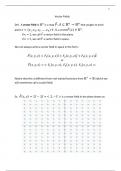
Ex. 𝐹⃗ (𝑥, 𝑦) = 2𝑖⃗ − 3𝑗⃗ = < 2, −3 > is a vector field in the plane drawn as
, 2
Ex. 𝐹⃗ (𝑥, 𝑦) = 𝑦𝑖⃗ − 𝑥𝑗⃗ = < 𝑦, −𝑥 > is a vector field in the plane
Point 𝐹⃗ (𝑥, 𝑦)
(1,0) < 0, −1 >
(1, −1) < −1, −1 >
(0, −2) < −2,0 >
(−2, −2) < −2,2 >
(−4,0) < 0,4 >
(−4,4) < 4,4 >
(0,8) < 8,0 >
(8,8) < 8, −8 >
⃗⃗ is a vector field on ℝ3 .
Ex. 𝐹⃗ (𝑥, 𝑦, 𝑧) = (𝑥 2 𝑧)𝑖⃗ + 𝑒 𝑦 𝑗⃗ + sin(𝑥𝑧)𝑘
𝑓(𝑥, 𝑦, 𝑧) = 𝑥 2 𝑧 + 𝑒 𝑦 + sin(𝑥𝑧) is a real-valued function on ℝ3 .
Notice that for every value of 𝑥, 𝑦, 𝑧, 𝐹⃗ (𝑥, 𝑦, 𝑧) gives us a vector in ℝ3 .
For every value of 𝑥, 𝑦, 𝑧, 𝑓(𝑥, 𝑦, 𝑧) gives us a real number, not a
vector in ℝ3 .
Vector Fields
⃗: 𝐴 ⊆
Def. A vector field in ℝ𝑛 is a map 𝐹 ℝ𝑛 → ℝ𝑛 that assigns to each
point 𝑥 = (𝑥1 , 𝑥2 , 𝑥3 , … , 𝑥𝑛 ) ∈ 𝐴, a vector𝐹⃗ (𝑥) ∈ ℝ𝑛 .
If 𝑛 = 2, we call 𝐹⃗ a vector field in the plane.
If 𝑛 = 3, we call 𝐹⃗ a vector field in space.
We can always write a vector field in space in the form:
𝐹⃗ (𝑥, 𝑦, 𝑧) = 𝐹1 (𝑥, 𝑦, 𝑧)𝑖⃗ + 𝐹2 (𝑥, 𝑦, 𝑧)𝑗⃗ + 𝐹3 (𝑥, 𝑦, 𝑧)𝑘⃗⃗
or
𝐹⃗ (𝑥, 𝑦, 𝑧) = < 𝐹1 (𝑥, 𝑦, 𝑧), 𝐹2 (𝑥, 𝑦, 𝑧), 𝐹3 (𝑥, 𝑦, 𝑧) >.
Notice that this is different from real-valued functions from ℝ3 → ℝ (which we
will sometimes call a scalar field).
Ex. 𝐹⃗ (𝑥, 𝑦) = 2𝑖⃗ − 3𝑗⃗ = < 2, −3 > is a vector field in the plane drawn as
, 2
Ex. 𝐹⃗ (𝑥, 𝑦) = 𝑦𝑖⃗ − 𝑥𝑗⃗ = < 𝑦, −𝑥 > is a vector field in the plane
Point 𝐹⃗ (𝑥, 𝑦)
(1,0) < 0, −1 >
(1, −1) < −1, −1 >
(0, −2) < −2,0 >
(−2, −2) < −2,2 >
(−4,0) < 0,4 >
(−4,4) < 4,4 >
(0,8) < 8,0 >
(8,8) < 8, −8 >
⃗⃗ is a vector field on ℝ3 .
Ex. 𝐹⃗ (𝑥, 𝑦, 𝑧) = (𝑥 2 𝑧)𝑖⃗ + 𝑒 𝑦 𝑗⃗ + sin(𝑥𝑧)𝑘
𝑓(𝑥, 𝑦, 𝑧) = 𝑥 2 𝑧 + 𝑒 𝑦 + sin(𝑥𝑧) is a real-valued function on ℝ3 .
Notice that for every value of 𝑥, 𝑦, 𝑧, 𝐹⃗ (𝑥, 𝑦, 𝑧) gives us a vector in ℝ3 .
For every value of 𝑥, 𝑦, 𝑧, 𝑓(𝑥, 𝑦, 𝑧) gives us a real number, not a
vector in ℝ3 .