1
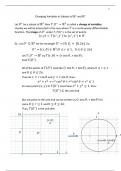
Changing Variables in Subsets of ℝ2 and ℝ3
Let 𝐷 ∗ be a subset of ℝ2 then 𝑇: 𝐷 ∗ → ℝ2 is called a change of variables.
Usually we will be interested in the case where 𝑇 is a continuously differentiable
function. The image of 𝐷 ∗ under 𝑇, 𝑇(𝐷∗ ), is the set of points:
(𝑥, 𝑦) = 𝑇(𝑥 ∗ , 𝑦 ∗ ) for (𝑥 ∗ , 𝑦 ∗ ) ∈ 𝐷∗
Ex. Let 𝐷 ∗ ⊆ ℝ2 be the rectangle 𝐷 ∗ = [0, 1] × [0, 2𝜋]. So,
𝐷 ∗ = {(𝑟, 𝜃) ∈ ℝ2 | 0 ≤ 𝑟 ≤ 1, 0 ≤ 𝜃 ≤ 2𝜋}
Let 𝑇: 𝐷 ∗ → ℝ2 by 𝑇(𝑟, 𝜃 ) = (𝑟 cos 𝜃 , 𝑟 sin 𝜃).
Find 𝑇 (𝐷 ∗ ).
All of the points of 𝑇(𝐷 ∗ ) look like (𝑟 cos 𝜃 , 𝑟 sin 𝜃 ), where 0 ≤ 𝑟 ≤ 1
and 0 ≤ 𝜃 ≤ 2𝜋.
If we let 𝑥 = 𝑟 cos 𝜃 and 𝑦 = 𝑟 sin 𝜃, then:
𝑥 2 + 𝑦 2 = 𝑟 2 cos2 𝜃 + 𝑟 2 sin2 𝜃 = 𝑟 2 ≤ 1
So every point (𝑥, 𝑦) in 𝑇(𝐷 ∗ ) must have 𝑥 2 + 𝑦 2 ≤ 1, thus:
𝑇(𝐷∗ ) ⊆ the unit disk
But any point in the unit disk can be written as (𝑟 cos 𝜃 , 𝑟 sin 𝜃 ) for
some 0 ≤ 𝑟 ≤ 1 and 0 ≤ 𝜃 ≤ 2𝜋.
Thus, 𝑇(𝐷 ∗ ) is the unit disk.
2𝜋 𝑦
1
(𝑟, 𝜃)
𝜃 𝐷∗ 𝑇
1 𝑥
(𝑟𝑐𝑜𝑠𝜃, 𝑟𝑠𝑖𝑛𝜃)
1 𝑟
, 2
Ex. Let 𝐷 ∗ = [−1, 1] × [−1, 1] ⊆ ℝ2 , a square with side length of 2
(𝑥−𝑦) (𝑥+𝑦)
centered at the origin. Let 𝑇(𝑥, 𝑦) = (
2
,
2
). Find 𝑇(𝐷 ∗ ).
First, let’s see what 𝑇 does to the boundary of 𝐷 ∗ .
(−1,1) (1,1)
𝑐1 (𝑡)
𝐷∗
(−1, −1) (1, −1)
𝑐1 (𝑡) = < 1, 𝑡 > ; −1 ≤ 𝑡 ≤ 1
1−𝑡 1+𝑡
𝑇(𝑐1 (𝑡)) = ( , ) ; −1 ≤ 𝑡 ≤ 1
2 2
1−𝑡 1+𝑡
So 𝑥 = and 𝑦 =
2 2
We can eliminate the 𝑡 by adding the equations to get:
𝑥+𝑦=1
Since −1 ≤ 𝑡 ≤ 1, we get the portion of the line that starts at 𝑡 = −1
(i.e. 𝑥 = 1, 𝑦 = 0) and ends at 𝑡 = 1 (i.e. 𝑥 = 0, 𝑦 = 1).
(0,1)
(1,1)
𝑇
𝑦 =1−𝑥
(1, −1)
(1,0)
Changing Variables in Subsets of ℝ2 and ℝ3
Let 𝐷 ∗ be a subset of ℝ2 then 𝑇: 𝐷 ∗ → ℝ2 is called a change of variables.
Usually we will be interested in the case where 𝑇 is a continuously differentiable
function. The image of 𝐷 ∗ under 𝑇, 𝑇(𝐷∗ ), is the set of points:
(𝑥, 𝑦) = 𝑇(𝑥 ∗ , 𝑦 ∗ ) for (𝑥 ∗ , 𝑦 ∗ ) ∈ 𝐷∗
Ex. Let 𝐷 ∗ ⊆ ℝ2 be the rectangle 𝐷 ∗ = [0, 1] × [0, 2𝜋]. So,
𝐷 ∗ = {(𝑟, 𝜃) ∈ ℝ2 | 0 ≤ 𝑟 ≤ 1, 0 ≤ 𝜃 ≤ 2𝜋}
Let 𝑇: 𝐷 ∗ → ℝ2 by 𝑇(𝑟, 𝜃 ) = (𝑟 cos 𝜃 , 𝑟 sin 𝜃).
Find 𝑇 (𝐷 ∗ ).
All of the points of 𝑇(𝐷 ∗ ) look like (𝑟 cos 𝜃 , 𝑟 sin 𝜃 ), where 0 ≤ 𝑟 ≤ 1
and 0 ≤ 𝜃 ≤ 2𝜋.
If we let 𝑥 = 𝑟 cos 𝜃 and 𝑦 = 𝑟 sin 𝜃, then:
𝑥 2 + 𝑦 2 = 𝑟 2 cos2 𝜃 + 𝑟 2 sin2 𝜃 = 𝑟 2 ≤ 1
So every point (𝑥, 𝑦) in 𝑇(𝐷 ∗ ) must have 𝑥 2 + 𝑦 2 ≤ 1, thus:
𝑇(𝐷∗ ) ⊆ the unit disk
But any point in the unit disk can be written as (𝑟 cos 𝜃 , 𝑟 sin 𝜃 ) for
some 0 ≤ 𝑟 ≤ 1 and 0 ≤ 𝜃 ≤ 2𝜋.
Thus, 𝑇(𝐷 ∗ ) is the unit disk.
2𝜋 𝑦
1
(𝑟, 𝜃)
𝜃 𝐷∗ 𝑇
1 𝑥
(𝑟𝑐𝑜𝑠𝜃, 𝑟𝑠𝑖𝑛𝜃)
1 𝑟
, 2
Ex. Let 𝐷 ∗ = [−1, 1] × [−1, 1] ⊆ ℝ2 , a square with side length of 2
(𝑥−𝑦) (𝑥+𝑦)
centered at the origin. Let 𝑇(𝑥, 𝑦) = (
2
,
2
). Find 𝑇(𝐷 ∗ ).
First, let’s see what 𝑇 does to the boundary of 𝐷 ∗ .
(−1,1) (1,1)
𝑐1 (𝑡)
𝐷∗
(−1, −1) (1, −1)
𝑐1 (𝑡) = < 1, 𝑡 > ; −1 ≤ 𝑡 ≤ 1
1−𝑡 1+𝑡
𝑇(𝑐1 (𝑡)) = ( , ) ; −1 ≤ 𝑡 ≤ 1
2 2
1−𝑡 1+𝑡
So 𝑥 = and 𝑦 =
2 2
We can eliminate the 𝑡 by adding the equations to get:
𝑥+𝑦=1
Since −1 ≤ 𝑡 ≤ 1, we get the portion of the line that starts at 𝑡 = −1
(i.e. 𝑥 = 1, 𝑦 = 0) and ends at 𝑡 = 1 (i.e. 𝑥 = 0, 𝑦 = 1).
(0,1)
(1,1)
𝑇
𝑦 =1−𝑥
(1, −1)
(1,0)