

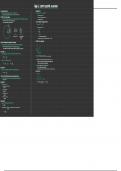
lab 6 : centripetal motion
·
centripetal motion ·
procedure 2
·
occurs anytime an object m ove s in a circular path how are v ,
R ,
a T related
·
when a n object has constant speed a uniform circular motion
v is proportional to R
·
uniform circular motion v is inversely proportional to T
·
the velocity vectors all have the same magnitude a point tangential to the circle R is proportional to T
·
constant magnitude but changing direction
h ow to make the graph linear
↳ this means there is acceleration
mr
&
function : F =
Vf
relating to y = my + b
r it ri -vi vi F =
y
m
O
m =
r #
,
DV r
ri
Ar =
rf -
ri DV =
Vf
-
Vi X = v2
points up 3 left points towards b = force when velocity = 0
center of
to make the graph linear we need to plot v2 & NOT V
circle
straight line analysis
·
·
the two triangles are isosceles triangles
bic both radius a velocity vectors are the s a m e i n magnitude
·
&
·
the two triangles are also similar bic its angles are congruent M
sides on either side of the angle are also
8
↳ the same equal i n proportion
deriving a
·
velocity ?
·
based on geometric rule we can relate the radius a velocity
the slope of the graph represents
Ap
DV m in units of kglm
=
r
avadivide the intercept of the graph represents the force when =
v =
0
solve for at
by
·
↳ however i n this lab we had a starting uncertainty for the
Ar
Vr =
V =
* V =
force so it represents the uncertainty
At
our expected slope result is
calculating mir
↳ whour measured mass a radius
question 4
·
our expected intercept is the uncertainty the software provided
what is the magnitute of the force responsible ford c ?
·
uncertainty
F mac =
mv
=
AF
mr
=
there i s no
single force that is centripetal force
·
AVI = 2V .
AV
·
multiple forces combine to cause centripetal acceleration
AmV2 = Am .
V2 + 2VDV .
M
·
unlike gravity
va
my
m
Gr
DF m + 2VAV
question S
. .
·
=
.
.
mu
what causes ac ?
1 swinging ball on string
tension
. earth
2 orbiting
gravity
.
3 cararound curve
friction
4 .
Kid on a swing
tension
question G
·
·
what is the velocity i n ter ms of r a T
T = period
Since velocity = distance ,
the distance is the circumference
time
&
2πr
v =
T
·
centripetal motion ·
procedure 2
·
occurs anytime an object m ove s in a circular path how are v ,
R ,
a T related
·
when a n object has constant speed a uniform circular motion
v is proportional to R
·
uniform circular motion v is inversely proportional to T
·
the velocity vectors all have the same magnitude a point tangential to the circle R is proportional to T
·
constant magnitude but changing direction
h ow to make the graph linear
↳ this means there is acceleration
mr
&
function : F =
Vf
relating to y = my + b
r it ri -vi vi F =
y
m
O
m =
r #
,
DV r
ri
Ar =
rf -
ri DV =
Vf
-
Vi X = v2
points up 3 left points towards b = force when velocity = 0
center of
to make the graph linear we need to plot v2 & NOT V
circle
straight line analysis
·
·
the two triangles are isosceles triangles
bic both radius a velocity vectors are the s a m e i n magnitude
·
&
·
the two triangles are also similar bic its angles are congruent M
sides on either side of the angle are also
8
↳ the same equal i n proportion
deriving a
·
velocity ?
·
based on geometric rule we can relate the radius a velocity
the slope of the graph represents
Ap
DV m in units of kglm
=
r
avadivide the intercept of the graph represents the force when =
v =
0
solve for at
by
·
↳ however i n this lab we had a starting uncertainty for the
Ar
Vr =
V =
* V =
force so it represents the uncertainty
At
our expected slope result is
calculating mir
↳ whour measured mass a radius
question 4
·
our expected intercept is the uncertainty the software provided
what is the magnitute of the force responsible ford c ?
·
uncertainty
F mac =
mv
=
AF
mr
=
there i s no
single force that is centripetal force
·
AVI = 2V .
AV
·
multiple forces combine to cause centripetal acceleration
AmV2 = Am .
V2 + 2VDV .
M
·
unlike gravity
va
my
m
Gr
DF m + 2VAV
question S
. .
·
=
.
.
mu
what causes ac ?
1 swinging ball on string
tension
. earth
2 orbiting
gravity
.
3 cararound curve
friction
4 .
Kid on a swing
tension
question G
·
·
what is the velocity i n ter ms of r a T
T = period
Since velocity = distance ,
the distance is the circumference
time
&
2πr
v =
T


