

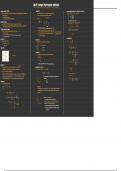
lab 9 : simple harmonic motion
motion question 7
simple harmonic how can you determine ax without massdk ?
·
·
·
when the acceleration of an object is proportional to its displacement a points in the how would you plot
Ta m to obtain linear graph F KAX KDX
Since F mg
·
a
·
mg = =
·
=
,
opposite direction to get a linear graph you would need to square T
bX finda
M this
=
type of periodic motion
/NIm
·
K
units
·
y = mx + b
eg : Suspension spring bungee jumping ↑
·
, ,
·
periodic motion T =
m .
2π n +
c =
y two parameters we don't know
m
you can replace m/k in the period
formula
·
K
any motion that repeats itself after certain time interval
T
-
·
a
↑ X
·
objects that have periodic motion needd restoring force to bring it back to equilibrium slope T =
M2πpT =
P .
2π
the intercept should be zero because when m = 0 , T = 0
·
simple harmonic motion
* however t h e intercept also includes the mass of the pand the now you can rewrite to do a linear ea
.
occurs when
restoring force obeys hooke's law : F -kX
·
=
mass of the Spring .
Therefore while the intercept would ideally why the intercept is not
K: Spring constant
+
+
2 4
be zero ,
in reality it is non-zero becauses these masses are consistent with zero
=
BX
X : the one-dimensional displacement from the
equilibrium position
not physically negligible .
SI units for K : N/m
·
uncertainties
question 2
·
·
question 8
1
·
newton's second law .
m
·
what if the block was hanging vertically ? T = 2π .
F = ma but also F = -kX -
17
FS
,
ma = -
kX F = ma =
mg -
Es
a
Fs kX g
m AM A
q =
question 3
· =
·
mg ma =
mg -
kX
F = max left
1
am
question 9
am
·
= +
F = O m
F = max ·
if the mass is not accelerating , derive equation for X
right Fmax = KA
F = 0
F = max left
ma
: mg-kx 2
.
m
+ a
F =
g Am
F = maX x =
mg
m
right ST
K =
24 -
X is directly proportional to my inversely proportional to k 2
.
m
question S
·
·
the motion of the block can be described as X =
Acos ·
procedures to find K
.
2 k = 442m
A: amplitude maximum ,
distance from equilibrium the box can go ·
procedure 1 : plot T2 vs
. m graph
T2
·
why is T the period of oscillations ?
cosine is an oscillating function that oscillates btwn-1 and 1 every 2it .
analogously
,
&
·
equation : Th =
Th m
A42m =
42 Am .
m
AT = 2 DT T
the the spring oscillates btwn A and A for every period T
.
motion of . -
therefore
you can calculate the spring constant by dividing it by
·
.
M
AK
cosine values repeat every 2 i t
=
i n the same way that the motion repeats every . T2
T
4TRM LBIT
the slope ·
K
4π2
k =
question 6
·
D
m slope
·
what is the equation for T
1x ad F -
F =
ma
procedure
= = ·
2
F =
by measuring the position
-
at equilibrium mg kX we can plot an mg vs X graph
·
= .
,
of the spring when it is not oscillating a placing a different mass on the spring
wixa each time
d
kx w
=
-
=
&
I
wom =
wa K
=
= the slope is k in units of N/m
m &
m
mg & there is no expected bic we are finding it
2π
2
w =
DT =
·
the intercept represents the weight when the spring is
masses are attached
D
T in equilibrium a no
substitute X
) the expected intercept
↳ is O b l we are considering
T = 2π .
m the spring to be massless a frictionless so when
X =
0 , mg =
0
motion question 7
simple harmonic how can you determine ax without massdk ?
·
·
·
when the acceleration of an object is proportional to its displacement a points in the how would you plot
Ta m to obtain linear graph F KAX KDX
Since F mg
·
a
·
mg = =
·
=
,
opposite direction to get a linear graph you would need to square T
bX finda
M this
=
type of periodic motion
/NIm
·
K
units
·
y = mx + b
eg : Suspension spring bungee jumping ↑
·
, ,
·
periodic motion T =
m .
2π n +
c =
y two parameters we don't know
m
you can replace m/k in the period
formula
·
K
any motion that repeats itself after certain time interval
T
-
·
a
↑ X
·
objects that have periodic motion needd restoring force to bring it back to equilibrium slope T =
M2πpT =
P .
2π
the intercept should be zero because when m = 0 , T = 0
·
simple harmonic motion
* however t h e intercept also includes the mass of the pand the now you can rewrite to do a linear ea
.
occurs when
restoring force obeys hooke's law : F -kX
·
=
mass of the Spring .
Therefore while the intercept would ideally why the intercept is not
K: Spring constant
+
+
2 4
be zero ,
in reality it is non-zero becauses these masses are consistent with zero
=
BX
X : the one-dimensional displacement from the
equilibrium position
not physically negligible .
SI units for K : N/m
·
uncertainties
question 2
·
·
question 8
1
·
newton's second law .
m
·
what if the block was hanging vertically ? T = 2π .
F = ma but also F = -kX -
17
FS
,
ma = -
kX F = ma =
mg -
Es
a
Fs kX g
m AM A
q =
question 3
· =
·
mg ma =
mg -
kX
F = max left
1
am
question 9
am
·
= +
F = O m
F = max ·
if the mass is not accelerating , derive equation for X
right Fmax = KA
F = 0
F = max left
ma
: mg-kx 2
.
m
+ a
F =
g Am
F = maX x =
mg
m
right ST
K =
24 -
X is directly proportional to my inversely proportional to k 2
.
m
question S
·
·
the motion of the block can be described as X =
Acos ·
procedures to find K
.
2 k = 442m
A: amplitude maximum ,
distance from equilibrium the box can go ·
procedure 1 : plot T2 vs
. m graph
T2
·
why is T the period of oscillations ?
cosine is an oscillating function that oscillates btwn-1 and 1 every 2it .
analogously
,
&
·
equation : Th =
Th m
A42m =
42 Am .
m
AT = 2 DT T
the the spring oscillates btwn A and A for every period T
.
motion of . -
therefore
you can calculate the spring constant by dividing it by
·
.
M
AK
cosine values repeat every 2 i t
=
i n the same way that the motion repeats every . T2
T
4TRM LBIT
the slope ·
K
4π2
k =
question 6
·
D
m slope
·
what is the equation for T
1x ad F -
F =
ma
procedure
= = ·
2
F =
by measuring the position
-
at equilibrium mg kX we can plot an mg vs X graph
·
= .
,
of the spring when it is not oscillating a placing a different mass on the spring
wixa each time
d
kx w
=
-
=
&
I
wom =
wa K
=
= the slope is k in units of N/m
m &
m
mg & there is no expected bic we are finding it
2π
2
w =
DT =
·
the intercept represents the weight when the spring is
masses are attached
D
T in equilibrium a no
substitute X
) the expected intercept
↳ is O b l we are considering
T = 2π .
m the spring to be massless a frictionless so when
X =
0 , mg =
0


