1
Error Estimation Using Taylor Polynomials
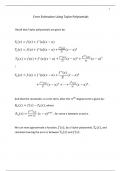
Recall that Taylor polynomials are given by:
𝑇1 (𝑥 ) = 𝑓 (𝑎) + 𝑓 ′ (𝑎)(𝑥 − 𝑎)
𝑓′′(𝑎)
𝑇2 (𝑥 ) = 𝑓 (𝑎) + 𝑓 ′ (𝑎)(𝑥 − 𝑎) + (𝑥 − 𝑎)2
2!
𝑓′′(𝑎) 𝑓′′′ (𝑎)
𝑇3 (𝑥 ) = 𝑓(𝑎) + 𝑓 𝑎)(𝑥 ′(
− 𝑎) + (𝑥 2
− 𝑎) + (𝑥 − 𝑎)3
2! 3!
⋮
′(
𝑓 ′′ (𝑎)
𝑇𝑛 (𝑥 ) = 𝑓(𝑎) + 𝑓 𝑎)(𝑥 − 𝑎) + (𝑥 − 𝑎)2
2!
𝑓′′′(𝑎) 3 𝑓𝑛 (𝑎)
+ (𝑥 − 𝑎) + ⋯+ (𝑥 − 𝑎)𝑛 .
3! 𝑛!
And that the remainder, or error term, after the 𝑛𝑡ℎ degree term is given by:
𝑅𝑛 (𝑥) = 𝑓 (𝑥 ) − 𝑇𝑛 (𝑥), where
𝑓𝑛+1 (𝑧)
𝑅𝑛 (𝑥) = (𝑛+1)!
(𝑥 − 𝑎)𝑛+1 , for some 𝑧 between 𝑎 and 𝑥 .
We can now approximate a function, 𝑓 (𝑥 ), by a Taylor polynomial, 𝑇𝑛 (𝑥 ), and
calculate how big the error is between 𝑇𝑛 (𝑥 ) and 𝑓 (𝑥 ).
, 2
Ex. Approximate 𝑓 (𝑥 ) = √𝑥 with a Taylor polynomial of degree 3 at 𝑎 = 4.
How accurate is the approximation when 3 ≤ 𝑥 ≤ 5?
𝑓′′(𝑎) 𝑓′′′(𝑎)
𝑇3 (𝑥 ) = 𝑓 (𝑎) + 𝑓 ′ (𝑎)(𝑥 − 𝑎) + (𝑥 − 𝑎)2 + (𝑥 − 𝑎)3
2! 3!
𝑓′′(4) 𝑓′′′ (4)
𝑇3 (𝑥 ) = 𝑓 (4) + 𝑓 ′ (4)(𝑥 − 4) + (𝑥 2
− 4) + (𝑥 − 4)3
2! 3!
1
𝑓(𝑥 ) = 𝑥 2 𝑓(4) = √4 = 2
1 1 1 1
′( 1 −
𝑓 𝑥) = 𝑥 2 = 𝑓 ′ (4) = =4
2 2√𝑥 2√ 4
3 1 1 1
1
𝑓 ′′ (𝑥 ) = − 𝑥 −2 = − 𝑓′′(4) = − = − 32
4 4𝑥 √𝑥 4(4)√ 4
5 3 3 3
3
𝑓 ′′′ (𝑥 ) = 𝑥 −2 = 𝑓 ′′′ (4) = =
8 8𝑥 2 √𝑥 8(42 )√4 256
1 1 1
𝑓(𝑥 ) = √𝑥 ≈ 𝑇3 (𝑥 ) = 2 + 4 (𝑥 − 4) − 64 (𝑥 − 4)2 + 512 (𝑥 − 4)3 .
Error Estimation Using Taylor Polynomials
Recall that Taylor polynomials are given by:
𝑇1 (𝑥 ) = 𝑓 (𝑎) + 𝑓 ′ (𝑎)(𝑥 − 𝑎)
𝑓′′(𝑎)
𝑇2 (𝑥 ) = 𝑓 (𝑎) + 𝑓 ′ (𝑎)(𝑥 − 𝑎) + (𝑥 − 𝑎)2
2!
𝑓′′(𝑎) 𝑓′′′ (𝑎)
𝑇3 (𝑥 ) = 𝑓(𝑎) + 𝑓 𝑎)(𝑥 ′(
− 𝑎) + (𝑥 2
− 𝑎) + (𝑥 − 𝑎)3
2! 3!
⋮
′(
𝑓 ′′ (𝑎)
𝑇𝑛 (𝑥 ) = 𝑓(𝑎) + 𝑓 𝑎)(𝑥 − 𝑎) + (𝑥 − 𝑎)2
2!
𝑓′′′(𝑎) 3 𝑓𝑛 (𝑎)
+ (𝑥 − 𝑎) + ⋯+ (𝑥 − 𝑎)𝑛 .
3! 𝑛!
And that the remainder, or error term, after the 𝑛𝑡ℎ degree term is given by:
𝑅𝑛 (𝑥) = 𝑓 (𝑥 ) − 𝑇𝑛 (𝑥), where
𝑓𝑛+1 (𝑧)
𝑅𝑛 (𝑥) = (𝑛+1)!
(𝑥 − 𝑎)𝑛+1 , for some 𝑧 between 𝑎 and 𝑥 .
We can now approximate a function, 𝑓 (𝑥 ), by a Taylor polynomial, 𝑇𝑛 (𝑥 ), and
calculate how big the error is between 𝑇𝑛 (𝑥 ) and 𝑓 (𝑥 ).
, 2
Ex. Approximate 𝑓 (𝑥 ) = √𝑥 with a Taylor polynomial of degree 3 at 𝑎 = 4.
How accurate is the approximation when 3 ≤ 𝑥 ≤ 5?
𝑓′′(𝑎) 𝑓′′′(𝑎)
𝑇3 (𝑥 ) = 𝑓 (𝑎) + 𝑓 ′ (𝑎)(𝑥 − 𝑎) + (𝑥 − 𝑎)2 + (𝑥 − 𝑎)3
2! 3!
𝑓′′(4) 𝑓′′′ (4)
𝑇3 (𝑥 ) = 𝑓 (4) + 𝑓 ′ (4)(𝑥 − 4) + (𝑥 2
− 4) + (𝑥 − 4)3
2! 3!
1
𝑓(𝑥 ) = 𝑥 2 𝑓(4) = √4 = 2
1 1 1 1
′( 1 −
𝑓 𝑥) = 𝑥 2 = 𝑓 ′ (4) = =4
2 2√𝑥 2√ 4
3 1 1 1
1
𝑓 ′′ (𝑥 ) = − 𝑥 −2 = − 𝑓′′(4) = − = − 32
4 4𝑥 √𝑥 4(4)√ 4
5 3 3 3
3
𝑓 ′′′ (𝑥 ) = 𝑥 −2 = 𝑓 ′′′ (4) = =
8 8𝑥 2 √𝑥 8(42 )√4 256
1 1 1
𝑓(𝑥 ) = √𝑥 ≈ 𝑇3 (𝑥 ) = 2 + 4 (𝑥 − 4) − 64 (𝑥 − 4)2 + 512 (𝑥 − 4)3 .