1
Approximating the Area under a Curve
Let’s start with the area under a velocity curve.
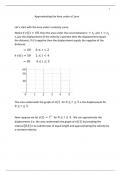
Notice if 𝑣(𝑡) = 60, then the area under the curve between 𝑡 = 𝑡1 and 𝑡 = 𝑡2
is just the displacement (if the velocity is positive then the displacement equals
the distance, if it’s negative then the displacement equals the negative of the
distance).
= 60 0≤𝑡<2
If 𝑣 (𝑡) = 50 2≤𝑡<4
= 30 4≤𝑡≤5
60
50
30
0 1 2 3 4 5
The area underneath the graph of 𝑣(𝑡) for 0 ≤ 𝑡 ≤ 5 is the displacement for
0 ≤ 𝑡 ≤ 5.
Now suppose we let 𝑣 (𝑡) = 𝑡 2 for 0 ≤ 𝑡 ≤ 4. We can approximate the
displacement (i.e. the area underneath the graph of 𝑣(𝑡)) by breaking the
interval [0,4] in to subintervals of equal length and approximating the velocity by
a constant velocity.
, 2
Ex. Approximate the area under the curve 𝑣 (𝑡) = 𝑡 2 for 0 ≤ 𝑡 ≤ 4 by
assuming that the velocity at the midpoint was the constant velocity over the
interval.
a. Let 𝑛 = 2, [0, 2], [2, 4]
b. Let 𝑛 = 4, [0, 1], [1, 2], [2, 3], [3, 4]
c. Let 𝑛 = 8, [0, .5], [. 5, 1], [1, 1.5], … , [3.5, 4]
𝑛=2 𝑣(𝑡) = 𝑡 2
𝑛=4
2
𝑣(𝑡) = 𝑡 12.25
9
6.25
2.25
1
0 1 2 3 4 0 1 2 3 4
a. Area≈ 𝑣 (1) ∙ 2 + 𝑣 (3) ∙ 2 = 12 (2) + 32 (2) = 2 + 18 = 20
1 3 5 7
b. Area≈ 𝑣 ( ) ∙ (1) + 𝑣 ( ) ∙ 1 + 𝑣 ( ) ∙ 1 + 𝑣 ( ) ∙ 1
2 2 2 2
1 3 5 7
= ( )2 (1) + ( )2 (1) + ( )2 (1) + ( )2 (1)
2 2 2 2
= .25 + 2.25 + 6.25 + 12.25 = 21.
c. Area≈ 𝑣 (. 25) ∙ (. 5) + 𝑣 (. 75) ∙ (. 5) + ⋯ + 𝑣 (3.75) ∙ (. 5)
= 21.25.
Approximating the Area under a Curve
Let’s start with the area under a velocity curve.
Notice if 𝑣(𝑡) = 60, then the area under the curve between 𝑡 = 𝑡1 and 𝑡 = 𝑡2
is just the displacement (if the velocity is positive then the displacement equals
the distance, if it’s negative then the displacement equals the negative of the
distance).
= 60 0≤𝑡<2
If 𝑣 (𝑡) = 50 2≤𝑡<4
= 30 4≤𝑡≤5
60
50
30
0 1 2 3 4 5
The area underneath the graph of 𝑣(𝑡) for 0 ≤ 𝑡 ≤ 5 is the displacement for
0 ≤ 𝑡 ≤ 5.
Now suppose we let 𝑣 (𝑡) = 𝑡 2 for 0 ≤ 𝑡 ≤ 4. We can approximate the
displacement (i.e. the area underneath the graph of 𝑣(𝑡)) by breaking the
interval [0,4] in to subintervals of equal length and approximating the velocity by
a constant velocity.
, 2
Ex. Approximate the area under the curve 𝑣 (𝑡) = 𝑡 2 for 0 ≤ 𝑡 ≤ 4 by
assuming that the velocity at the midpoint was the constant velocity over the
interval.
a. Let 𝑛 = 2, [0, 2], [2, 4]
b. Let 𝑛 = 4, [0, 1], [1, 2], [2, 3], [3, 4]
c. Let 𝑛 = 8, [0, .5], [. 5, 1], [1, 1.5], … , [3.5, 4]
𝑛=2 𝑣(𝑡) = 𝑡 2
𝑛=4
2
𝑣(𝑡) = 𝑡 12.25
9
6.25
2.25
1
0 1 2 3 4 0 1 2 3 4
a. Area≈ 𝑣 (1) ∙ 2 + 𝑣 (3) ∙ 2 = 12 (2) + 32 (2) = 2 + 18 = 20
1 3 5 7
b. Area≈ 𝑣 ( ) ∙ (1) + 𝑣 ( ) ∙ 1 + 𝑣 ( ) ∙ 1 + 𝑣 ( ) ∙ 1
2 2 2 2
1 3 5 7
= ( )2 (1) + ( )2 (1) + ( )2 (1) + ( )2 (1)
2 2 2 2
= .25 + 2.25 + 6.25 + 12.25 = 21.
c. Area≈ 𝑣 (. 25) ∙ (. 5) + 𝑣 (. 75) ∙ (. 5) + ⋯ + 𝑣 (3.75) ∙ (. 5)
= 21.25.