1
The Mean Value Theorem
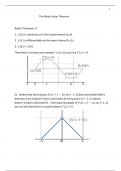
Rolle’s Theorem: If
1. 𝑓(𝑥) is continuous on the closed interval [𝑎, 𝑏]
2. 𝑓(𝑥) is differentiable on the open interval (𝑎, 𝑏)
3. 𝑓(𝑎) = 𝑓(𝑏)
Then there is at least one number 𝑐 in (𝑎, 𝑏) such the 𝑓’(𝑐) = 0.
𝑓 ′ (𝑐)
𝑓 ′ (𝑐)
= 0= 0
(𝑏, 𝑓(𝑏))
(𝑎, 𝑓(𝑎))
𝑓 ′ (𝑑)
𝑓 ′ (𝑑)
==00
𝑎 𝑐 𝑑 𝑏
Ex. Notice that the function 𝑓(𝑥) = 1 − |𝑥| on [−1, 1] does not satisfy Rolle’s
theorem since it doesn’t have a derivative at every point in (−1, 1) (where
doesn’t it have a derivative?). If we draw the graph of 𝑓(𝑥) = 1 − |𝑥| on [−1, 1]
we can see that there is no point where 𝑓 ′ (𝑥) = 0.
𝑓(𝑥) = 1 − |𝑥|
−1 0 1
, 2
Ex. Verify that 𝑓(𝑥) = 𝑥 2 − 3𝑥 + 2 satisfies Rolle’s Thm on [0,3] and find all
values 𝑐 that satisfy the conclusion of Rolle’s Thm (ie, 𝑓’(𝑐) = 0).
a. 𝑓(𝑥) is a polynomial so it is continuous everywhere. In particular, it’s
continuous on [0,3].
b. 𝑓(𝑥) is a polynomial so it is differentiable everywhere. In particular, it’s
differentiable on (0,3).
c. 𝑓(0) = 2, 𝑓(3) = 32 − 3(3) + 2 = 2. Thus 𝑓(0) = 𝑓(3).
So 𝑓(𝑥) satisfies the conditions of Rolle’s theorem.
3
𝑓 ′ (𝑥) = 2𝑥 − 3 = 0 ⟹ 𝑥= .
2
3
Thus 𝑐 = is the only point in [0,3] where 𝑓 ′ (𝑥) = 0.
2
The Mean Value Theorem: If
1. 𝑓(𝑥) is continuous on the closed interval [𝑎, 𝑏]
2. 𝑓(𝑥) is differentiable on the open interval (𝑎, 𝑏)
𝑓(𝑏)−𝑓(𝑎)
Then there is at least one number 𝑐 in (𝑎, 𝑏) such that 𝑓 ′ (𝑐 ) = .
𝑏−𝑎
(𝑐, 𝑓(𝑐))
(𝑏, 𝑓(𝑏))
𝑓(𝑏)−𝑓(𝑎)
Slope of secant line=
𝑏−𝑎
(𝑎, 𝑓(𝑎)) Slope of tangent line= 𝑓′(𝑐).
(𝑎, 𝑓(𝑎))
𝑎 𝑐 𝑏
The Mean Value Theorem
Rolle’s Theorem: If
1. 𝑓(𝑥) is continuous on the closed interval [𝑎, 𝑏]
2. 𝑓(𝑥) is differentiable on the open interval (𝑎, 𝑏)
3. 𝑓(𝑎) = 𝑓(𝑏)
Then there is at least one number 𝑐 in (𝑎, 𝑏) such the 𝑓’(𝑐) = 0.
𝑓 ′ (𝑐)
𝑓 ′ (𝑐)
= 0= 0
(𝑏, 𝑓(𝑏))
(𝑎, 𝑓(𝑎))
𝑓 ′ (𝑑)
𝑓 ′ (𝑑)
==00
𝑎 𝑐 𝑑 𝑏
Ex. Notice that the function 𝑓(𝑥) = 1 − |𝑥| on [−1, 1] does not satisfy Rolle’s
theorem since it doesn’t have a derivative at every point in (−1, 1) (where
doesn’t it have a derivative?). If we draw the graph of 𝑓(𝑥) = 1 − |𝑥| on [−1, 1]
we can see that there is no point where 𝑓 ′ (𝑥) = 0.
𝑓(𝑥) = 1 − |𝑥|
−1 0 1
, 2
Ex. Verify that 𝑓(𝑥) = 𝑥 2 − 3𝑥 + 2 satisfies Rolle’s Thm on [0,3] and find all
values 𝑐 that satisfy the conclusion of Rolle’s Thm (ie, 𝑓’(𝑐) = 0).
a. 𝑓(𝑥) is a polynomial so it is continuous everywhere. In particular, it’s
continuous on [0,3].
b. 𝑓(𝑥) is a polynomial so it is differentiable everywhere. In particular, it’s
differentiable on (0,3).
c. 𝑓(0) = 2, 𝑓(3) = 32 − 3(3) + 2 = 2. Thus 𝑓(0) = 𝑓(3).
So 𝑓(𝑥) satisfies the conditions of Rolle’s theorem.
3
𝑓 ′ (𝑥) = 2𝑥 − 3 = 0 ⟹ 𝑥= .
2
3
Thus 𝑐 = is the only point in [0,3] where 𝑓 ′ (𝑥) = 0.
2
The Mean Value Theorem: If
1. 𝑓(𝑥) is continuous on the closed interval [𝑎, 𝑏]
2. 𝑓(𝑥) is differentiable on the open interval (𝑎, 𝑏)
𝑓(𝑏)−𝑓(𝑎)
Then there is at least one number 𝑐 in (𝑎, 𝑏) such that 𝑓 ′ (𝑐 ) = .
𝑏−𝑎
(𝑐, 𝑓(𝑐))
(𝑏, 𝑓(𝑏))
𝑓(𝑏)−𝑓(𝑎)
Slope of secant line=
𝑏−𝑎
(𝑎, 𝑓(𝑎)) Slope of tangent line= 𝑓′(𝑐).
(𝑎, 𝑓(𝑎))
𝑎 𝑐 𝑏