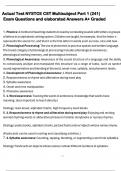
Actual Test NYSTCE CST Multisubject Part 1 (241)
Exam Questions and elaborated Answers A+ Graded
1. Phonics: A method of teaching students to read by correlating sounds with letters or groups
of letters in an alphabetic writing system. Children are taught, for example, that the letter n
represents the sound /n/, and that it is the first letter in words such as nose, nice and new.
2. Phonological Processing: The use of phonemes to process spoken and written language.
The broad category of phonological processing includes phonological awareness,
phonological working memory, and phonological retrieval.
3. Phonological Awareness: Awareness of the sound structure of a language and the ability
to consciously analyze and manipulate this structure via a range of tasks, such as speech
sound segmentation and blending at the word, onset-rime, syllable, and phonemic levels.
4. Development of Phonological Awareness: 1. Word awareness
2. Responsiveness to rhyme and alliteration during word play
3. Syllable awareness
4. Onset and rime manipulation
5. Phoneme awareness
5. 1. Word awareness: Tracking the words in sentences. Knowledge that words have
meaning. (less important to teach directly)
Strategy: read-aloud, alphabet chants, high-frequency word books
6. 2. Responsiveness to rhyme and alliteration during word play: Enjoying and reciting
learned rhyming words or alliterative phrases in familiar storybooks or nursery rhymes.
Strategy: poetry books, alphabet chants, picture flashcards w/ objects whose names rhyme.
(Flashcards can be used in sorting and classifying activities.)
7. 3. Syllable awareness: Counting, tapping, blending, or segmenting a word into syllables.
Strategy: Flashcards w/ objects whose names contain different numbers of syllables.
,(Flashcards can be used in sorting activity.)
8. 4. Onset and rime manipulation: Onset is the initial consonant in a one-syllable word.
Rime includes the remaining sounds, including the vowel and any sounds that follow.The
ability to produce a rhyming word depends on understanding that rhyming words have the
same rime. Recognizing a rhyme is much easier than producing a rhyme.
,Strategy: Blending and substitution activities.
9. 5. Phonemic awareness: This is the student's awareness of the smallest units of sound in a
word. It also refers to a student's ability to segment, blend, and manipulate these units.
- Identify and match the initial sounds in words, then the final and middle sounds (e.g.,
"Which picture begins with /m/?"; "Find another picture that ends in /r/").
- Segment and produce the initial sound, then the final and middle sounds (e.g., "What
sound does zoo start with?"; "Say the last sound in milk"; "Say the vowel sound in rope").
- Blend sounds into words (e.g., "Listen: /f/ / / /t/. Say it fast").
- Segment the phonemes in two- or three-sound words, moving to four- and five- sound
words as the student becomes proficient (e.g., "The word is eyes. Stretch and say the
sounds: /+/ /z/").
- Manipulate phonemes by removing, adding, or substituting sounds (e.g., "Say smoke
without the /m/").
Strategy: listening to alliterative passages, blending and segmenting words, and ma- nipulating
sounds in words through substitution, deletion, and addition of phonemics. Elkonin boxes are
provided for tactile blending and segmenting activities.
10. Phonological Working Memory: Involves storing phoneme information in a
temporary, short-term memory store. This phonemic information is then readily available
for manipulation during phonological awareness tasks.
11. Phonological Retrieval: Phonological retrieval is the ability to recall the phonemes
associated with specific graphemes, which can be assessed by rapid naming tasks.
12. Phoneme Manipulation Task (Strategy): Tasks that tap into phonological pro- cessing,
such as phoneme manipulation tasks (say "cat" without the kuh), have proven to be some of
the strongest correlates and predictors of learning to read.
13. Orthographic Processing: Defined as "the ability to form, store, and access or- thographic
representations." Orthography is the methodology of writing a language, which primarily
, consists of
spelling, but includes, contractions, punctuation and capitalization.
Exam Questions and elaborated Answers A+ Graded
1. Phonics: A method of teaching students to read by correlating sounds with letters or groups
of letters in an alphabetic writing system. Children are taught, for example, that the letter n
represents the sound /n/, and that it is the first letter in words such as nose, nice and new.
2. Phonological Processing: The use of phonemes to process spoken and written language.
The broad category of phonological processing includes phonological awareness,
phonological working memory, and phonological retrieval.
3. Phonological Awareness: Awareness of the sound structure of a language and the ability
to consciously analyze and manipulate this structure via a range of tasks, such as speech
sound segmentation and blending at the word, onset-rime, syllable, and phonemic levels.
4. Development of Phonological Awareness: 1. Word awareness
2. Responsiveness to rhyme and alliteration during word play
3. Syllable awareness
4. Onset and rime manipulation
5. Phoneme awareness
5. 1. Word awareness: Tracking the words in sentences. Knowledge that words have
meaning. (less important to teach directly)
Strategy: read-aloud, alphabet chants, high-frequency word books
6. 2. Responsiveness to rhyme and alliteration during word play: Enjoying and reciting
learned rhyming words or alliterative phrases in familiar storybooks or nursery rhymes.
Strategy: poetry books, alphabet chants, picture flashcards w/ objects whose names rhyme.
(Flashcards can be used in sorting and classifying activities.)
7. 3. Syllable awareness: Counting, tapping, blending, or segmenting a word into syllables.
Strategy: Flashcards w/ objects whose names contain different numbers of syllables.
,(Flashcards can be used in sorting activity.)
8. 4. Onset and rime manipulation: Onset is the initial consonant in a one-syllable word.
Rime includes the remaining sounds, including the vowel and any sounds that follow.The
ability to produce a rhyming word depends on understanding that rhyming words have the
same rime. Recognizing a rhyme is much easier than producing a rhyme.
,Strategy: Blending and substitution activities.
9. 5. Phonemic awareness: This is the student's awareness of the smallest units of sound in a
word. It also refers to a student's ability to segment, blend, and manipulate these units.
- Identify and match the initial sounds in words, then the final and middle sounds (e.g.,
"Which picture begins with /m/?"; "Find another picture that ends in /r/").
- Segment and produce the initial sound, then the final and middle sounds (e.g., "What
sound does zoo start with?"; "Say the last sound in milk"; "Say the vowel sound in rope").
- Blend sounds into words (e.g., "Listen: /f/ / / /t/. Say it fast").
- Segment the phonemes in two- or three-sound words, moving to four- and five- sound
words as the student becomes proficient (e.g., "The word is eyes. Stretch and say the
sounds: /+/ /z/").
- Manipulate phonemes by removing, adding, or substituting sounds (e.g., "Say smoke
without the /m/").
Strategy: listening to alliterative passages, blending and segmenting words, and ma- nipulating
sounds in words through substitution, deletion, and addition of phonemics. Elkonin boxes are
provided for tactile blending and segmenting activities.
10. Phonological Working Memory: Involves storing phoneme information in a
temporary, short-term memory store. This phonemic information is then readily available
for manipulation during phonological awareness tasks.
11. Phonological Retrieval: Phonological retrieval is the ability to recall the phonemes
associated with specific graphemes, which can be assessed by rapid naming tasks.
12. Phoneme Manipulation Task (Strategy): Tasks that tap into phonological pro- cessing,
such as phoneme manipulation tasks (say "cat" without the kuh), have proven to be some of
the strongest correlates and predictors of learning to read.
13. Orthographic Processing: Defined as "the ability to form, store, and access or- thographic
representations." Orthography is the methodology of writing a language, which primarily
, consists of
spelling, but includes, contractions, punctuation and capitalization.