NYSTCE CST MATH Test Exam Guide Questions and Answers 100% Verified
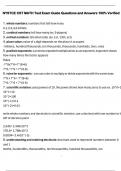
1. whole numbers: numbers that tell how many
0,1,2,3,4,5 infinite
2. cardinal numbers: tell how many (ex. 9 players)
3. ordinal numbers: tell what order (ex. 1st, 13th, ect)
4. place value: value of a digit depends on the place it occupies
-millions, hundred thousands, ten thousands, thousands, hundreds, tens, ones
5. positive exponents: can show repeated multiplication as an exponent, exponent shows
how many times the factor appears
Rules
-7^8x7^6=7^(8+6)
7^^6 = 7^(8-6)
6. rules for exponents: -can use rules to multiply or divide exponents with the same base
7^8 x 7^6 = 7^(8+6)
7^^6 = 7^(8-6)
7. scientific notation: uses powers of 10. the power shows how many zeros to use ex. 10^0=1
10^1=10
10^2=100
10^(-1)=0.1
10^(-2)=0.01
write whole numbers and decimals in scientific notation. use a decimal with one number to th
left of decimal point
2,345= 2.345x10^3
176.8= 1.768x10^2
0.0034= 3.4x10^(-3)
8. understanding and ordering decimals: decimals used to represent numbers between 0
and 1
tenths, hundredths, thousandths, ten thousandths, hundred thousandths, ect.
1/
13
, 9. rounding: if next digit is more than 5 round up if next
digit is less than 5, round down
10. rational numbers: numbers that can be written as a fraction, can be written as decimals
that terminate or repeat
1=1/1
.25-1/4
.666666(repeating)=2/3
2/
13
1. whole numbers: numbers that tell how many
0,1,2,3,4,5 infinite
2. cardinal numbers: tell how many (ex. 9 players)
3. ordinal numbers: tell what order (ex. 1st, 13th, ect)
4. place value: value of a digit depends on the place it occupies
-millions, hundred thousands, ten thousands, thousands, hundreds, tens, ones
5. positive exponents: can show repeated multiplication as an exponent, exponent shows
how many times the factor appears
Rules
-7^8x7^6=7^(8+6)
7^^6 = 7^(8-6)
6. rules for exponents: -can use rules to multiply or divide exponents with the same base
7^8 x 7^6 = 7^(8+6)
7^^6 = 7^(8-6)
7. scientific notation: uses powers of 10. the power shows how many zeros to use ex. 10^0=1
10^1=10
10^2=100
10^(-1)=0.1
10^(-2)=0.01
write whole numbers and decimals in scientific notation. use a decimal with one number to th
left of decimal point
2,345= 2.345x10^3
176.8= 1.768x10^2
0.0034= 3.4x10^(-3)
8. understanding and ordering decimals: decimals used to represent numbers between 0
and 1
tenths, hundredths, thousandths, ten thousandths, hundred thousandths, ect.
1/
13
, 9. rounding: if next digit is more than 5 round up if next
digit is less than 5, round down
10. rational numbers: numbers that can be written as a fraction, can be written as decimals
that terminate or repeat
1=1/1
.25-1/4
.666666(repeating)=2/3
2/
13