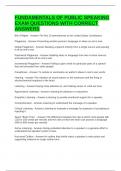
FUNDAMENTALS OF PUBLIC SPEAKING
EXAM QUESTIONS WITH CORRECT
ANSWERS
Bill of Rights - Answer-The first 10 amendments to the United States Constitution.
Plagiarism - Answer-Presenting another person's language or ideas as one's own.
Global Plagiarism - Answer-Stealing a speech entirely from a single source and passing
it off as one's own.
Patchwork Plagiarism - Answer-Stealing ideas or language from two or three sources
and passing them off as one's own.
Incremental Plagiarism - Answer-Falling to give credit for particular parts of a speech
that are borrowed from other people.
Paraphrase - Answer-To restate or summarize an author's ideas in one's own words.
Hearing - Answer-The vibration of sound waves on the eardrums and the firing of
electrochemical impulses in the brain.
Listening - Answer-Paying close attention to, and making sense of, what we hear.
Appreciative Listening - Answer-Listening for pleasure or enjoyment.
Empathic Listening - Answer-Listening to provide emotional support for a speaker.
Comprehensive - Answer-Listening to understand the message of a speaker.
Critical Listening - Answer-Listening to evaluate a message for purposes of accepting or
rejecting it.
Spare "Brain Time" - Answer-The difference between the rate at which most people talk
(120 to 150 words per minute) and the rate at which the brain can process a language
(400 to 800 words per minute).
Active Listening - Answer-Giving undivided attention to a speaker in a genuine effort to
understand the speaker's point of view.
Key-word Outline - Answer-An outline that briefly notes a speaker's main points and
supporting evidence in rough outline form.
EXAM QUESTIONS WITH CORRECT
ANSWERS
Bill of Rights - Answer-The first 10 amendments to the United States Constitution.
Plagiarism - Answer-Presenting another person's language or ideas as one's own.
Global Plagiarism - Answer-Stealing a speech entirely from a single source and passing
it off as one's own.
Patchwork Plagiarism - Answer-Stealing ideas or language from two or three sources
and passing them off as one's own.
Incremental Plagiarism - Answer-Falling to give credit for particular parts of a speech
that are borrowed from other people.
Paraphrase - Answer-To restate or summarize an author's ideas in one's own words.
Hearing - Answer-The vibration of sound waves on the eardrums and the firing of
electrochemical impulses in the brain.
Listening - Answer-Paying close attention to, and making sense of, what we hear.
Appreciative Listening - Answer-Listening for pleasure or enjoyment.
Empathic Listening - Answer-Listening to provide emotional support for a speaker.
Comprehensive - Answer-Listening to understand the message of a speaker.
Critical Listening - Answer-Listening to evaluate a message for purposes of accepting or
rejecting it.
Spare "Brain Time" - Answer-The difference between the rate at which most people talk
(120 to 150 words per minute) and the rate at which the brain can process a language
(400 to 800 words per minute).
Active Listening - Answer-Giving undivided attention to a speaker in a genuine effort to
understand the speaker's point of view.
Key-word Outline - Answer-An outline that briefly notes a speaker's main points and
supporting evidence in rough outline form.