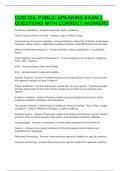
COM 115: PUBLIC SPEAKING EXAM 1
QUESTIONS WITH CORRECT ANSWERS
Persuasive Speaking - Answer-Argument, Claim, Evidence
Three Classical Forms of Proof - Answer-Logos, Pathos, Ethos
Contemporary Persuasive Appeals - Answer-Maslow's Hierarchy of Needs, Expectancy-
Outcome Values Theory, Elaboration Likelihood Model, Central/Peripheral Processing
Monroe's Motivated Sequence - Answer-Attention, Need, Satisfaction, Visualization,
Action
Three Steps to Successful Presentations - Answer-Analyze Your Audience, Organize
Your Topic, Practice
KISS - Answer-Keep It Short and Simple
KILL - Answer-Keep It Large and Legible
Specific Purpose - Answer-A refined statement of purpose that zeroes in more closely
than general purpose on goal of speech
Thesis Statement - Answer-Expresses central idea for your speech, Typically includes
phrases about each of your main points, Keeps you on track as you develop your
speech
Audience Analysis - Answer-Process of gathering and analyzing information about
audience members' attributes and motivations
The Speech Setting - Answer-Size of Audience, Physical Setting, Time of Day, Length
of Speech, Context, Rhetorical Situation, Captive Audience
Working Outline - Answer-Preparation outline that refines and finalizes specific speech
purpose, firms up and organizes main points, and develops supporting material
Paralanguage - Answer-Vocalizations, the nonverbal elements of vocal delivery
Dialects - Answer-Sub-cultural variations of the mainstream pronunciation and
articulation of a language
Deductive Reasoning - Answer-Reasoning from general condition to specific instance
Inductive Reasoning - Answer-Reasoning from specific instances to general condition
QUESTIONS WITH CORRECT ANSWERS
Persuasive Speaking - Answer-Argument, Claim, Evidence
Three Classical Forms of Proof - Answer-Logos, Pathos, Ethos
Contemporary Persuasive Appeals - Answer-Maslow's Hierarchy of Needs, Expectancy-
Outcome Values Theory, Elaboration Likelihood Model, Central/Peripheral Processing
Monroe's Motivated Sequence - Answer-Attention, Need, Satisfaction, Visualization,
Action
Three Steps to Successful Presentations - Answer-Analyze Your Audience, Organize
Your Topic, Practice
KISS - Answer-Keep It Short and Simple
KILL - Answer-Keep It Large and Legible
Specific Purpose - Answer-A refined statement of purpose that zeroes in more closely
than general purpose on goal of speech
Thesis Statement - Answer-Expresses central idea for your speech, Typically includes
phrases about each of your main points, Keeps you on track as you develop your
speech
Audience Analysis - Answer-Process of gathering and analyzing information about
audience members' attributes and motivations
The Speech Setting - Answer-Size of Audience, Physical Setting, Time of Day, Length
of Speech, Context, Rhetorical Situation, Captive Audience
Working Outline - Answer-Preparation outline that refines and finalizes specific speech
purpose, firms up and organizes main points, and develops supporting material
Paralanguage - Answer-Vocalizations, the nonverbal elements of vocal delivery
Dialects - Answer-Sub-cultural variations of the mainstream pronunciation and
articulation of a language
Deductive Reasoning - Answer-Reasoning from general condition to specific instance
Inductive Reasoning - Answer-Reasoning from specific instances to general condition