Neuropsychology II
Child Neuropsychology
Brain development
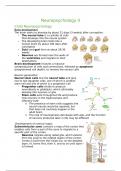
The brain starts to develop by about 21 days (3 weeks) after conception.
- The neural tube is a cylinder of cells
that develops into the neural system
- The developing brain looks like a
human brain by about 100 days after
conception
- Sulci and gyri form at about 28-30
weeks
- Neurons are formed near the walls of
the ventricles and migrate to their
destinations
Brain development involves a massive
overproduction of cells and connections, followed by apoptosis
(programmed cell death), to remove the excess cells
Neuron generation:
Neural stem cells line the neural tube and give
rise to two daughter cells, one of which is another
stem cell and one of which is a progenitor cell
- Progenitor cells divide to produce
neuroblasts or glioblasts, which ultimately
develop into neurons or glia
- Stem cells exist throughout life and produce
new neurons in the hippocampus and
olfactory bulb
o The presence of stem cells suggests the
neural injuries would be repaired, but
that does not routinely happen in the
adult brain
o The rate of neurogenesis decreases with age, and the function
of neurons produced later in life may be different
Development of cortical maps:
Subventricular zone contains a map of the cortex that
enables cells from a part of the zone to migrate to a
specific part of the cortex
- Neurons migrate along radial glia, which extend
from the zone to the related region of the cortex
- Cortex is built from the inside out, so the deepest
layer, VI, forms first, then V, and so on until layer I
is formed
,Neural maturation:
During maturation, the cells produce dendrites to increase their surface
area to form synapses
- Dendritic arborization involves branching
- Dendritic spines are the targets for the synapses
- Dendrites start to form prenatally, and this continues long after
birth
- Dendrites grow slowly, only micrometers per day
In addition, axons grow toward the appropriate targets
- Axons grow at a (fairly) constant rate of 1 millimeter per day
- The faster axon growth means, that axons reach their targets before
dendrites have developed, so they can influence dendritic
development
Plasticity after Early Brain Injury: (experiment in rats characterized these
effects)
- If cortical injury occurs during neurogenesis (embryonic day 18),
recovery tends to be complete, even if the destruction of the cortex
is complete
- Damage during neuronal migration and differentiation
(postnatal days 1-5) results in permanent damage, regardless of
size or location of the lesion
- Damage after migration (postnatal days 7-12) results in nearly
complete recovery of cognitive functions and partial recovery of
motor functions
Children can “grow into deficits” because regions that were previously
compensating for the lost function can no longer do so
Environment and Brain Organization:
Early life experiences influence brain organization
- Some cortical regions of domesticated animals are 10%-20%
smaller than animals raised in the wild
- Animals born in the wild and domesticated at a young age have
brain sizes like animals who live their whole life in the wild
Exposure to a complex environment increases brain size, particularly
the cortex
- Differences are observed in the density of glial cells, length of
dendrites, density of spines, and size of synapses
- Young brains and old brains seem to react differently to the same
experience
Socioeconomic status and brain development:
- There is a relationship between socioeconomic status and
academic achievement
- Causes likely include parental education, child health, school quality,
stress, and language exposure
, - At age 3, children form high-SES families are exposed to 11 million
words per year, while children form low-SES families are exposed
to only 3,2 million words per year
- Lower family income is associated with decreased cortical volume
across the frontal, temporal, and parietal cortex, independent of sex
or race
Neurodevelopmental disorders:
- Characterized by onset between in utero development and the start
of formal schooling
- Result in deficits in social, personal, or school functioning
- Impairments may be specific to one function or more global
- Incidence may be as high as 17% of school-age children
- Deficits often emerge gradually, making it difficult to identify the
disorder
- Testing and assessment identify variation in the population, so may
fail to identify individuals who have difficulties but are still
performing close to standard levels
Neurodiversity: Differences in brain functioning within the human
population are normal (they are different and function different but are not
defect brains, still normal brains that work differently)
- Disability vs impairment:
o Disability: Interaction between personal characteristics and
societal barriers
o Impairment: Physical difference that creates a limitation
- Identity vs disorder:
o Identity: Characteristics that define a sense of self
o Disorder: Characteristics that could be treated or modified
Neurodevelopmental disorders contain all aspects: identity, disorder,
disability, impairment
ADHD:
1902: First scientific article on ADHD, 1937: First use of stimulant
medications as treatment (1960 FDA approves Ritalin)
DSM-5-TR:
Equal weight given to inattention and hyperactivity/impulsivity (child
must have 6 or more symptoms of inattention and/or hyperactivity for at
least 6 months)
- Three ADHD sub-categories:
o Predominantly inattentive type
Inattentiveness: Style of behavior involving
disorganization and lack of persistence
Distractible, forgetful, can’t follow directions,
disorganized
o Predominantly hyperactive-impulsive type
Hyperactivity: Excess of movement
Fidgety, always on the go, excessive talking
, Impulsivity: Acting without reflecting
Interrupting people, blurting out answers
o Combined type
- The symptoms must be present in two or more settings
- Several symptoms must have been present before the age of 12
years
- Lead to impairment in social, academic, or occupational functioning
Prevalence:
- One of the most common reasons for referral to CAMHS
o CAMHS: Child and Adolescent Mental Health Services
- 5,9% of youth, 2,5% of adults
- 2x more common in males
- Inattentive subtype identified more in girls
Differences in diagnoses across the world, but no significant difference
in prevalence between North America, Europe, Asia, Africa, South
America, and Oceania (not Antarctica?)
- Increased amount of diagnosis in the past 30-40 years
- Higher rates of diagnosis in children ‘young for their year’
High heritability: 70-80%
- Higher than personality, temperament, or depression
- Like schizophrenia, bipolar disorder, ASD
Complex genetics:
- Not explained by Mendelian inheritance (primary genetic disorder
but without universal/specific outcome)
- Not associated with common genetic variants with a large effect
size
- Associated with thousands of genetic variants with a small effect
size
- High overlap between polygenic risk for ADHD and other disorders,
esp. ASD
Cognitive theories:
1. Attentional Lapse Model
2. Behavioral Inhibition Model
3. Cognitive Neuroenergetic Model
4. Default Mode Network Model
5. Dynamic Development Model
6. Variability Trait Model
7. Subcortical Deficit Model
8. Tripartite Pathway Model
9. Working Memory Model
Executive Function deficit:
EF= higher-order cognitive processes that guide behaviors in pursuit of a
goal
o Includes: inhibition, updating, shifting, and planning
Child Neuropsychology
Brain development
The brain starts to develop by about 21 days (3 weeks) after conception.
- The neural tube is a cylinder of cells
that develops into the neural system
- The developing brain looks like a
human brain by about 100 days after
conception
- Sulci and gyri form at about 28-30
weeks
- Neurons are formed near the walls of
the ventricles and migrate to their
destinations
Brain development involves a massive
overproduction of cells and connections, followed by apoptosis
(programmed cell death), to remove the excess cells
Neuron generation:
Neural stem cells line the neural tube and give
rise to two daughter cells, one of which is another
stem cell and one of which is a progenitor cell
- Progenitor cells divide to produce
neuroblasts or glioblasts, which ultimately
develop into neurons or glia
- Stem cells exist throughout life and produce
new neurons in the hippocampus and
olfactory bulb
o The presence of stem cells suggests the
neural injuries would be repaired, but
that does not routinely happen in the
adult brain
o The rate of neurogenesis decreases with age, and the function
of neurons produced later in life may be different
Development of cortical maps:
Subventricular zone contains a map of the cortex that
enables cells from a part of the zone to migrate to a
specific part of the cortex
- Neurons migrate along radial glia, which extend
from the zone to the related region of the cortex
- Cortex is built from the inside out, so the deepest
layer, VI, forms first, then V, and so on until layer I
is formed
,Neural maturation:
During maturation, the cells produce dendrites to increase their surface
area to form synapses
- Dendritic arborization involves branching
- Dendritic spines are the targets for the synapses
- Dendrites start to form prenatally, and this continues long after
birth
- Dendrites grow slowly, only micrometers per day
In addition, axons grow toward the appropriate targets
- Axons grow at a (fairly) constant rate of 1 millimeter per day
- The faster axon growth means, that axons reach their targets before
dendrites have developed, so they can influence dendritic
development
Plasticity after Early Brain Injury: (experiment in rats characterized these
effects)
- If cortical injury occurs during neurogenesis (embryonic day 18),
recovery tends to be complete, even if the destruction of the cortex
is complete
- Damage during neuronal migration and differentiation
(postnatal days 1-5) results in permanent damage, regardless of
size or location of the lesion
- Damage after migration (postnatal days 7-12) results in nearly
complete recovery of cognitive functions and partial recovery of
motor functions
Children can “grow into deficits” because regions that were previously
compensating for the lost function can no longer do so
Environment and Brain Organization:
Early life experiences influence brain organization
- Some cortical regions of domesticated animals are 10%-20%
smaller than animals raised in the wild
- Animals born in the wild and domesticated at a young age have
brain sizes like animals who live their whole life in the wild
Exposure to a complex environment increases brain size, particularly
the cortex
- Differences are observed in the density of glial cells, length of
dendrites, density of spines, and size of synapses
- Young brains and old brains seem to react differently to the same
experience
Socioeconomic status and brain development:
- There is a relationship between socioeconomic status and
academic achievement
- Causes likely include parental education, child health, school quality,
stress, and language exposure
, - At age 3, children form high-SES families are exposed to 11 million
words per year, while children form low-SES families are exposed
to only 3,2 million words per year
- Lower family income is associated with decreased cortical volume
across the frontal, temporal, and parietal cortex, independent of sex
or race
Neurodevelopmental disorders:
- Characterized by onset between in utero development and the start
of formal schooling
- Result in deficits in social, personal, or school functioning
- Impairments may be specific to one function or more global
- Incidence may be as high as 17% of school-age children
- Deficits often emerge gradually, making it difficult to identify the
disorder
- Testing and assessment identify variation in the population, so may
fail to identify individuals who have difficulties but are still
performing close to standard levels
Neurodiversity: Differences in brain functioning within the human
population are normal (they are different and function different but are not
defect brains, still normal brains that work differently)
- Disability vs impairment:
o Disability: Interaction between personal characteristics and
societal barriers
o Impairment: Physical difference that creates a limitation
- Identity vs disorder:
o Identity: Characteristics that define a sense of self
o Disorder: Characteristics that could be treated or modified
Neurodevelopmental disorders contain all aspects: identity, disorder,
disability, impairment
ADHD:
1902: First scientific article on ADHD, 1937: First use of stimulant
medications as treatment (1960 FDA approves Ritalin)
DSM-5-TR:
Equal weight given to inattention and hyperactivity/impulsivity (child
must have 6 or more symptoms of inattention and/or hyperactivity for at
least 6 months)
- Three ADHD sub-categories:
o Predominantly inattentive type
Inattentiveness: Style of behavior involving
disorganization and lack of persistence
Distractible, forgetful, can’t follow directions,
disorganized
o Predominantly hyperactive-impulsive type
Hyperactivity: Excess of movement
Fidgety, always on the go, excessive talking
, Impulsivity: Acting without reflecting
Interrupting people, blurting out answers
o Combined type
- The symptoms must be present in two or more settings
- Several symptoms must have been present before the age of 12
years
- Lead to impairment in social, academic, or occupational functioning
Prevalence:
- One of the most common reasons for referral to CAMHS
o CAMHS: Child and Adolescent Mental Health Services
- 5,9% of youth, 2,5% of adults
- 2x more common in males
- Inattentive subtype identified more in girls
Differences in diagnoses across the world, but no significant difference
in prevalence between North America, Europe, Asia, Africa, South
America, and Oceania (not Antarctica?)
- Increased amount of diagnosis in the past 30-40 years
- Higher rates of diagnosis in children ‘young for their year’
High heritability: 70-80%
- Higher than personality, temperament, or depression
- Like schizophrenia, bipolar disorder, ASD
Complex genetics:
- Not explained by Mendelian inheritance (primary genetic disorder
but without universal/specific outcome)
- Not associated with common genetic variants with a large effect
size
- Associated with thousands of genetic variants with a small effect
size
- High overlap between polygenic risk for ADHD and other disorders,
esp. ASD
Cognitive theories:
1. Attentional Lapse Model
2. Behavioral Inhibition Model
3. Cognitive Neuroenergetic Model
4. Default Mode Network Model
5. Dynamic Development Model
6. Variability Trait Model
7. Subcortical Deficit Model
8. Tripartite Pathway Model
9. Working Memory Model
Executive Function deficit:
EF= higher-order cognitive processes that guide behaviors in pursuit of a
goal
o Includes: inhibition, updating, shifting, and planning