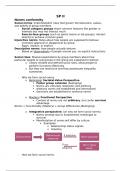
SP II
Norms conformity
Social norms: Implicit/explicit rules that govern the behaviors, values,
and beliefs of group members
- Social category groups share common features like gender or
interests but may not interact much
- Face-to-face groups (such as sports teams or lab groups), interact
directly to achieve common goals
Injunctive norms: Rules about how people are supposed to behave
- Connotes approval or disapproval by group
- Again, implicit, or explicit
Descriptive norms: How people actually behave
- Based on observations of people around you, no explicit instructions
Social roles: Shared expectations by group members about how
particular people or sub-groups in the group are supposed to behave
o Clearly divided and defined social roles, allow people to
perform functions effectively
o But they are restrictive and they perpetuate inequality
sometimes
- Why we form social norms:
o Belonging: Societal-Value Perspective
Foster group cohesion (belonging)
Norms are culturally relativistic and arbitrary
Arbitrary norms are established and internalized
Sanctions are established to reinforce norms
o Mastery: Functional Perspective
Content of norms are not arbitrary, but confer survival
advantage
Norms = Functionality (Mastery) + Group Differences (Belonging)
o Integrative perspective: (on why we form social norms)
Norms emerge due to fundamental challenges to
survival
Manifestation of norms will differ by culture
Examples:
o Relationship status signals
o Greeting
- How we form social norms
, We are influenced by the ideas, emotions, and behavior
of others
Within groups
Group polarization: Tendency for group decisions to be more extreme
than those made by individuals
- Direction of polarization depends on one’s initial inclination (group
discussion shifts initial inclination)
o Especially true of homogenous groups
- Superficial processing (relying on others' positions) and
systematic processing (attending to both positions and
arguments) can contribute to group polarization
Dynamic Social Impact Theory (DSIT): Individuals influence each other
primarily through interactions, leading to clusters of like-minded people
- Majority arguments are exaggerated:
o More people (majority) hold that argument and everyone
gives information about it
o They are more discussed
o They seem more compelling (people making the same
argument gives it extra impact)
o Presented as being more compelling
- People oriented in social space that allows for interactions and
mutual influence causes DSIT process resulting in clustering
- Clustering especially strong for more important attitudes
o We talk about the important attitudes more
o We are motivated to be “better than average” in the attitudes
we find more important
Conformity: Change in behavior due to real OR imagined influence of
other people
- Neither inherently positive nor negative (depends on culture and
situation)
Different forms of Conformity:
- Public compliance
o Doing what others are doing
o Problem: Inferring the injunctive norms
Pluralistic ignorance: Everyone publicly complies
without private acceptance but then THINKS everyone
else privately accepts the norm
- Private acceptance
Genuinely believe that copied thoughts, beliefs, and
actions are correct and should be copied
These forms can cause:
o Fear of repercussion
Due to normative influence
Solomon Asch’s “line study” (going with the group even
though the answer is obviously different)
, o False consensus effect
Tendency to overestimate others’ agreement with one’s
own opinions
Consensus is based on our reference group (who we
think is the appropriate source to get our information
from)
Groups we share attributes with (we trust them
more)
Relying on biases and heuristics
Motivations for conformity:
- Normative influence (belonging)
o Conform so that we are liked and accepted by others (relies
on social acceptance and our social identity)
o Relies on:
Wanting to be liked
Desire for companionship
Conjunctive norms
o Important aspects:
Failure to comply: Ridicule, punishment, exclusion
Can be with groups consisting of people we don’t even
know
o Public compliance OR private acceptance
- Informative influence (information)
o Conforming to other’s behavior due to belief that other’s
interpretations of ambiguous situations is correct
We belief that other people can help us construct
appropriate reality (we accept privately to maintain
mastery of reality)
Disagreement causes us confusion and loss of reality
o Mundane situations to extraordinary situations
o More likely to conform due to:
Ambiguous situation
Crisis situation
Experts present
o Relies on:
Descriptive norms
o Public compliance AND private acceptance
Negative consequence norm following and consensus:
Groupthink: Faulty decisions group make because consensus is prioritized
over correctness
- Function of:
o Highly cohesive group
o Social pressure to reach consensus
o Consensus more important than critical scrutiny of
important issues
, - Irving Janis’ (1972) model of groupthink:
- Preventing groupthink
o Leader refrains from expressing own opinions at the
beginning
o Group must not be isolated from external input
o Designate group members to play devil’s advocate
o Create subgroups that meet before the meeting to come up
with different recommendations
o Seek anonymous opinions
Cultural tightness versus looseness:
- Tight cultures
o Strong expectations of adherence to social norms
o Little tolerance for deviance
History of threats in the environment produce higher
tightness
Extreme climate
Natural disasters
Less natural recourses
Poverty
History of diseases
More summiting (team work) but also more deaths
(groupthink)
- Loose cultures
o Fewer expectations for conformity
o May encourage new forms of behavior
Norms conformity
Social norms: Implicit/explicit rules that govern the behaviors, values,
and beliefs of group members
- Social category groups share common features like gender or
interests but may not interact much
- Face-to-face groups (such as sports teams or lab groups), interact
directly to achieve common goals
Injunctive norms: Rules about how people are supposed to behave
- Connotes approval or disapproval by group
- Again, implicit, or explicit
Descriptive norms: How people actually behave
- Based on observations of people around you, no explicit instructions
Social roles: Shared expectations by group members about how
particular people or sub-groups in the group are supposed to behave
o Clearly divided and defined social roles, allow people to
perform functions effectively
o But they are restrictive and they perpetuate inequality
sometimes
- Why we form social norms:
o Belonging: Societal-Value Perspective
Foster group cohesion (belonging)
Norms are culturally relativistic and arbitrary
Arbitrary norms are established and internalized
Sanctions are established to reinforce norms
o Mastery: Functional Perspective
Content of norms are not arbitrary, but confer survival
advantage
Norms = Functionality (Mastery) + Group Differences (Belonging)
o Integrative perspective: (on why we form social norms)
Norms emerge due to fundamental challenges to
survival
Manifestation of norms will differ by culture
Examples:
o Relationship status signals
o Greeting
- How we form social norms
, We are influenced by the ideas, emotions, and behavior
of others
Within groups
Group polarization: Tendency for group decisions to be more extreme
than those made by individuals
- Direction of polarization depends on one’s initial inclination (group
discussion shifts initial inclination)
o Especially true of homogenous groups
- Superficial processing (relying on others' positions) and
systematic processing (attending to both positions and
arguments) can contribute to group polarization
Dynamic Social Impact Theory (DSIT): Individuals influence each other
primarily through interactions, leading to clusters of like-minded people
- Majority arguments are exaggerated:
o More people (majority) hold that argument and everyone
gives information about it
o They are more discussed
o They seem more compelling (people making the same
argument gives it extra impact)
o Presented as being more compelling
- People oriented in social space that allows for interactions and
mutual influence causes DSIT process resulting in clustering
- Clustering especially strong for more important attitudes
o We talk about the important attitudes more
o We are motivated to be “better than average” in the attitudes
we find more important
Conformity: Change in behavior due to real OR imagined influence of
other people
- Neither inherently positive nor negative (depends on culture and
situation)
Different forms of Conformity:
- Public compliance
o Doing what others are doing
o Problem: Inferring the injunctive norms
Pluralistic ignorance: Everyone publicly complies
without private acceptance but then THINKS everyone
else privately accepts the norm
- Private acceptance
Genuinely believe that copied thoughts, beliefs, and
actions are correct and should be copied
These forms can cause:
o Fear of repercussion
Due to normative influence
Solomon Asch’s “line study” (going with the group even
though the answer is obviously different)
, o False consensus effect
Tendency to overestimate others’ agreement with one’s
own opinions
Consensus is based on our reference group (who we
think is the appropriate source to get our information
from)
Groups we share attributes with (we trust them
more)
Relying on biases and heuristics
Motivations for conformity:
- Normative influence (belonging)
o Conform so that we are liked and accepted by others (relies
on social acceptance and our social identity)
o Relies on:
Wanting to be liked
Desire for companionship
Conjunctive norms
o Important aspects:
Failure to comply: Ridicule, punishment, exclusion
Can be with groups consisting of people we don’t even
know
o Public compliance OR private acceptance
- Informative influence (information)
o Conforming to other’s behavior due to belief that other’s
interpretations of ambiguous situations is correct
We belief that other people can help us construct
appropriate reality (we accept privately to maintain
mastery of reality)
Disagreement causes us confusion and loss of reality
o Mundane situations to extraordinary situations
o More likely to conform due to:
Ambiguous situation
Crisis situation
Experts present
o Relies on:
Descriptive norms
o Public compliance AND private acceptance
Negative consequence norm following and consensus:
Groupthink: Faulty decisions group make because consensus is prioritized
over correctness
- Function of:
o Highly cohesive group
o Social pressure to reach consensus
o Consensus more important than critical scrutiny of
important issues
, - Irving Janis’ (1972) model of groupthink:
- Preventing groupthink
o Leader refrains from expressing own opinions at the
beginning
o Group must not be isolated from external input
o Designate group members to play devil’s advocate
o Create subgroups that meet before the meeting to come up
with different recommendations
o Seek anonymous opinions
Cultural tightness versus looseness:
- Tight cultures
o Strong expectations of adherence to social norms
o Little tolerance for deviance
History of threats in the environment produce higher
tightness
Extreme climate
Natural disasters
Less natural recourses
Poverty
History of diseases
More summiting (team work) but also more deaths
(groupthink)
- Loose cultures
o Fewer expectations for conformity
o May encourage new forms of behavior