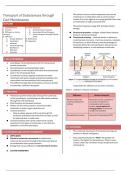
Transport of Substances through Movement of ions or other substances across the
membrane in combination with a carrier protein
Cell Membranes causes it to move against an energy gradient (from low-
concentration to high concentration)
OUTLINE
Movement requires energy ATP, (besides kinetic
I. Cell Membrane V. Active Transport energy)
II. Proteins A. Primary Active Transport
III. Diffusion vs. Active B. Secondary Active Transport ● Structural proteins: collagen, elastic fibers (mostly
Transport C. Active transport Through Cellular found in connective tissue)
IV. Diffusion Sheet ● Functional proteins - could be motile or adhere to
A. Simple diffusion VI. References
membranous structures. It acts as enzymes, catalysts
B. Facilitated VII. Appendix
diffusion of reactions, or those that are used as passages or
C. Factors affecting channels within the cell membrane. Also serves as
Net Rate of identifying markers, or cell adhesion molecules
Diffusion
D. Osmosis
I. CELL MEMBRANE
● Lipid bilayer of phospholipids with the interspersed
protein molecules.
● Has hydrophilic and hydrophobic sides.
● Lipid bilayer is not miscible with either the extracellular
fluid or the intracellular fluid
● Constitutes a barrier against movement of water
molecules and water-soluble substances between the
intracellular and extracellular fluid compartment
● Has different properties and proteins, and each protein
involved has a different transport responsible for adhesion of one cell to another.
Table 1 . Diffusion vs Active Transport
II. PROTEINS
● Membrane protein molecules interrupt the continuity Diffusion Active transport
of the lipid bilayer, constituting the alternative pathway
Random molecular Movement of ions, substances
through the cell membrane
movement (Brownian across the membrane in
● Most function as transport proteins motion) combination with a carrier
● Others act as carrier proteins, which bind other protein, moves against an
molecules in order to get inside the cell energy gradient, such as low
● Channel proteins to high concentration.
o Have a watery spaces all the way through the
molecule and allow free movement of water as well Normal Kinetic motion Adenosine Triphosphate (ATP)
as selected ions or molecules
● Channel proteins and carrier proteins are usually
selective for the types of molecules or ions that are
allowed to cross the membrane
IV. DIFFUSION
III. DIFFUSION AND ACTIVE TRANSPORT ▪ The continual movement of molecules among one
another in liquids and gasses
A. DIFFUSION
● Random molecular movement of substances ▪ Also called by physicists “Heat” the greater the
molecule by molecule through intermolecular spaces motion, the higher the temperature. Motion never
or combination with carrier proteins ceases under any condition except at absolute zero
● Energy that causes diffusion is normal kinetic motion temperature
B. ACTIVE TRANSPORT
, Diffusion through Protein pores and Channels-selective ➔ Hydrated potassium ions interact with the
permeability and “Gating” of channels - distinguished by two carbonyl oxygen, causing the removal of
important characteristics: bound water molecules and the subsequent
dehydration of the potassium ions thereby
1. Often selectively permeable to certain substances
allowing them to pass the channel.
2. Many channels can be opened closed by gates that are
➔ The carbonyl oxygen is far apart, which makes
regulated by electro signals (volted-gated channels) or
them less likely to interact with the smaller
chemicals that bind to proteins (ligand-gated
sodium ions, excluding them
channels).
Diffusion through the cell membrane is divided into two
subtypes:
● Simple diffusion
● Facilitated diffusion
A. SIMPLE DIFFUSION
● Kinetic movement of molecules or ions through a
membrane opening or through intermolecular spaces
● Has no interaction with a carrier protein in the
membrane
Rate of diffusion is Determined by:
● Amount of substance available
● Velocity of kinetic motion
● Number and sizes of openings in the cell membrane
(space at which molecules can move)
Two pathways
● Through interstices of the lipid bilayer. ● Sodium Channels
❖ For lipid-soluble substances (oxygen, nitrogen, ❖ 0.3-0.5 nm in diameter
carbon dioxide and alcohol) ❖ Lined with amino acids that are strongly negatively
❖ Rate of diffusion is directly proportional to charged
their lipid solubility ❖ Negative charges pull the sodium ions into the channel
● Through watery channels or water channels ❖ The pulling strength is strong enough to pull them from
❖ For lipid-insoluble substances (water) water molecule, hence dehydrating the sodium ions
❖ other lipid-insoluble substances can pass ❖ Sodium and Potassium ions binding to the protein
through pore channels if they are water transporters causes conformational change in the
soluble/small enough proteins, triggering the passage of molecules
❖ Rate of diffusion is inversely proportional to
the size of the molecule
❖ Aquaporins: protein pores that selectively
permit rapid passage of water through the
membrane
Two Important Characteristics of Protein Channels:
● Selective Permeability
❖ Due to its diameter, shape, electrical charge
➢ Potassium Channels
➔ Permits passage of both potassium and
sodium ions, with more preference towards
potassium
➔ Tetrameric structure (4 identical protein
subunits surrounding a central pore)
➔ With a pore loop on top forming a selective
filter that’s lined with carbonyl oxygen
membrane in combination with a carrier protein
Cell Membranes causes it to move against an energy gradient (from low-
concentration to high concentration)
OUTLINE
Movement requires energy ATP, (besides kinetic
I. Cell Membrane V. Active Transport energy)
II. Proteins A. Primary Active Transport
III. Diffusion vs. Active B. Secondary Active Transport ● Structural proteins: collagen, elastic fibers (mostly
Transport C. Active transport Through Cellular found in connective tissue)
IV. Diffusion Sheet ● Functional proteins - could be motile or adhere to
A. Simple diffusion VI. References
membranous structures. It acts as enzymes, catalysts
B. Facilitated VII. Appendix
diffusion of reactions, or those that are used as passages or
C. Factors affecting channels within the cell membrane. Also serves as
Net Rate of identifying markers, or cell adhesion molecules
Diffusion
D. Osmosis
I. CELL MEMBRANE
● Lipid bilayer of phospholipids with the interspersed
protein molecules.
● Has hydrophilic and hydrophobic sides.
● Lipid bilayer is not miscible with either the extracellular
fluid or the intracellular fluid
● Constitutes a barrier against movement of water
molecules and water-soluble substances between the
intracellular and extracellular fluid compartment
● Has different properties and proteins, and each protein
involved has a different transport responsible for adhesion of one cell to another.
Table 1 . Diffusion vs Active Transport
II. PROTEINS
● Membrane protein molecules interrupt the continuity Diffusion Active transport
of the lipid bilayer, constituting the alternative pathway
Random molecular Movement of ions, substances
through the cell membrane
movement (Brownian across the membrane in
● Most function as transport proteins motion) combination with a carrier
● Others act as carrier proteins, which bind other protein, moves against an
molecules in order to get inside the cell energy gradient, such as low
● Channel proteins to high concentration.
o Have a watery spaces all the way through the
molecule and allow free movement of water as well Normal Kinetic motion Adenosine Triphosphate (ATP)
as selected ions or molecules
● Channel proteins and carrier proteins are usually
selective for the types of molecules or ions that are
allowed to cross the membrane
IV. DIFFUSION
III. DIFFUSION AND ACTIVE TRANSPORT ▪ The continual movement of molecules among one
another in liquids and gasses
A. DIFFUSION
● Random molecular movement of substances ▪ Also called by physicists “Heat” the greater the
molecule by molecule through intermolecular spaces motion, the higher the temperature. Motion never
or combination with carrier proteins ceases under any condition except at absolute zero
● Energy that causes diffusion is normal kinetic motion temperature
B. ACTIVE TRANSPORT
, Diffusion through Protein pores and Channels-selective ➔ Hydrated potassium ions interact with the
permeability and “Gating” of channels - distinguished by two carbonyl oxygen, causing the removal of
important characteristics: bound water molecules and the subsequent
dehydration of the potassium ions thereby
1. Often selectively permeable to certain substances
allowing them to pass the channel.
2. Many channels can be opened closed by gates that are
➔ The carbonyl oxygen is far apart, which makes
regulated by electro signals (volted-gated channels) or
them less likely to interact with the smaller
chemicals that bind to proteins (ligand-gated
sodium ions, excluding them
channels).
Diffusion through the cell membrane is divided into two
subtypes:
● Simple diffusion
● Facilitated diffusion
A. SIMPLE DIFFUSION
● Kinetic movement of molecules or ions through a
membrane opening or through intermolecular spaces
● Has no interaction with a carrier protein in the
membrane
Rate of diffusion is Determined by:
● Amount of substance available
● Velocity of kinetic motion
● Number and sizes of openings in the cell membrane
(space at which molecules can move)
Two pathways
● Through interstices of the lipid bilayer. ● Sodium Channels
❖ For lipid-soluble substances (oxygen, nitrogen, ❖ 0.3-0.5 nm in diameter
carbon dioxide and alcohol) ❖ Lined with amino acids that are strongly negatively
❖ Rate of diffusion is directly proportional to charged
their lipid solubility ❖ Negative charges pull the sodium ions into the channel
● Through watery channels or water channels ❖ The pulling strength is strong enough to pull them from
❖ For lipid-insoluble substances (water) water molecule, hence dehydrating the sodium ions
❖ other lipid-insoluble substances can pass ❖ Sodium and Potassium ions binding to the protein
through pore channels if they are water transporters causes conformational change in the
soluble/small enough proteins, triggering the passage of molecules
❖ Rate of diffusion is inversely proportional to
the size of the molecule
❖ Aquaporins: protein pores that selectively
permit rapid passage of water through the
membrane
Two Important Characteristics of Protein Channels:
● Selective Permeability
❖ Due to its diameter, shape, electrical charge
➢ Potassium Channels
➔ Permits passage of both potassium and
sodium ions, with more preference towards
potassium
➔ Tetrameric structure (4 identical protein
subunits surrounding a central pore)
➔ With a pore loop on top forming a selective
filter that’s lined with carbonyl oxygen