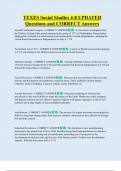
TEXES Social Studies 4-8 UPDATED
Questions and CORRECT Answers
Second Continental Congress - CORRECT ANSWER - A convention of delegates from
the Thirteen Colonies that started meeting in the spring of 1775 in Philadelphia, Pennsylvania.
Managed the Colonial war effort and moved incrementally towards independence, adopting the
United States Declaration of Independence on July 4, 1776.
Townshend Acts (1767) - CORRECT ANSWER - A series of British acts passed beginning
in 1767 and relating to the British American colonies in North America.
Thirteen Colonies - CORRECT ANSWER - A group of British colonies on the east coast
of North America founded in the 17th and 18th centuries that declared independence in 1776 and
formed the United States of America.
Fluvial Processes - CORRECT ANSWER - Processes that are associated with rivers and
streams and the deposits and landforms created by them. These landforms include Basins,
Channels, Delta, Floodplain, Canyons, Islands, Gully, Waterfalls, etc.
Aeolian Processes - CORRECT ANSWER - Processes pertaining to wind activity,
specifically to the wind's ability to shape the surface of the Earth. Winds may erode, transport,
and deposit materials and are effective agents in regions with sparse vegetation, a lack of soil
moisture and a large supply of unconsolidated sediments.
Aridification - CORRECT ANSWER - The process of a region becoming increasingly dry.
Refers to long term change rather than seasonal variation. Measured by the reduction of average
soil moisture content.
Industrial Revolution - CORRECT ANSWER - The transition to new manufacturing
processes in the period from 1760 to 1840. Included going from hand production to machines,
new chemical manufacturing and iron production, increasing use of steam power, the
development of machine tools and the rise of the factory system. Textiles were the dominant
industry. With the first cotton mill in 1733.
,Cotton Gin - CORRECT ANSWER - Eli Whitney invented this in 1793 in America.
Giovanni da Verrazzano (1485-1528) - CORRECT ANSWER - An Italian explorer of
North America in the service of King Francis I of France. Explored the area between Florida and
the St. Lawrence Seaway for France.
Samuel de Champlain (1574-1635 - CORRECT ANSWER - "The Father of New France",
was a French navigator, cartographer, draftsman, soldier, explorer, geographer, ethnologist,
diplomat, and chronicler. He made from 21-29 trips across the Atlantic, and founded New France
and Quebec City on July 3, 1608. Set up a fur empire.
Fr. Jacques Marquette (1637-1675) - CORRECT ANSWER - Was a French Jesuit
missionary who founded Michigan's first European settlement, Sault Ste. Marie, and later
founded St. Ignace, Michigan. In 1673 he and Louis Jolliet were the first Europeans to explore
and map the northern portion of the Mississippi River.
Rene-Robert de la Salle (1643-1687) - CORRECT ANSWER - He explored the Great
Lakes region of the United States and Canada, the Mississippi River, and the Gulf of Mexico. He
claimed the entire Mississippi River basin for France.
Christopher Columbus (1451-1506) - CORRECT ANSWER - During his first voyage in
1492, he reached the New World instead of arriving in Japan as he had intended, landing on an
island in the Bahamas archipelago that he named San Salvador. European explorer credited with
establishing and documenting routes to the Americas, securing lasting European ties to the
Americas, and inaugurating a period of exploration, conquest, and colonization that lasted for
centuries.
Transatlantic Slave Trade - CORRECT ANSWER - Involved the transportation by slave
traders of enslaved African people, mainly from Africa to the Americas, and then their sale there.
The slave trade used mainly the triangular trade route and its Middle Passage, and existed from
the 16th to the 19th centuries.
,Juan Ponce de Leon (1474-1521) - CORRECT ANSWER - He became the first Governor
of Puerto Rico by appointment of the Spanish crown. He led the first known European
expedition to La Florida, which he named during his first voyage to the area in 1513.
Conquistador - CORRECT ANSWER - A term used to refer to the soldiers and explorers
of the Spanish Empire or the Portuguese Empire in a general sense.[1][2] During the Age of
Discovery, they sailed beyond Europe to the Americas, Oceania, Africa and Asia, conquering
territory and opening trade routes. They colonized much of the world for Spain and Portugal in
the 16th, 17th and 18th centuries.
Alonso Alvarez de Pineda (1494-1520) - CORRECT ANSWER - In 1519 he led several
expeditions to map the western coastlines of the Gulf of Mexico to Florida.
Panifilo de Narvaez (14-1528) - CORRECT ANSWER - He came to participate in the
conquest of Cuba and led an expedition to Camagüey escorting Bartolomé de las Casas.
Hernan Cortes (1485-1547) - CORRECT ANSWER - A Spanish Conquistador who led an
expedition that caused the fall of the Aztec Empire and brought large portions of what is now
mainland Mexico under the rule of the King of Castile in the early 16th century. Cortés was part
of the generation of Spanish colonizers who began the first phase of the Spanish colonization of
the Americas.
Alvar Nunez Cabeza de Vaca (1488-1560) - CORRECT ANSWER - A Spanish explorer of
the New World, and one of four survivors of the 1527 Narváez expedition. During eight years of
traveling across the US Southwest, he became a trader and faith healer to various Native
American tribes before reconnecting with Spanish civilization in Mexico in 1536.
Francisco Vasquez de Coronado (1510-1554) - CORRECT ANSWER - A Spanish
conquistador and explorer who led a large expedition from Mexico to present-day Kansas
through parts of the southwestern United States between 1540 and 1542. His expedition marked
the first European sightings of the Grand Canyon and the Colorado River, among other
landmarks.
, Hernando de Soto (1495-1542) - CORRECT ANSWER - Led the first European
expedition deep into the territory of the modern-day United States (Florida, Georgia, Mississippi,
Alabama and most likely Arkansas). He is the first European documented as having crossed the
Mississippi River.
Merchantilism - CORRECT ANSWER - A national economic policy designed to maximize
the trade of a nation and, historically, to maximize the accumulation of gold and silver. was
dominant in modernized parts of Europe from the 16th to the 18th centuries.
Anglo-Spanish War (1585-1604) - CORRECT ANSWER - An intermittent conflict
between the kingdoms of Spain and England that was never formally declared. The war was
punctuated by widely separated battles, and began with England's military expedition in 1585 to
the Netherlands under the command of the Earl of Leicester in support of the resistance of the
States General to Spanish Habsburg rule.
Slavery in the United States - CORRECT ANSWER - The modern conception of slavery
in the United States was formalized in 1640 (the John Punch hearing) and was fully entrenched
in Virginia by 1660.
Virginia Company - CORRECT ANSWER - Refers collectively to two joint stock
companies chartered under James I on 10 April 1606 with the goal of establishing settlements on
the coast of North America.
American Revolution - CORRECT ANSWER - A colonial revolt that took place between
1765 and 1783. The American Patriots in the Thirteen Colonies won independence from Great
Britain, becoming the United States of America. They defeated the British in the American
Revolutionary War in alliance with France and others.
No Taxation Without Representation - CORRECT ANSWER - A slogan originating during
the 1750s and 1760s that summarized a primary grievance of the American colonists in the
Thirteen Colonies, which was one of the major causes of the American Revolution.
Sugar Act - CORRECT ANSWER - Also known as the American Revenue Act or the
American Duties Act, was a revenue-raising act passed by the Parliament of Great Britain on 5
Questions and CORRECT Answers
Second Continental Congress - CORRECT ANSWER - A convention of delegates from
the Thirteen Colonies that started meeting in the spring of 1775 in Philadelphia, Pennsylvania.
Managed the Colonial war effort and moved incrementally towards independence, adopting the
United States Declaration of Independence on July 4, 1776.
Townshend Acts (1767) - CORRECT ANSWER - A series of British acts passed beginning
in 1767 and relating to the British American colonies in North America.
Thirteen Colonies - CORRECT ANSWER - A group of British colonies on the east coast
of North America founded in the 17th and 18th centuries that declared independence in 1776 and
formed the United States of America.
Fluvial Processes - CORRECT ANSWER - Processes that are associated with rivers and
streams and the deposits and landforms created by them. These landforms include Basins,
Channels, Delta, Floodplain, Canyons, Islands, Gully, Waterfalls, etc.
Aeolian Processes - CORRECT ANSWER - Processes pertaining to wind activity,
specifically to the wind's ability to shape the surface of the Earth. Winds may erode, transport,
and deposit materials and are effective agents in regions with sparse vegetation, a lack of soil
moisture and a large supply of unconsolidated sediments.
Aridification - CORRECT ANSWER - The process of a region becoming increasingly dry.
Refers to long term change rather than seasonal variation. Measured by the reduction of average
soil moisture content.
Industrial Revolution - CORRECT ANSWER - The transition to new manufacturing
processes in the period from 1760 to 1840. Included going from hand production to machines,
new chemical manufacturing and iron production, increasing use of steam power, the
development of machine tools and the rise of the factory system. Textiles were the dominant
industry. With the first cotton mill in 1733.
,Cotton Gin - CORRECT ANSWER - Eli Whitney invented this in 1793 in America.
Giovanni da Verrazzano (1485-1528) - CORRECT ANSWER - An Italian explorer of
North America in the service of King Francis I of France. Explored the area between Florida and
the St. Lawrence Seaway for France.
Samuel de Champlain (1574-1635 - CORRECT ANSWER - "The Father of New France",
was a French navigator, cartographer, draftsman, soldier, explorer, geographer, ethnologist,
diplomat, and chronicler. He made from 21-29 trips across the Atlantic, and founded New France
and Quebec City on July 3, 1608. Set up a fur empire.
Fr. Jacques Marquette (1637-1675) - CORRECT ANSWER - Was a French Jesuit
missionary who founded Michigan's first European settlement, Sault Ste. Marie, and later
founded St. Ignace, Michigan. In 1673 he and Louis Jolliet were the first Europeans to explore
and map the northern portion of the Mississippi River.
Rene-Robert de la Salle (1643-1687) - CORRECT ANSWER - He explored the Great
Lakes region of the United States and Canada, the Mississippi River, and the Gulf of Mexico. He
claimed the entire Mississippi River basin for France.
Christopher Columbus (1451-1506) - CORRECT ANSWER - During his first voyage in
1492, he reached the New World instead of arriving in Japan as he had intended, landing on an
island in the Bahamas archipelago that he named San Salvador. European explorer credited with
establishing and documenting routes to the Americas, securing lasting European ties to the
Americas, and inaugurating a period of exploration, conquest, and colonization that lasted for
centuries.
Transatlantic Slave Trade - CORRECT ANSWER - Involved the transportation by slave
traders of enslaved African people, mainly from Africa to the Americas, and then their sale there.
The slave trade used mainly the triangular trade route and its Middle Passage, and existed from
the 16th to the 19th centuries.
,Juan Ponce de Leon (1474-1521) - CORRECT ANSWER - He became the first Governor
of Puerto Rico by appointment of the Spanish crown. He led the first known European
expedition to La Florida, which he named during his first voyage to the area in 1513.
Conquistador - CORRECT ANSWER - A term used to refer to the soldiers and explorers
of the Spanish Empire or the Portuguese Empire in a general sense.[1][2] During the Age of
Discovery, they sailed beyond Europe to the Americas, Oceania, Africa and Asia, conquering
territory and opening trade routes. They colonized much of the world for Spain and Portugal in
the 16th, 17th and 18th centuries.
Alonso Alvarez de Pineda (1494-1520) - CORRECT ANSWER - In 1519 he led several
expeditions to map the western coastlines of the Gulf of Mexico to Florida.
Panifilo de Narvaez (14-1528) - CORRECT ANSWER - He came to participate in the
conquest of Cuba and led an expedition to Camagüey escorting Bartolomé de las Casas.
Hernan Cortes (1485-1547) - CORRECT ANSWER - A Spanish Conquistador who led an
expedition that caused the fall of the Aztec Empire and brought large portions of what is now
mainland Mexico under the rule of the King of Castile in the early 16th century. Cortés was part
of the generation of Spanish colonizers who began the first phase of the Spanish colonization of
the Americas.
Alvar Nunez Cabeza de Vaca (1488-1560) - CORRECT ANSWER - A Spanish explorer of
the New World, and one of four survivors of the 1527 Narváez expedition. During eight years of
traveling across the US Southwest, he became a trader and faith healer to various Native
American tribes before reconnecting with Spanish civilization in Mexico in 1536.
Francisco Vasquez de Coronado (1510-1554) - CORRECT ANSWER - A Spanish
conquistador and explorer who led a large expedition from Mexico to present-day Kansas
through parts of the southwestern United States between 1540 and 1542. His expedition marked
the first European sightings of the Grand Canyon and the Colorado River, among other
landmarks.
, Hernando de Soto (1495-1542) - CORRECT ANSWER - Led the first European
expedition deep into the territory of the modern-day United States (Florida, Georgia, Mississippi,
Alabama and most likely Arkansas). He is the first European documented as having crossed the
Mississippi River.
Merchantilism - CORRECT ANSWER - A national economic policy designed to maximize
the trade of a nation and, historically, to maximize the accumulation of gold and silver. was
dominant in modernized parts of Europe from the 16th to the 18th centuries.
Anglo-Spanish War (1585-1604) - CORRECT ANSWER - An intermittent conflict
between the kingdoms of Spain and England that was never formally declared. The war was
punctuated by widely separated battles, and began with England's military expedition in 1585 to
the Netherlands under the command of the Earl of Leicester in support of the resistance of the
States General to Spanish Habsburg rule.
Slavery in the United States - CORRECT ANSWER - The modern conception of slavery
in the United States was formalized in 1640 (the John Punch hearing) and was fully entrenched
in Virginia by 1660.
Virginia Company - CORRECT ANSWER - Refers collectively to two joint stock
companies chartered under James I on 10 April 1606 with the goal of establishing settlements on
the coast of North America.
American Revolution - CORRECT ANSWER - A colonial revolt that took place between
1765 and 1783. The American Patriots in the Thirteen Colonies won independence from Great
Britain, becoming the United States of America. They defeated the British in the American
Revolutionary War in alliance with France and others.
No Taxation Without Representation - CORRECT ANSWER - A slogan originating during
the 1750s and 1760s that summarized a primary grievance of the American colonists in the
Thirteen Colonies, which was one of the major causes of the American Revolution.
Sugar Act - CORRECT ANSWER - Also known as the American Revenue Act or the
American Duties Act, was a revenue-raising act passed by the Parliament of Great Britain on 5