Critical Care
Traumatic brain injuries:
Causes:
● MVA
● Falls
● Struck by objects
● Assaults
Primary: initial damage to brain from traumatic event (contusions, lacerations, direct impact,
penetration)
Secondary: evolves over hours to days after initial injury r/t inadequate oxygen/ nutrients from
cells (cerebral edema, bleeding, increased ICP, brain damage)
The Monro–Kellie hypothesis: The cranial vault contains three main components: brain, blood,
and cerebrospinal fluid (CSF). If one of the three components increases in volume, at least one
of the other two must decrease in volume or the pressure will increase.
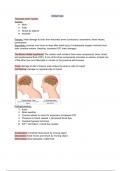
Coup: damage at site of impact; brain strikes the skull on side of impact
Contrecoup: damage on opposite side of impact
Pathophysiology:
1. Injury
2. Brain swelling
3. Cranium allows no room for expansion (increases ICP)
4. Pressure on blood vessels = decreased blood flow
5. Cerebral hypoxia/ ischemia
6. ICP = herniation = blood flow ceases
Acceleration: immobile head struck by moving object
Declaration: head moves and struck by moving object
Deformation: skull disrupted, malformed
,Scalp injury: avulsion
- Dx by inspection
- Scalp is vascular; lots of bleeding
- Requires very good irrigation (prevention of infection)
Skull fractures:
Linear (simple): break in continuity of bone (like a hairline fracture)
Comminuted: refers to a splintered or multiple fracture lines
Depressed: bones of skull are displaced downward (pushed downward, requires OR; imbedded
into brain tissue)
Locations: frontal, temporal, basilar
Basilar fracture: linear fracture in skull base
Most common locations: sphenoid sinus, temporal bone, sphenoid wings
foramen magnum (allows blood to pass in and out of brain)
● NEVER NASAL SUCTION WITH BASILAR FX
- Battles sign (bruising behind ears)
- Raccoon eyes (bruising around eyes)
- Bleeding from nose, ears, pharynx
- CSF leakage
,Skull fracture S/S and assessment:
● General LOC and neurological assessment
● Specific changes related to parts of brain
● Persistent localized pain
● Check for CSF leakage
● Cranial nerve damage (Vision, hearing, smell loss)
● Battles sign
● Vision and hearing loss
● Anosmia (loss of smell)
● Pupil changes
● Facial paresis
● Arousable? Hyper/hypo, posturing (decorticate or decerebrate)
● Monitor for ICP** CUSHING'S TRIAD!
DX skull fractures: CT, MRI
Management:
Elevate HOB 45-50 degrees
Rapid neuro evaluation
Depressed fractures usually require surgery within 24 hours
CSF leak complication:
- Clear drainage from ear or nose
- Dip w/ dextrostix; check for glucose
- If blood present; check for halo sign (blood congeals at center and CSF rings around)
- NEVER pack nose; don't obstruct
- Leak will seal w/ bedrest, elevate HOB
, Brain injury:
Concussion: temporary loss of neurological function with no apparent structural damage
● Mild: Transient confusion, disorientation, loss of consciousness lasting <30 minutes
● Classic: Results in loss of consciousness, lasts less than 6 hours,some degree of
posttraumatic amnesia
- Frontal lobe: bizzare irrational behavior
- Temporal lobe: amnesia, disorientation
- Monitoring: LOC, dizziness, worsening headache, seizures, pupil response, slurred
speech, numbness, of weakness; all may indicate need for further interventions
Post traumatic syndrome: lasts months to years after injury, causes poor concentration,
dizziness, difficulty reading, headaches. TX: cognitive rehabilitation
Contusion: moderate to severe head injury, brain is bruised and damaged
● Multiple petechiae
● Loss of consciousness with stupor and confusion
● Headache is expected
● Temporal lobe: greater risk swelling, brain herniation
● Edema and hemorrhage peak after 18-36 hours
● If vomiting: notify PCP (sign of ICP)
Diffuse axonal injury: most serious; widespread shearing and rotational forces
● Results of damage throughout whole brain
● Associated with prolonged traumatic coma
● Decorticate and decerebrate posturing
● Global cerebral edema (worsening ICP), poorer prognosis
● DX: CT, MRI
Traumatic brain injuries:
Causes:
● MVA
● Falls
● Struck by objects
● Assaults
Primary: initial damage to brain from traumatic event (contusions, lacerations, direct impact,
penetration)
Secondary: evolves over hours to days after initial injury r/t inadequate oxygen/ nutrients from
cells (cerebral edema, bleeding, increased ICP, brain damage)
The Monro–Kellie hypothesis: The cranial vault contains three main components: brain, blood,
and cerebrospinal fluid (CSF). If one of the three components increases in volume, at least one
of the other two must decrease in volume or the pressure will increase.
Coup: damage at site of impact; brain strikes the skull on side of impact
Contrecoup: damage on opposite side of impact
Pathophysiology:
1. Injury
2. Brain swelling
3. Cranium allows no room for expansion (increases ICP)
4. Pressure on blood vessels = decreased blood flow
5. Cerebral hypoxia/ ischemia
6. ICP = herniation = blood flow ceases
Acceleration: immobile head struck by moving object
Declaration: head moves and struck by moving object
Deformation: skull disrupted, malformed
,Scalp injury: avulsion
- Dx by inspection
- Scalp is vascular; lots of bleeding
- Requires very good irrigation (prevention of infection)
Skull fractures:
Linear (simple): break in continuity of bone (like a hairline fracture)
Comminuted: refers to a splintered or multiple fracture lines
Depressed: bones of skull are displaced downward (pushed downward, requires OR; imbedded
into brain tissue)
Locations: frontal, temporal, basilar
Basilar fracture: linear fracture in skull base
Most common locations: sphenoid sinus, temporal bone, sphenoid wings
foramen magnum (allows blood to pass in and out of brain)
● NEVER NASAL SUCTION WITH BASILAR FX
- Battles sign (bruising behind ears)
- Raccoon eyes (bruising around eyes)
- Bleeding from nose, ears, pharynx
- CSF leakage
,Skull fracture S/S and assessment:
● General LOC and neurological assessment
● Specific changes related to parts of brain
● Persistent localized pain
● Check for CSF leakage
● Cranial nerve damage (Vision, hearing, smell loss)
● Battles sign
● Vision and hearing loss
● Anosmia (loss of smell)
● Pupil changes
● Facial paresis
● Arousable? Hyper/hypo, posturing (decorticate or decerebrate)
● Monitor for ICP** CUSHING'S TRIAD!
DX skull fractures: CT, MRI
Management:
Elevate HOB 45-50 degrees
Rapid neuro evaluation
Depressed fractures usually require surgery within 24 hours
CSF leak complication:
- Clear drainage from ear or nose
- Dip w/ dextrostix; check for glucose
- If blood present; check for halo sign (blood congeals at center and CSF rings around)
- NEVER pack nose; don't obstruct
- Leak will seal w/ bedrest, elevate HOB
, Brain injury:
Concussion: temporary loss of neurological function with no apparent structural damage
● Mild: Transient confusion, disorientation, loss of consciousness lasting <30 minutes
● Classic: Results in loss of consciousness, lasts less than 6 hours,some degree of
posttraumatic amnesia
- Frontal lobe: bizzare irrational behavior
- Temporal lobe: amnesia, disorientation
- Monitoring: LOC, dizziness, worsening headache, seizures, pupil response, slurred
speech, numbness, of weakness; all may indicate need for further interventions
Post traumatic syndrome: lasts months to years after injury, causes poor concentration,
dizziness, difficulty reading, headaches. TX: cognitive rehabilitation
Contusion: moderate to severe head injury, brain is bruised and damaged
● Multiple petechiae
● Loss of consciousness with stupor and confusion
● Headache is expected
● Temporal lobe: greater risk swelling, brain herniation
● Edema and hemorrhage peak after 18-36 hours
● If vomiting: notify PCP (sign of ICP)
Diffuse axonal injury: most serious; widespread shearing and rotational forces
● Results of damage throughout whole brain
● Associated with prolonged traumatic coma
● Decorticate and decerebrate posturing
● Global cerebral edema (worsening ICP), poorer prognosis
● DX: CT, MRI