Chapter one:Introduction
What is leadership?
Leadership is the process of influencing others towards the realisation of a shared goal.
Leaders are individuals who have a differential influence on the initiation, direction, and coordination of
group activities over and above the influence associated with formal authority.
What is the difference between a leader and a manager?
A leader is a leader whether they have a formal position or formal power in a hierarchy.
Are leaders born or made?
Few abilities are inherited. The majority of the more important abilities are learned and developed in
interaction with others. There are no born leaders.
What do we know about leadership?
Leadership is a dynamic influential process, not a. Position or a static label.
Everyone exercises some form of leadership.
Leadership can be developed.
The effective leader behaviours/styles are context-specific
Women and men are equally effective as leaders
Many leadership practices are universal and some are culturally-specific
Being a leader contains certain pitfalls
There is no right or wrong leadership theory.
Leadership training vs development
Training focuses on knowledges, skills and attitudes
Development focuses on behaviours, identity and self-views
Developing as a leader:
You do this across the entire lifespan.
All individuals do not experience or benefit in the same ways from the same experience.
70% challenging assignments
20% developmental relationships
10% coursework and training
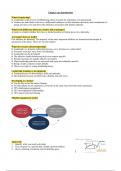
Mindful engagement model
Approach:
1. Identify what you need to develop
2. You can grow as a person and a leader: growth mindset
3. Have a learning orientation and set learning goal.
,We learn about 40% of the skills about every 3 years
Tech savviness is a sine-qua-non condition
You need a growth mindset
You have to stay critical to “learn to learn”.
Mindful Engagement
You have to get out of your comfort zone by gaining some experience in leading challenging assignments
Get unfamiliar responsibilities, create change, work across cultures/boundaries and manage diversity
Reflection
You have to capture the lessons of experience and make sense of what happened and why
For example conduct after events review, consider counterfactuals like what-if scenarios and gather
lessons learned and distill new insights.
, Chapter two:Traits and behaviours
What are traits:
Traits are”differences among individuals in a typical tendency to behave, think, or feel in some
conceptually related ways, across a variety of relevant situations and across some fairly long period of
time”
Unlike behaviours- which are malleable and can be changed, our personality is relatively stable and is
partly determined by our genes.
Environmental and contextual factors may have limited influence; although important life events and
ageing affect our personality.
History of trait research
Started in the 19th century with great man there’s that sought to identity the unique qualities possessed by
heroes or geniuses, arguing that these qualities are in fact inherited.
Pursued later as core ideologies during WWII, where the study of innate differences stopped in the 1960s
and 1970s to focus on groups and situations to “understand how the world has gone mad”
In the leadership field, two major studies/reviews found weak relationships between leader traits and
outcomes, and researchers started studying how behaviours and contexts affect the leadership process.
Resurgence of trait research in leadership:
1. Kenny & Zaccaro (1983) found that between 49% and 82% of the variance regarding leadership
emergence was attributed to leadership’s characteristics.
2. Lord,DeVader & Alliger(1976) reanalysed Mann’s (1959) review, using a more sophisticated stats
techniques. They found strong links between leader traits and leader emergence.
• Today we are moving away from univariate/multivariate associations between traits and leadership
outcomes to focus on profiles or patterns of leadership traits that are effective or ineffective in certain
situations.
Recent Review of traits which are association with leadership
Zooming in on personality dimensions
HEXACO Model: provides one predominant personality typology. It has six dimensions:
1. Honesty-Humility:
Sincerity:the tendency to be genuine in interpersonal relations.
Fairness: the tendency to avoid fraud and corruption
Greed Avoidance: the tendency to be uninterested in possessing lavish wealth, luxury goods, and signs
of high social status
Modesty scale: the tendency to be modest and unassuming.
It predicts many variables in organisational work such as corruption, work performance and abusive
supervision.
2. Emotionality
Fearfulness: the tendency to experience fear
Anxiety: the tendency to worry in a variety of contexts
Dependence: one’s need for emotional support from others
Sentimentality: the tendency to feel strong emotional bonds with others
, Across many situations, ideal employees have a low level of emotionality which helps performance,
teamwork and leadership.
3. Extraversion
Self-esteem: the tendency to have a positive self-regard
Social boldness: one’s comfort or confidence within a variety of social situations
Sociability: the tendency to enjoy conversation, social interactions and parties
Liveliness: one’s typical enthusiasm and energy
This dimension predicts who emerges a leader in work groups. However, extroverts may be perceived
as bad listeners or as lacking a clear vision.
4. Agreeableness
Forgiveness: one’s willingness to feel trust and like those who may have caused them harm
Gentleness: the tendency to be mild and lenient in dealings with other people
Flexibility: one’s willingness to compromise and cooperate with others
Patience: the tendency to remain calm rather than to become angry
Agreeable individuals are better liked, engage in more organisational citizenship behaviours and are
more likely to emerge as leaders. But, agreeable leaders tend to refrain from providing critical negative
feedback.
5. Conscientiousness
Organisation: the tendency to seek order, particularly in one’s physical surroundings
Diligence: the tendency to work hard
Perfectionism: the tendency to be thorough and concerned with details
Prudence: the tendency to deliberate carefully and inhibit impulses
This dimension is the strongest and most consistent predictor of overall job performance.
6. Openness to Experience
Aesthetic appreciation: one’s enjoyment of beauty and art in nature
Inquisitiveness: the tendency to seek information about and experience with the natural and human
world
Creativity: one’s preference for innovation and experiment
Unconventionality: the tendency to accept the unusual
This dimension is the best predictor of creative behaviours.
Intelligence
General intelligence is the ability to learn, to abstract and to process information, or the ability to deal with
complexity to process information.
Intelligence is positively correlated with job performance especially for more complex jobs.
Intelligence is positively correlate with leader emergence and leader effectiveness.
Can you be too high on a desirable factor?
Does context matter in Traits
Lewin’s equation: B=f(P,E)
Situation strength refers to the degree to which norms, scripts, or standards dictate appropriate behaviours.
• In strong situations, conformity is expected from individuals. The script of the situation suggests what
the desirable behaviour is. In these contexts, our personality does not predict our behaviours.
What is leadership?
Leadership is the process of influencing others towards the realisation of a shared goal.
Leaders are individuals who have a differential influence on the initiation, direction, and coordination of
group activities over and above the influence associated with formal authority.
What is the difference between a leader and a manager?
A leader is a leader whether they have a formal position or formal power in a hierarchy.
Are leaders born or made?
Few abilities are inherited. The majority of the more important abilities are learned and developed in
interaction with others. There are no born leaders.
What do we know about leadership?
Leadership is a dynamic influential process, not a. Position or a static label.
Everyone exercises some form of leadership.
Leadership can be developed.
The effective leader behaviours/styles are context-specific
Women and men are equally effective as leaders
Many leadership practices are universal and some are culturally-specific
Being a leader contains certain pitfalls
There is no right or wrong leadership theory.
Leadership training vs development
Training focuses on knowledges, skills and attitudes
Development focuses on behaviours, identity and self-views
Developing as a leader:
You do this across the entire lifespan.
All individuals do not experience or benefit in the same ways from the same experience.
70% challenging assignments
20% developmental relationships
10% coursework and training
Mindful engagement model
Approach:
1. Identify what you need to develop
2. You can grow as a person and a leader: growth mindset
3. Have a learning orientation and set learning goal.
,We learn about 40% of the skills about every 3 years
Tech savviness is a sine-qua-non condition
You need a growth mindset
You have to stay critical to “learn to learn”.
Mindful Engagement
You have to get out of your comfort zone by gaining some experience in leading challenging assignments
Get unfamiliar responsibilities, create change, work across cultures/boundaries and manage diversity
Reflection
You have to capture the lessons of experience and make sense of what happened and why
For example conduct after events review, consider counterfactuals like what-if scenarios and gather
lessons learned and distill new insights.
, Chapter two:Traits and behaviours
What are traits:
Traits are”differences among individuals in a typical tendency to behave, think, or feel in some
conceptually related ways, across a variety of relevant situations and across some fairly long period of
time”
Unlike behaviours- which are malleable and can be changed, our personality is relatively stable and is
partly determined by our genes.
Environmental and contextual factors may have limited influence; although important life events and
ageing affect our personality.
History of trait research
Started in the 19th century with great man there’s that sought to identity the unique qualities possessed by
heroes or geniuses, arguing that these qualities are in fact inherited.
Pursued later as core ideologies during WWII, where the study of innate differences stopped in the 1960s
and 1970s to focus on groups and situations to “understand how the world has gone mad”
In the leadership field, two major studies/reviews found weak relationships between leader traits and
outcomes, and researchers started studying how behaviours and contexts affect the leadership process.
Resurgence of trait research in leadership:
1. Kenny & Zaccaro (1983) found that between 49% and 82% of the variance regarding leadership
emergence was attributed to leadership’s characteristics.
2. Lord,DeVader & Alliger(1976) reanalysed Mann’s (1959) review, using a more sophisticated stats
techniques. They found strong links between leader traits and leader emergence.
• Today we are moving away from univariate/multivariate associations between traits and leadership
outcomes to focus on profiles or patterns of leadership traits that are effective or ineffective in certain
situations.
Recent Review of traits which are association with leadership
Zooming in on personality dimensions
HEXACO Model: provides one predominant personality typology. It has six dimensions:
1. Honesty-Humility:
Sincerity:the tendency to be genuine in interpersonal relations.
Fairness: the tendency to avoid fraud and corruption
Greed Avoidance: the tendency to be uninterested in possessing lavish wealth, luxury goods, and signs
of high social status
Modesty scale: the tendency to be modest and unassuming.
It predicts many variables in organisational work such as corruption, work performance and abusive
supervision.
2. Emotionality
Fearfulness: the tendency to experience fear
Anxiety: the tendency to worry in a variety of contexts
Dependence: one’s need for emotional support from others
Sentimentality: the tendency to feel strong emotional bonds with others
, Across many situations, ideal employees have a low level of emotionality which helps performance,
teamwork and leadership.
3. Extraversion
Self-esteem: the tendency to have a positive self-regard
Social boldness: one’s comfort or confidence within a variety of social situations
Sociability: the tendency to enjoy conversation, social interactions and parties
Liveliness: one’s typical enthusiasm and energy
This dimension predicts who emerges a leader in work groups. However, extroverts may be perceived
as bad listeners or as lacking a clear vision.
4. Agreeableness
Forgiveness: one’s willingness to feel trust and like those who may have caused them harm
Gentleness: the tendency to be mild and lenient in dealings with other people
Flexibility: one’s willingness to compromise and cooperate with others
Patience: the tendency to remain calm rather than to become angry
Agreeable individuals are better liked, engage in more organisational citizenship behaviours and are
more likely to emerge as leaders. But, agreeable leaders tend to refrain from providing critical negative
feedback.
5. Conscientiousness
Organisation: the tendency to seek order, particularly in one’s physical surroundings
Diligence: the tendency to work hard
Perfectionism: the tendency to be thorough and concerned with details
Prudence: the tendency to deliberate carefully and inhibit impulses
This dimension is the strongest and most consistent predictor of overall job performance.
6. Openness to Experience
Aesthetic appreciation: one’s enjoyment of beauty and art in nature
Inquisitiveness: the tendency to seek information about and experience with the natural and human
world
Creativity: one’s preference for innovation and experiment
Unconventionality: the tendency to accept the unusual
This dimension is the best predictor of creative behaviours.
Intelligence
General intelligence is the ability to learn, to abstract and to process information, or the ability to deal with
complexity to process information.
Intelligence is positively correlated with job performance especially for more complex jobs.
Intelligence is positively correlate with leader emergence and leader effectiveness.
Can you be too high on a desirable factor?
Does context matter in Traits
Lewin’s equation: B=f(P,E)
Situation strength refers to the degree to which norms, scripts, or standards dictate appropriate behaviours.
• In strong situations, conformity is expected from individuals. The script of the situation suggests what
the desirable behaviour is. In these contexts, our personality does not predict our behaviours.