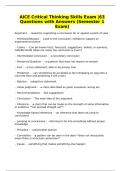
AICE Critical Thinking Skills Exam |63
Questions with Answers (Semester 1
Exam)
Argument - -reason(s) supporting a conclusion for or against a point of view
- Premises/Reasons - -Lead to the conclusion; needed to support an
argument/conclusion
- Claims - -Can be known facts, forecasts, suggestions, beliefs, or opinions;
CAN BE FALSE (does not mean the conclusion is true!!)
- Intermediate Conclusion - -a secondary conclusion
- Rhetorical Question - -a question that does not require an answer
- Fact - -a true statement; able to be proven true
- Prediction - -can sometimes be accepted as fact (dropping an egg onto a
concrete floor and predicting it will crack)
- Opinion - -subjective statement
- Value Judgment - -a claim described as good, excessive, wrong etc.
- Recommendations - -like suggestions
- Conclusion - -The main idea of the argument
- Inference - -a claim that can be made on the strength of some information
or evidence **not pointed straight out**
- Knowledge based inferences - -an inference that does not jump to
conclusions
- Jumping to conclusions - -inferring to far into something without proper
knowledge
- Prejudice - -unfavorable opinion
- Correlation - -a pattern can be seen in the data **does not necessarily
mean there is an actual connection**
- Cause - -something that makes something else happen
, - Assumption - -implicit claims; basing it off of the unknown and hoping for
the best
- Implicit Assumption - -an assumption that is not clearly present (you have
to "look between the lines")
- Explicit Assumption - -an assumption that is clearly present (it is outright
stated)
- Underlying Assumption - -assumptions that have to be made for an
argument to be true (Ex. "I paid for your ticket so now you owe me $500."
We have to ASSUME that the ticket cost $500 but we could be wrong.)
- Deductive Argument - -conclusion follows from the premises with
certainty; if all the premises are true, then conclusion is certain ***ALWAYS
VALID***
- Inductive Argument - -conclusion follows from premises with some type of
certainty, but to be likely need a high degree of certainty ***NEVER VALID***
STRENGTH HAS NOTHING TO DO WITH THE TRUTH!
- Strong Quantifiers - -Almost all, Almost definitely, Highly probable, it is
likely that, most, most likely, more often than not, the majority
- Weak quantifiers - -A few, a percentage, a significant percentage, could
be, it is possible that, many, some, somewhat likely
- Valid - -refers to the STRUCTURE of an argument! ***A=B and B=C, then
A=C*** NOT TRUE/FALSE!!!!!
- Sound - -VALID and all the premises are true, so then the conclusion is
also true. ***IF IT IS SOUND, IT IS ALSO VALID***
- Cogent - -An argument is strong and all the premises are true. **THEY ARE
MOST LIKELY TRUE!!** P1: It walks like a duck. P2: It quacks like a duck. P3:
It looks like a duck. C: Thus, it is probably a duck. **keyword: PROBABLY.**
- Fallacy - -any various types of erroneous reasoning that render arguments
logically UNSOUND.
- Argumentum ad antiquitatem - -saying something is good or right because
its old or has always been that way
- Argumentum ad crumenam - -saying money means correctness and those
with more money are more correct
Questions with Answers (Semester 1
Exam)
Argument - -reason(s) supporting a conclusion for or against a point of view
- Premises/Reasons - -Lead to the conclusion; needed to support an
argument/conclusion
- Claims - -Can be known facts, forecasts, suggestions, beliefs, or opinions;
CAN BE FALSE (does not mean the conclusion is true!!)
- Intermediate Conclusion - -a secondary conclusion
- Rhetorical Question - -a question that does not require an answer
- Fact - -a true statement; able to be proven true
- Prediction - -can sometimes be accepted as fact (dropping an egg onto a
concrete floor and predicting it will crack)
- Opinion - -subjective statement
- Value Judgment - -a claim described as good, excessive, wrong etc.
- Recommendations - -like suggestions
- Conclusion - -The main idea of the argument
- Inference - -a claim that can be made on the strength of some information
or evidence **not pointed straight out**
- Knowledge based inferences - -an inference that does not jump to
conclusions
- Jumping to conclusions - -inferring to far into something without proper
knowledge
- Prejudice - -unfavorable opinion
- Correlation - -a pattern can be seen in the data **does not necessarily
mean there is an actual connection**
- Cause - -something that makes something else happen
, - Assumption - -implicit claims; basing it off of the unknown and hoping for
the best
- Implicit Assumption - -an assumption that is not clearly present (you have
to "look between the lines")
- Explicit Assumption - -an assumption that is clearly present (it is outright
stated)
- Underlying Assumption - -assumptions that have to be made for an
argument to be true (Ex. "I paid for your ticket so now you owe me $500."
We have to ASSUME that the ticket cost $500 but we could be wrong.)
- Deductive Argument - -conclusion follows from the premises with
certainty; if all the premises are true, then conclusion is certain ***ALWAYS
VALID***
- Inductive Argument - -conclusion follows from premises with some type of
certainty, but to be likely need a high degree of certainty ***NEVER VALID***
STRENGTH HAS NOTHING TO DO WITH THE TRUTH!
- Strong Quantifiers - -Almost all, Almost definitely, Highly probable, it is
likely that, most, most likely, more often than not, the majority
- Weak quantifiers - -A few, a percentage, a significant percentage, could
be, it is possible that, many, some, somewhat likely
- Valid - -refers to the STRUCTURE of an argument! ***A=B and B=C, then
A=C*** NOT TRUE/FALSE!!!!!
- Sound - -VALID and all the premises are true, so then the conclusion is
also true. ***IF IT IS SOUND, IT IS ALSO VALID***
- Cogent - -An argument is strong and all the premises are true. **THEY ARE
MOST LIKELY TRUE!!** P1: It walks like a duck. P2: It quacks like a duck. P3:
It looks like a duck. C: Thus, it is probably a duck. **keyword: PROBABLY.**
- Fallacy - -any various types of erroneous reasoning that render arguments
logically UNSOUND.
- Argumentum ad antiquitatem - -saying something is good or right because
its old or has always been that way
- Argumentum ad crumenam - -saying money means correctness and those
with more money are more correct