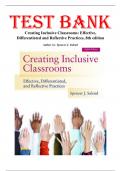
Creating Inclusive Classrooms: Effective, Differentiated and Reflective Practices 8th Edition
MANUAL &
TEST BANK
ST
U
Creating Inclusive Classrooms:
VI
Effective, Differentiated and
A
Reflective Practices 8th Edition
AP
PR
Authors:
Spencer J. Salend
OV
◊ ALL CHAPTERS
◊ INSTANT PDF DOWNLOAD💯💯💯
ED
◊ ORIGINAL FROM PUBLISHER
?
MEDCONNOISSEUR
, Table of Contents
Chapter 1: Understanding Inclusion………………………………………………………...4
Chapter 2: Understanding the Diverse Educational Strengths and Challenges of Students with
Disabilities…………………………………………………………………………………..11
Chapter 3: Understanding the Diverse Educational Strengths and Challenges of Students Who
Challenge Schools…………………………………………………………………………..17
ST
Chapter 4: Understanding the Educational Strengths and Challenges of Students From Diverse
Backgrounds…………………………………………………………………………………23
U
Chapter 5: Creating Collaborative Relationships and Fostering Communication…………..28
VI
Chapter 6: Creating Successful Transitions to Inclusive Settings…………………………..34
Chapter 7: Creating a Classroom Environment That Promotes Positive Behavior…………40
A
Chapter 8: Differentiating Instruction for ALL Learners…………………………………...46
AP
Chapter 9: Differentiating Large- and Small-Group Instruction……………………………52
Chapter 10: Differentiating Reading, Writing, and Spelling Instruction……………………57
PR
Chapter 11: Differentiating Mathematics, Science, and Social Studies Instruction…………63
Chapter 12: Evaluating Student Progress and the Effectiveness of Your Inclusion
Program……………………………………………………………………………………………...68
OV
Test Bank……………………………………………………………………………………….……75
ED
?
1
, Chapter 1: Understanding Inclusion
Chapter Overview
Chapter 1 introduces the concepts of special education, inclusion, evidence-based education and the least
restrictive environment; the philosophical principles that guide this book; the factors that contributed to the growth
of inclusion; and the current research on the impact of inclusion on students, teachers, and families.
Chapter Objectives
ST
After reading this chapter, students will have the knowledge, skills, and dispositions to:
• Define the concepts of special education, evidence-based education, inclusion and the least restrictive
environment;
• Explain the relevant and evolving principles, theories, philosophies, events, laws, court cases, policies, and
U
factors that have influenced and continue to inform the field of special education and its current
professional practices and the movement to educate students in inclusive classrooms; and
•
VI
Summarize the research on the impact of inclusion on students, educators, and families.
On
Demand Introductory Text Discussion Question
A
Learning
1.1 View the video to learn more about how the What would Bernard Carabello’s life be had he
education and treatment of individuals with stayed in Willowbrook? if he had an inclusive
AP
disabilities has undergone a transformation from the education like Mary?
segregation and dependence that defined Marie’s
life to the inclusion and advocacy that typifies
Mary’s life.
1.2 View this this video to learn more about creating What roles did the teachers and students perform
PR
secondary inclusive classrooms. in their classroom?
1.3 Read this document to learn more about creating How are the four principles of inclusion
elementary inclusive classrooms. implemented?
1.4 View the video to learn more about universal design What are the three UDL principles?
for learning (UDL).
OV
1.5 View the video to learn more about the advocacy How did the advocacy of people with disabilities
roles played by individuals with disability, and what change society’s and your perceptions of
it means to be an individual with a disability. disability?
1.6 View the video to learn more about the What are the major curricular and instructional
implementation of the Common Core Standards for aspects that are integral parts of the Common
ED
English Language Arts and Literacy and Core Standards for English Language Arts and
Mathematics at the elementary level. Literacy and Mathematics and how will these
aspects impact your students and your teaching
in your inclusive classroom?
1.7 View the video to learn more about the What are the major curricular and instructional
implementation of the Common Core Standards for aspects that are integral parts of the Common
?
English Language Arts and Literacy and Core Standards for English Language Arts and
Mathematics at the secondary level. Literacy and Mathematics and how will these
aspects impact your students and your teaching
in your inclusive classroom?
1.8 View the video to learn more about the education of What would the education of individuals with
individuals with disabilities prior to and after the disabilities be like without the passage of the
passage of the Individuals with Disabilities IDEA?
Education Act.
1.9 Read the document to learn more about the Is the research consistent with your experiences
2
, research on the impact of inclusive education regarding the impact of inclusion on the
placements on the academic and social performance academic and social performance students with
of elementary and/or secondary level students with disabilities?
disabilities, respectively.
1.10 Learn more about the impact of inclusion by How did being in an inclusive school impact this
reading about the reactions of a secondary student student’s academic, social, and behavioral
with a disability to being in an inclusive school. progress and self-esteem?
1.11 View this video to learn more about the experiences How did being in an inclusive school impact this
of elementary students with disabilities in inclusive student’s academic, social, and behavioral
classrooms. progress and self-esteem?
1.12 Read the document to learn more about the research What are the implications of this research for
ST
on the impact of inclusive education placements on creating your inclusive classroom?
the academic and social performance of elementary
and/or secondary level students without disabilities,
respectively.
U
Chapter Outline
VI
Marie and Mary (Chapter-opening vignette)
I. Special Education
A. Individualized assessment and planning
A
B. Specialized instruction
C. Intensive instruction
D. Goal-directed instruction
AP
E. Evidence-based instructional practices
F. Collaborative partnerships
G. Student performance evaluation
II. Inclusion
III. Principles of Effective Inclusion
PR
A. Principle 1: All Learners and Equal Access
B. Principle 2: Individual Strengths and Challenges and Diversity
C. Principle 3: Reflective, Universally-Designed, Culturally-Responsive, Evidenced-Based, and
Differentiated Practices
D. Principle 4: Community and Collaboration
OV
IV. Mainstreaming
V. Least Restrictive Environment
A. Continuum of Educational Placements
1. General Education Classroom Placement with Few or No Supportive Services
2. General Education Classroom Placement with Collaborative Teacher Assistance
ED
3. General Education Classroom Placement with Itinerant Specialist Assistance
4. General Education Classroom Placement with Resource Room Assistance
5. Special Education Classroom Placement with Part Time in the General Education Classroom
6. Full-Time Special Education Classroom
7. Special Day School
8. Residential School
?
9. Homebound Instruction
10. Hospital or Institution
VI. Factors Contributing to Inclusion
A. Normalization
B. Early Intervention and Early Childhood Programs
C. Civil Rights Movement and Resulting Court Cases
D. Advocacy Groups
E. Segregated Nature of Special Schools and Classes
F. Disproportionate Representation
G. Standards-Based Education Initiatives
3
MANUAL &
TEST BANK
ST
U
Creating Inclusive Classrooms:
VI
Effective, Differentiated and
A
Reflective Practices 8th Edition
AP
PR
Authors:
Spencer J. Salend
OV
◊ ALL CHAPTERS
◊ INSTANT PDF DOWNLOAD💯💯💯
ED
◊ ORIGINAL FROM PUBLISHER
?
MEDCONNOISSEUR
, Table of Contents
Chapter 1: Understanding Inclusion………………………………………………………...4
Chapter 2: Understanding the Diverse Educational Strengths and Challenges of Students with
Disabilities…………………………………………………………………………………..11
Chapter 3: Understanding the Diverse Educational Strengths and Challenges of Students Who
Challenge Schools…………………………………………………………………………..17
ST
Chapter 4: Understanding the Educational Strengths and Challenges of Students From Diverse
Backgrounds…………………………………………………………………………………23
U
Chapter 5: Creating Collaborative Relationships and Fostering Communication…………..28
VI
Chapter 6: Creating Successful Transitions to Inclusive Settings…………………………..34
Chapter 7: Creating a Classroom Environment That Promotes Positive Behavior…………40
A
Chapter 8: Differentiating Instruction for ALL Learners…………………………………...46
AP
Chapter 9: Differentiating Large- and Small-Group Instruction……………………………52
Chapter 10: Differentiating Reading, Writing, and Spelling Instruction……………………57
PR
Chapter 11: Differentiating Mathematics, Science, and Social Studies Instruction…………63
Chapter 12: Evaluating Student Progress and the Effectiveness of Your Inclusion
Program……………………………………………………………………………………………...68
OV
Test Bank……………………………………………………………………………………….……75
ED
?
1
, Chapter 1: Understanding Inclusion
Chapter Overview
Chapter 1 introduces the concepts of special education, inclusion, evidence-based education and the least
restrictive environment; the philosophical principles that guide this book; the factors that contributed to the growth
of inclusion; and the current research on the impact of inclusion on students, teachers, and families.
Chapter Objectives
ST
After reading this chapter, students will have the knowledge, skills, and dispositions to:
• Define the concepts of special education, evidence-based education, inclusion and the least restrictive
environment;
• Explain the relevant and evolving principles, theories, philosophies, events, laws, court cases, policies, and
U
factors that have influenced and continue to inform the field of special education and its current
professional practices and the movement to educate students in inclusive classrooms; and
•
VI
Summarize the research on the impact of inclusion on students, educators, and families.
On
Demand Introductory Text Discussion Question
A
Learning
1.1 View the video to learn more about how the What would Bernard Carabello’s life be had he
education and treatment of individuals with stayed in Willowbrook? if he had an inclusive
AP
disabilities has undergone a transformation from the education like Mary?
segregation and dependence that defined Marie’s
life to the inclusion and advocacy that typifies
Mary’s life.
1.2 View this this video to learn more about creating What roles did the teachers and students perform
PR
secondary inclusive classrooms. in their classroom?
1.3 Read this document to learn more about creating How are the four principles of inclusion
elementary inclusive classrooms. implemented?
1.4 View the video to learn more about universal design What are the three UDL principles?
for learning (UDL).
OV
1.5 View the video to learn more about the advocacy How did the advocacy of people with disabilities
roles played by individuals with disability, and what change society’s and your perceptions of
it means to be an individual with a disability. disability?
1.6 View the video to learn more about the What are the major curricular and instructional
implementation of the Common Core Standards for aspects that are integral parts of the Common
ED
English Language Arts and Literacy and Core Standards for English Language Arts and
Mathematics at the elementary level. Literacy and Mathematics and how will these
aspects impact your students and your teaching
in your inclusive classroom?
1.7 View the video to learn more about the What are the major curricular and instructional
implementation of the Common Core Standards for aspects that are integral parts of the Common
?
English Language Arts and Literacy and Core Standards for English Language Arts and
Mathematics at the secondary level. Literacy and Mathematics and how will these
aspects impact your students and your teaching
in your inclusive classroom?
1.8 View the video to learn more about the education of What would the education of individuals with
individuals with disabilities prior to and after the disabilities be like without the passage of the
passage of the Individuals with Disabilities IDEA?
Education Act.
1.9 Read the document to learn more about the Is the research consistent with your experiences
2
, research on the impact of inclusive education regarding the impact of inclusion on the
placements on the academic and social performance academic and social performance students with
of elementary and/or secondary level students with disabilities?
disabilities, respectively.
1.10 Learn more about the impact of inclusion by How did being in an inclusive school impact this
reading about the reactions of a secondary student student’s academic, social, and behavioral
with a disability to being in an inclusive school. progress and self-esteem?
1.11 View this video to learn more about the experiences How did being in an inclusive school impact this
of elementary students with disabilities in inclusive student’s academic, social, and behavioral
classrooms. progress and self-esteem?
1.12 Read the document to learn more about the research What are the implications of this research for
ST
on the impact of inclusive education placements on creating your inclusive classroom?
the academic and social performance of elementary
and/or secondary level students without disabilities,
respectively.
U
Chapter Outline
VI
Marie and Mary (Chapter-opening vignette)
I. Special Education
A. Individualized assessment and planning
A
B. Specialized instruction
C. Intensive instruction
D. Goal-directed instruction
AP
E. Evidence-based instructional practices
F. Collaborative partnerships
G. Student performance evaluation
II. Inclusion
III. Principles of Effective Inclusion
PR
A. Principle 1: All Learners and Equal Access
B. Principle 2: Individual Strengths and Challenges and Diversity
C. Principle 3: Reflective, Universally-Designed, Culturally-Responsive, Evidenced-Based, and
Differentiated Practices
D. Principle 4: Community and Collaboration
OV
IV. Mainstreaming
V. Least Restrictive Environment
A. Continuum of Educational Placements
1. General Education Classroom Placement with Few or No Supportive Services
2. General Education Classroom Placement with Collaborative Teacher Assistance
ED
3. General Education Classroom Placement with Itinerant Specialist Assistance
4. General Education Classroom Placement with Resource Room Assistance
5. Special Education Classroom Placement with Part Time in the General Education Classroom
6. Full-Time Special Education Classroom
7. Special Day School
8. Residential School
?
9. Homebound Instruction
10. Hospital or Institution
VI. Factors Contributing to Inclusion
A. Normalization
B. Early Intervention and Early Childhood Programs
C. Civil Rights Movement and Resulting Court Cases
D. Advocacy Groups
E. Segregated Nature of Special Schools and Classes
F. Disproportionate Representation
G. Standards-Based Education Initiatives
3