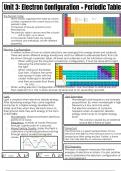
Unit 3: Electron Configuration + Periodic Table
The Periodic Table:
- Henry Mosley organized the table by atomic
number, represents the current layout of the
periodic table.
- Composed of Groups (columns) and
Periods(rows).
- The periodic table is always read like a book!
- Left to right, up to down.
- In the periodic table there are metals,
nonmetals and metalloids, all with different
properties.
Electron Configuration:
- A written outline of how an atoms electrons are arranged into energy levels and sublevels.
- There are seven different energy levels(rows) and four different sublevels(sections) that can
be shown through a periodic table. All levels and sublevels must be full before moving on.
- When writing out the long form of electron configuration, it must be done left to right,
following the information on
the right.
- When writing out the Noble
Gas form, it follows the same
rules except it starts with the
closest noble gas in bracket
and then proceeds from there.
- Ex, [Ar].........
- When writing electron configuration in Orbital Notation, one must draw a vertical line and
then adjacent to it, the 1s level, 2s level, 2p level and so on ascending upwards.
Light: Light Extended:
Light is created when electrons absorb energy. - Wavelength and frequency are inversely
After absorbing energy they come together proportional. Ex, when wavelength is high
and jump to a higher energy level(excited frequency is low and vice versa.
state) and then when they fall back down to - The electron emission of a photon
their ground state they emit energy in the form happens when an electron absorbs
of ROYGBIV. energy and moves to a higher energy
- Wavelength: distance between identical level.
points on a wave. - This can be caused by an external
- Frequency: number of waves that pass source like a flame or lazer.
through a given point in a second.
- Wave Particle Duality: states that light is Flame Test:
collections of particles(photons) moving The flame test is a great representation of how
through space as electromagnetic electrons emit light as they fall back down to a lowe
waves. energy level after being excited. Further, a flame
test can help identify an unknown element.
PES Diagrams:
This type of diagram measures the relative
energies of electrons in atoms. It is also another
way to determine the electron configuration of
an atom/element.
The Periodic Table:
- Henry Mosley organized the table by atomic
number, represents the current layout of the
periodic table.
- Composed of Groups (columns) and
Periods(rows).
- The periodic table is always read like a book!
- Left to right, up to down.
- In the periodic table there are metals,
nonmetals and metalloids, all with different
properties.
Electron Configuration:
- A written outline of how an atoms electrons are arranged into energy levels and sublevels.
- There are seven different energy levels(rows) and four different sublevels(sections) that can
be shown through a periodic table. All levels and sublevels must be full before moving on.
- When writing out the long form of electron configuration, it must be done left to right,
following the information on
the right.
- When writing out the Noble
Gas form, it follows the same
rules except it starts with the
closest noble gas in bracket
and then proceeds from there.
- Ex, [Ar].........
- When writing electron configuration in Orbital Notation, one must draw a vertical line and
then adjacent to it, the 1s level, 2s level, 2p level and so on ascending upwards.
Light: Light Extended:
Light is created when electrons absorb energy. - Wavelength and frequency are inversely
After absorbing energy they come together proportional. Ex, when wavelength is high
and jump to a higher energy level(excited frequency is low and vice versa.
state) and then when they fall back down to - The electron emission of a photon
their ground state they emit energy in the form happens when an electron absorbs
of ROYGBIV. energy and moves to a higher energy
- Wavelength: distance between identical level.
points on a wave. - This can be caused by an external
- Frequency: number of waves that pass source like a flame or lazer.
through a given point in a second.
- Wave Particle Duality: states that light is Flame Test:
collections of particles(photons) moving The flame test is a great representation of how
through space as electromagnetic electrons emit light as they fall back down to a lowe
waves. energy level after being excited. Further, a flame
test can help identify an unknown element.
PES Diagrams:
This type of diagram measures the relative
energies of electrons in atoms. It is also another
way to determine the electron configuration of
an atom/element.