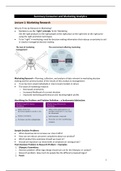
Summary Consumer and Marketing Analytics
Lecture 1: Marketing Research
Why do Firms do Research in Marketing?
• Marketers use the “right” principle ‘to do’ Marketing
Get the right products to the right people at the right place at the right time at the right price
using the right promotion techniques
• To be “right” in marketing: need for decision making information that reduces uncertainty to aid
in smarter managerial decision making
The task of marketing The environment affecting marketing
management
Marketing Research = Planning, collection, and analysis of data relevant to marketing decision
making and the communication of the results of this analysis to management.
• It can be micro-level (individual) or macro-level (market) in nature
• The value of marketing research:
o Decreased uncertainty
o Increased likelihood of a correct decision
o Improved marketing performance and resulting higher profits
Identifying the Problem and Problem Definition – a fundamental distinction:
Sample Decision Problems
• What should we do to increase our store traffic?
• How can we reduce consumer complaints about our product?
• Which product line extension should we invest in?
• Should we reposition our brand with an emphasis on raising prices?
From Decision Problem to Research Problem – Examples:
1. Olympics Committee:
o Decision problem: What logo design should we use for the Olympics in London?
o Research problem: How much do people like the different proposed logos?
2. Persil:
1
,o Decision problem: How should we position our product on supermarket shelves to attract
maximum consumer attention?
o Research problem: How does shelf positioning affect consumer attention?
3. Online Dating: What’s a Picture Worth?
o Decision problem: How can we optimize people’s usage of our website?
Striking correlation! According
to their users, “looks” and
“personality” were the same
thing…
o Research problem: How much a person’s profile photos actually matter compared to the
information written in their profile?
o Type of Analytics: (Online) Randomized Experiment
o Condition 1: Text & Picture; Condition 2: Only Picture
o DV: One overall rating
o “Your picture is worth that fabled thousand words, but your actual words are worth…almost
nothing.” – Picture alone was rated better.
Classifying Marketing Research
• By type of data
• Quantitative research
• Qualitative research
• By research design
• Exploratory research
• Descriptive research
• Causal research
• By data source
• Secondary data
» Syndicated research
• Primary data
1. By Type of Data
Quantitative Qualitative
Not concerned with numbers. Focus on numbers, amendable to statistical
Good for: analysis.
▪ Mapping the customer’s overall range Good for:
of behaviour and attitudes ▪ Profiling detailed usage and behaviour
▪ Pinpointing the motivations behind ▪ Highlighting variations between
people’s behaviour different sub‐groups
▪ Stimulating new and creative ideas ▪ Precisely measuring consumer
▪ Providing a forum for fresh creative preferences for different products and
thinking services
▪ Measuring the exact priorities
consumers attach to different product
features
2
,Quantitative research outgrows qualitative.
2. By Research Design
2.1. Exploratory Research
Research in which the major emphasis is on gaining ideas and insights
Purposes:
▪ Increase familiarity with problem
▪ Clarify concepts
▪ Develop specific hypotheses
Approaches:
▪ Literature survey
▪ Experience/key informant survey
▪ Case studies
▪ Focus groups
2.2. Descriptive Research
▪ Often guided by an initial hypothesis
▪ Purposes:
Describe the characteristics of certain groups
Estimate the proportion of people in a specified population who behave in a certain way
Examine associations between two or more variables
Make specific predictions
2.3. Causal Research
Research in which the major emphasis is on determining a cause‐and‐effect relationship
▪ Descriptive research reveals associations between variables
▪ Causal research reveals associations between changes in variables
Makes use of experiments:
▪ Laboratory experiments
▪ Field experiments
3. By Data Source
3.1. Secondary Data
Data previously collected for purposes other than the research at hand
Internal sources:
- Accounting records (e.g., sales invoices, marketing expenditures)
- Customer transaction databases
- Clickstream data
3
, - Operating records (e.g., warranty cards, customer complaint services)
- Previous market research studies
External sources:
- Market and industry research publishers (e.g., Datamonitor, Euromoniter EIU,
Forrester, Mintel)
- Trade associations
- Government agencies
Syndicated Research
Large‐scale marketing research that is undertaken by a research firm to be sold, often on a
subscription basis, to a number of clients (consumer panel data / scanner purchase data)
▪ Kantar NIPObase
▪ Nielsen TV Ratings
▪ Symphony IRI InfoScan
▪ ACNielsen Homescan
▪ Kantar Worldpanel
▪ Nielsen Bookscan
▪ GfK Consumer Panel
3.2. Primary Data
Data collected specifically to answer the question(s) posed by the current research objectives
Types of primary data:
▪ Demographic / Socioeconomic / Lifestyle characteristics
▪ Attitudes / Opinions
▪ Awareness / Knowledge
▪ Motivation
▪ Intentions and behaviour
Collecting primary data:
▪ "Communication”: Questioning respondents to secure the desired information (via
surveys, focus groups etc.)
▪ Observation: The situation of interest is watched and the relevant facts, actions, or
behaviours recorded
Overview of Course Contents Type of Data Research Design Data Source
Basic Data Analysis Quantitative Descriptive Primary Data
Factor Analysis Quantitative Descriptive Primary Data
Market Response Models, MRA Quantitative Descriptive Secondary Data
Customer Response, LR Quantitative Descriptive Secondary Data
Panel Data Quantitative Descriptive Secondary Data
(Syndicated Research)
Conjoint Analysis Quantitative Descriptive Primary Data
• Exploratory Research = qualitative
• Descriptive Research = quantitative
• Causal Research (cause and effect relationship) = quantitative
Macro Forces that Have Affected Marketing Research Practice
▪ Surveys have already largely gone from
– offline to online
4
, – desktop to mobile
▪ Researchers have already shifted from
– asking questions to capturing behavior through passive observation
– traditional qualitative research to social media listening via text mining tools
– human coding to machine coding
▪ New technologies emerged (geo tracking, in store tracking, wearable technologies, artificial
intelligence)
In‐store Tracking of Customers
• RFID tags on shopping cart
• Computer vision methods (with store camera)
• Startup Nomi – tracks shoppers by their mobile phone signals
• Eye tracking
In closing…
• Information provides focus to our marketing actions; it is the sights on our rifle for targeting the
customer. It is not that we won’t hit anything without the sights on the rifle; it’s just that our
chances are reduced.
• The relevance test: What will I do (differently) with this knowledge?
• Do not underestimate the importance of close interaction between researchers and decision
makers.
Lecture 2: Basic Data Analytics
1. Screen dataset: Investigate quality of data
• Errors, missing values, inconsistencies
2. Explore and analyze the data*:
• Describe and summarize data: A complete run down analysis of all the variables in your
dataset one-at-a-time (univariate statistics)
• Inferential analysis: Learning about “the world” (univariate statistics)
• Differential analysis (bivariate statistics)
• Associative analysis (bivariate statistics)
Definitions
• Descriptive analysis: used to describe the data set; frequency distributions and summary
statistics.
• Inferential analysis: used to generate conclusions about the population’s characteristics based
on the sample data; confidence intervals and hypothesis testing.
• Differences analysis: used to compare the mean of the responses of one group to that of
another group; testing differences between samples.
• Associative analysis: determines the strength and direction of relationships between two or
more variables; cross-tabulations and correlations.
Levels of Measurement
→ Statistical test depends on the level of measurement
5
Lecture 1: Marketing Research
Why do Firms do Research in Marketing?
• Marketers use the “right” principle ‘to do’ Marketing
Get the right products to the right people at the right place at the right time at the right price
using the right promotion techniques
• To be “right” in marketing: need for decision making information that reduces uncertainty to aid
in smarter managerial decision making
The task of marketing The environment affecting marketing
management
Marketing Research = Planning, collection, and analysis of data relevant to marketing decision
making and the communication of the results of this analysis to management.
• It can be micro-level (individual) or macro-level (market) in nature
• The value of marketing research:
o Decreased uncertainty
o Increased likelihood of a correct decision
o Improved marketing performance and resulting higher profits
Identifying the Problem and Problem Definition – a fundamental distinction:
Sample Decision Problems
• What should we do to increase our store traffic?
• How can we reduce consumer complaints about our product?
• Which product line extension should we invest in?
• Should we reposition our brand with an emphasis on raising prices?
From Decision Problem to Research Problem – Examples:
1. Olympics Committee:
o Decision problem: What logo design should we use for the Olympics in London?
o Research problem: How much do people like the different proposed logos?
2. Persil:
1
,o Decision problem: How should we position our product on supermarket shelves to attract
maximum consumer attention?
o Research problem: How does shelf positioning affect consumer attention?
3. Online Dating: What’s a Picture Worth?
o Decision problem: How can we optimize people’s usage of our website?
Striking correlation! According
to their users, “looks” and
“personality” were the same
thing…
o Research problem: How much a person’s profile photos actually matter compared to the
information written in their profile?
o Type of Analytics: (Online) Randomized Experiment
o Condition 1: Text & Picture; Condition 2: Only Picture
o DV: One overall rating
o “Your picture is worth that fabled thousand words, but your actual words are worth…almost
nothing.” – Picture alone was rated better.
Classifying Marketing Research
• By type of data
• Quantitative research
• Qualitative research
• By research design
• Exploratory research
• Descriptive research
• Causal research
• By data source
• Secondary data
» Syndicated research
• Primary data
1. By Type of Data
Quantitative Qualitative
Not concerned with numbers. Focus on numbers, amendable to statistical
Good for: analysis.
▪ Mapping the customer’s overall range Good for:
of behaviour and attitudes ▪ Profiling detailed usage and behaviour
▪ Pinpointing the motivations behind ▪ Highlighting variations between
people’s behaviour different sub‐groups
▪ Stimulating new and creative ideas ▪ Precisely measuring consumer
▪ Providing a forum for fresh creative preferences for different products and
thinking services
▪ Measuring the exact priorities
consumers attach to different product
features
2
,Quantitative research outgrows qualitative.
2. By Research Design
2.1. Exploratory Research
Research in which the major emphasis is on gaining ideas and insights
Purposes:
▪ Increase familiarity with problem
▪ Clarify concepts
▪ Develop specific hypotheses
Approaches:
▪ Literature survey
▪ Experience/key informant survey
▪ Case studies
▪ Focus groups
2.2. Descriptive Research
▪ Often guided by an initial hypothesis
▪ Purposes:
Describe the characteristics of certain groups
Estimate the proportion of people in a specified population who behave in a certain way
Examine associations between two or more variables
Make specific predictions
2.3. Causal Research
Research in which the major emphasis is on determining a cause‐and‐effect relationship
▪ Descriptive research reveals associations between variables
▪ Causal research reveals associations between changes in variables
Makes use of experiments:
▪ Laboratory experiments
▪ Field experiments
3. By Data Source
3.1. Secondary Data
Data previously collected for purposes other than the research at hand
Internal sources:
- Accounting records (e.g., sales invoices, marketing expenditures)
- Customer transaction databases
- Clickstream data
3
, - Operating records (e.g., warranty cards, customer complaint services)
- Previous market research studies
External sources:
- Market and industry research publishers (e.g., Datamonitor, Euromoniter EIU,
Forrester, Mintel)
- Trade associations
- Government agencies
Syndicated Research
Large‐scale marketing research that is undertaken by a research firm to be sold, often on a
subscription basis, to a number of clients (consumer panel data / scanner purchase data)
▪ Kantar NIPObase
▪ Nielsen TV Ratings
▪ Symphony IRI InfoScan
▪ ACNielsen Homescan
▪ Kantar Worldpanel
▪ Nielsen Bookscan
▪ GfK Consumer Panel
3.2. Primary Data
Data collected specifically to answer the question(s) posed by the current research objectives
Types of primary data:
▪ Demographic / Socioeconomic / Lifestyle characteristics
▪ Attitudes / Opinions
▪ Awareness / Knowledge
▪ Motivation
▪ Intentions and behaviour
Collecting primary data:
▪ "Communication”: Questioning respondents to secure the desired information (via
surveys, focus groups etc.)
▪ Observation: The situation of interest is watched and the relevant facts, actions, or
behaviours recorded
Overview of Course Contents Type of Data Research Design Data Source
Basic Data Analysis Quantitative Descriptive Primary Data
Factor Analysis Quantitative Descriptive Primary Data
Market Response Models, MRA Quantitative Descriptive Secondary Data
Customer Response, LR Quantitative Descriptive Secondary Data
Panel Data Quantitative Descriptive Secondary Data
(Syndicated Research)
Conjoint Analysis Quantitative Descriptive Primary Data
• Exploratory Research = qualitative
• Descriptive Research = quantitative
• Causal Research (cause and effect relationship) = quantitative
Macro Forces that Have Affected Marketing Research Practice
▪ Surveys have already largely gone from
– offline to online
4
, – desktop to mobile
▪ Researchers have already shifted from
– asking questions to capturing behavior through passive observation
– traditional qualitative research to social media listening via text mining tools
– human coding to machine coding
▪ New technologies emerged (geo tracking, in store tracking, wearable technologies, artificial
intelligence)
In‐store Tracking of Customers
• RFID tags on shopping cart
• Computer vision methods (with store camera)
• Startup Nomi – tracks shoppers by their mobile phone signals
• Eye tracking
In closing…
• Information provides focus to our marketing actions; it is the sights on our rifle for targeting the
customer. It is not that we won’t hit anything without the sights on the rifle; it’s just that our
chances are reduced.
• The relevance test: What will I do (differently) with this knowledge?
• Do not underestimate the importance of close interaction between researchers and decision
makers.
Lecture 2: Basic Data Analytics
1. Screen dataset: Investigate quality of data
• Errors, missing values, inconsistencies
2. Explore and analyze the data*:
• Describe and summarize data: A complete run down analysis of all the variables in your
dataset one-at-a-time (univariate statistics)
• Inferential analysis: Learning about “the world” (univariate statistics)
• Differential analysis (bivariate statistics)
• Associative analysis (bivariate statistics)
Definitions
• Descriptive analysis: used to describe the data set; frequency distributions and summary
statistics.
• Inferential analysis: used to generate conclusions about the population’s characteristics based
on the sample data; confidence intervals and hypothesis testing.
• Differences analysis: used to compare the mean of the responses of one group to that of
another group; testing differences between samples.
• Associative analysis: determines the strength and direction of relationships between two or
more variables; cross-tabulations and correlations.
Levels of Measurement
→ Statistical test depends on the level of measurement
5